




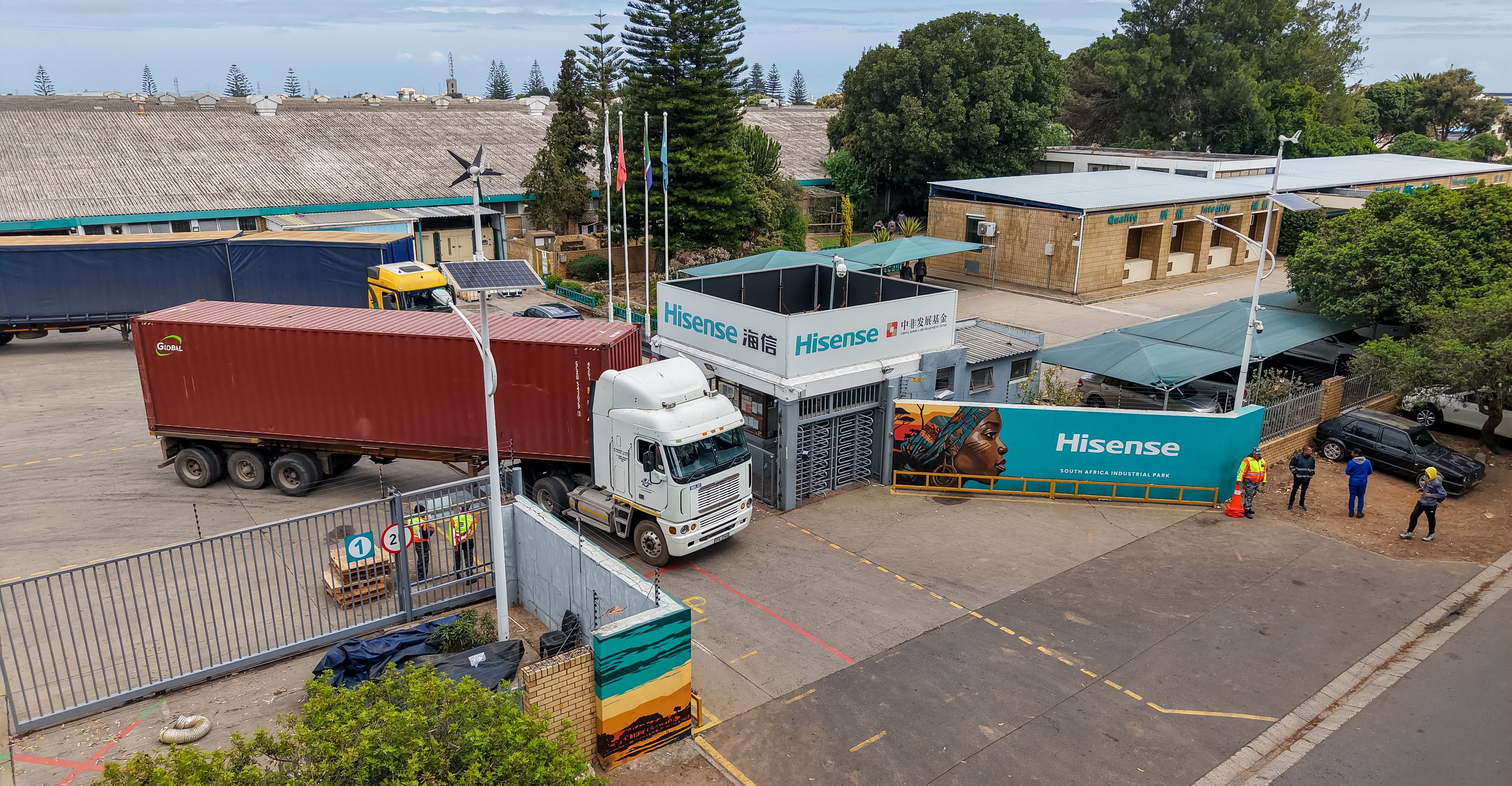
 Hisense Atlantis Factory
Established in October 1996, Hisense SA's three decades in the country have seen the business grow well beyond consumer electronics retail into local manufacturing, nationwide after-sales service, skills development, and community development. Hisense's most significant investment in the country came in 2013, when it established a R350 million manufacturing facility in Atlantis together with the China-Africa Development Fund.
To mark the anniversary, Hisense SA hosted an exclusive media tour of the facility, giving journalists a behind-the-scenes look at the production lines and the people who run them.
The Atlantis Plant has the capacity to produce up to one million televisions and 500,000 refrigerators a year. By mid-2024 it had produced approximately 4.5 million televisions and 2.9 million refrigerators in total. Refrigerators were exported to Europe for the first time in 2022, positioning South Africa as an export base within Hisense's global operations.
“Quality assurance is built into the plant's daily rhythm rather than treated as a periodic audit.” shares Luna Nortje, Deputy General Manager at Hisense SA. “On the refrigeration lines, this includes daily performance and safety checks, routine inspections, and monthly testing of energy consumption and freezing capacity.”
/file/attachments/2998/Hisense-FactoryTour-5_892354.jpg)
The Atlantis facility directly employs more than 1,000 South Africans, most of them from Atlantis and surrounding communities such as Melkbosstrand and Mamre, with thousands more livelihoods supported through its supplier and logistics network.
“Skills transfer has been part of the operation since it opened, when the first cohort of roughly 300 local hires trained directly under Hisense's Chinese engineers," shares Nortje. “Today, a formal skills-transfer programme pairs Chinese engineers and technicians with local staff, with the aim of enabling South African employees to run departments independently. Many have grown with the plant.”
Hugh Stephens joined in 2013 and worked his way from the production line to a mainboard repair technician role. Marlon Jacob started as a general worker with no refrigeration background and is now a team leader in the refrigeration department. Ayrton Minnies moved from the factory floor into a process technician team leader role. At the plant's tenth anniversary in June 2023, Hisense honoured 98 staff members who had been there since opening day, and boards on the factory floor recognise long-serving employees, high-performing teams and team leaders by name.
In September 2025, Hisense launched a fully funded, year-long learnership for 100 unemployed South Africans aged 18–28, delivered with EduPower Skills Academy and supported by MERSETA and W&RSETA. Combining hands-on production experience with structured career development, it is designed as a training-to-employment pathway rather than a short-term internship. Last month, that first group graduated, and a new intake of 120 learners has since begun the programme.
"Localisation can't only be measured by what comes off a production line," says Nortje. "It has to be measured by the capability we leave behind; the people we train, the employment we create, the opportunities that become possible because manufacturing happens here."
Atlantis has become a reference point in conversations about reindustrialising South Africa's smaller towns. At the Buy Local Summit in Johannesburg in March 2026, government and industry figures pointed to its combination of local manufacturing, export ambition, skills transfer, and community reinvestment as the kind of partnership the country needs more of. The United Nations Office for South-South Cooperation also cited the Atlantis Industrial Park in a 2020 report as a case study in how South-South investment can support sustainable development.
As Hisense's South African infrastructure matures, it is becoming a platform for further growth, from the 2025 opening of the company's first premium brand store at Canal Walk, Cape Town, to Toshiba TV's entry into the South African market in July 2026, backed by Hisense's established service and support network.
/file/attachments/2998/Hisense-FactoryTour-1_106131.jpg)
"South Africa was Hisense's first overseas operation, and 30 years later it remains central to our global story," Nortje concludes. "This anniversary isn't only a chance to look back; it's a chance to ask what we build next, for our customers, our employees, our communities and South Africa."
The company’s community and social responsibility initiatives also continue to have an impact well beyond the factory floor, and on the year of its 30th anniversary, has focused on youth development, practical skills and community wellbeing nationwide.
Through its Hands on the Future programme, Hisense SA launched a community soccer pitch development in Gauteng. It has also spearheaded educational visits from schools to its Atlantis Factory and Tevolution Museum. For children in 10 under-resourced communities in Cape Town, Hisense SA has funded and delivered football kits, sporting equipment and sponsored coaching for 160 children across several soccer teams. To strengthen pathways into employment, Hisense launched the Hisense-Northlink Technical Academy in Cape Town, supporting appliance-repair training and workplace experience.
Through its ongoing Loads of Love initiative, Hisense has donated hundreds of washing machines and tumble dryers nationwide, helping community centres, animal shelters, and hospitals reduce laundry costs and redirect resources towards essential care, education and feeding programmes. The company also donated R20,000 worth of sanitary products to PERIOD.project in Cape Town, supporting menstrual dignity and awareness.
Together, these efforts combine immediate practical support with investment in long-term opportunity. DM