



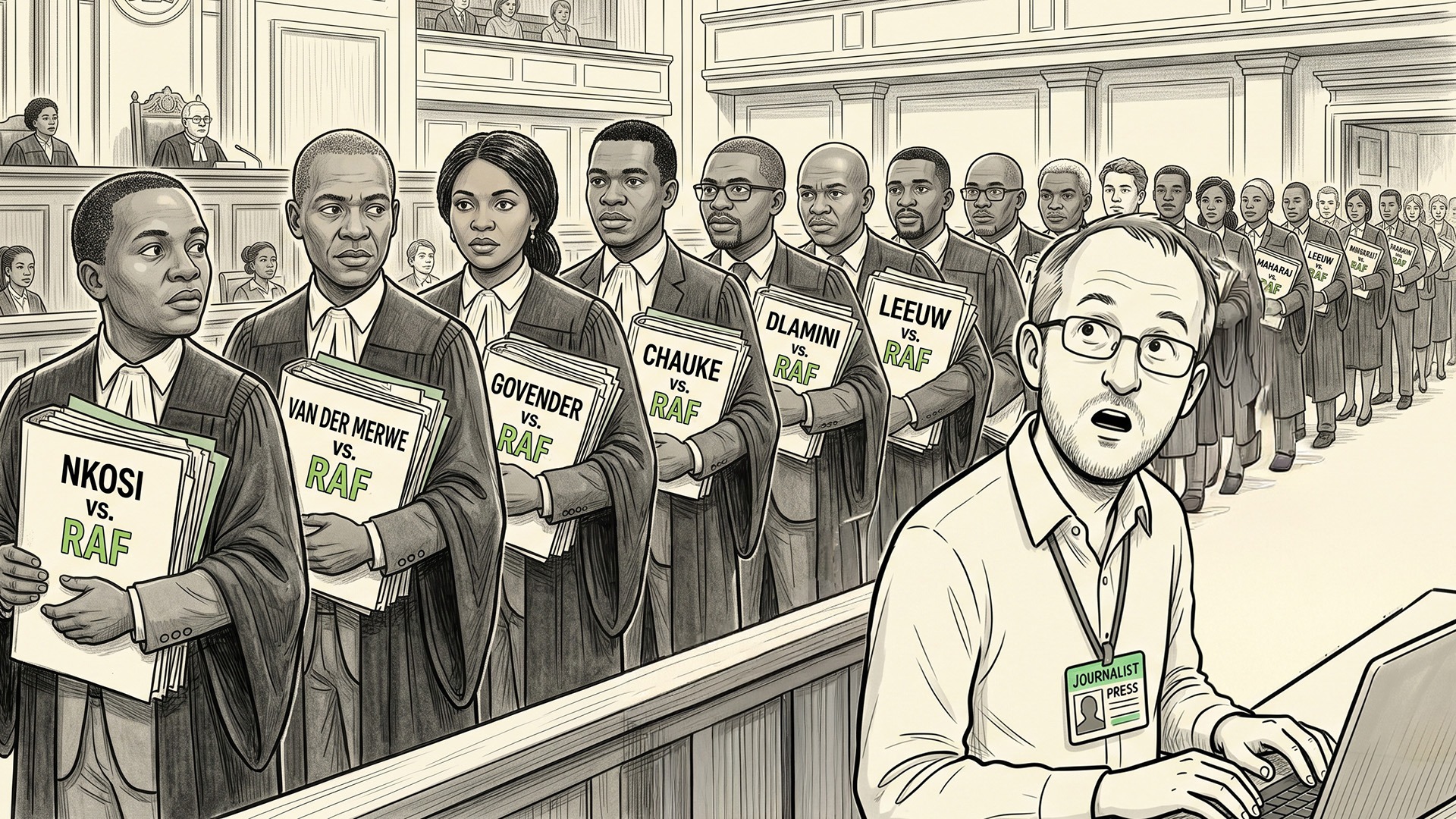
 The RAF is in crisis and needs a fundamental overhaul of both its funding model and payouts before declining fuel-levy revenue makes the system unsustainable. | Illustrative image: (Generated with Google Gemini Flash Image 2.5)
A few years ago, when I was younger and much more interesting, I happened to find myself being despatched to some boring political case about which nobody now cares in the Gauteng Division of the High Court in Johannesburg.
While there I happened to sit for a very unproductive hour in the motion court, the place where motions are put and logistics are sorted out. I noticed that there was a long queue of advocates who all had cases that went “surname” vs the fund.
I didn’t really understand what was happening, until it came to me. These were cases involving the Road Accident Fund, which was clearly not paying people who were owed money.
From what I can see, not much has changed since then.
Over the years we’ve seen reports of mountains of paper in parking lots, and the fund was led by a CEO who clearly didn’t give a fig for anyone. Collins Letsaolo displayed a horrible combination of arrogance and cowardice.
First he got the fund to pay for his bodyguards, then he made them work as labourers on his farm. When the time came for him to be accountable to Parliament, he simply ran away from them.
Now of course, other people have to clean up the mess.
On Friday the newly announced RAF CEO, Waseem Carrim, spelt out what he thinks he can do in the job on The Money Show.
He is one of those rare people who has been able to lead government entities and survive untarnished. But he’s completely aware of the problems the fund has.
In his view both the demand side and the supply side of the fund need to change. He points out that with fuel prices rising so dramatically people are going to use less of the stuff, and more people will move to electric cars where they can.
A lot less revenue
As a result there will be a lot less revenue from the fuel levy. Especially when the government is under pressure from Cosatu and others to reduce the amount we’re paying for fuel. But he also thinks there should be a change to the amount that people are paid after an accident, that it should be “commensurate with what should be paid out”.
Deputy Transport Minister Mkhuleko Hlengwa also thinks we need a major change. He’s told Moneyweb that this current system is simply not working. And he should know. He chaired some of the parliamentary hearings that Letsoalo was too cowardly to attend.
But how do we reform it?
As Carrim points out, one of the reasons the fund was created in the first place was to prevent the victims of accidents suing the people who caused them. That would result in anyone ever being involved in an accident being financially crippled for life.
I do think the starting point has to be what is really reasonable. As long ago as 2010 (back when I was more interesting and hiding out in courtrooms) one Swiss man was paid out more than half a billion rand after suffering injuries in a motorbike accident here.
That kind of thing can bankrupt a fund pretty quickly, especially when you take foreign exchange differences into account. I realise that it would be pretty heartless to literally get paid X for a broken arm and Y for a broken leg, but I think it might be the only way to go about doing it.
And how someone sits down and works out how much the future cost would be for a person who cannot care for themselves for the rest of their life I have no idea. But I’m sure somewhere there is a non-funny actuary who has a formula for that kind of thing.
I think the bigger problem is really going to be the funding.
Almost a regressive tax
If you continue to take the money from the sale of fuel, you will probably find that people who live far from work are paying the most. This is usually people who rely on minibus taxis to get to work. People driving electric cars will be paying nothing, which makes the whole thing almost a regressive tax (it’s taxing the poor more than the rich).
I do like the idea of pooling the insurance problem across as many people as possible though. That means it will have to be managed through the state – there really is no other way to do it.
But I don’t think we could just tell the National Treasury to allocate it money, either. There is no money to allocate.
I suspect we will follow the usual process in these situations. There will be some public debate before a group of experts go into a huddle somewhere and come up with some solution.
Hopefully they will come up with something thoughtful and clever. And it will have to survive our incredibly high rate of accidents.
We dare not waste this moment.
The RAF is in crisis. And we must use the chance that gives us to reimagine something completely new. DM
Comments
Scroll down to load comments...