



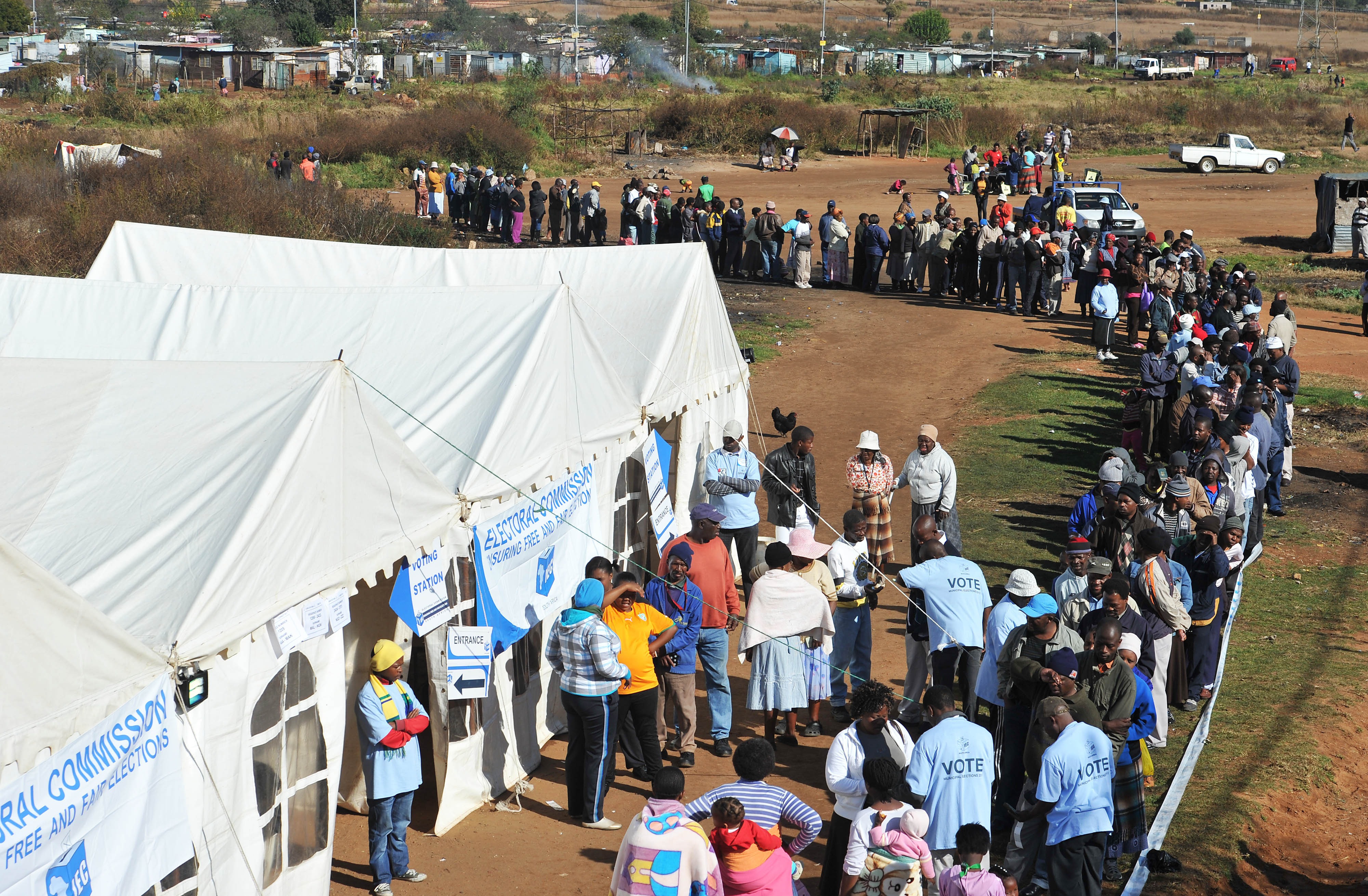
 Residents of the Motsoaledi informal settlement behind the Chris Hani Baragwanath Academic Hospital stand in a long voting queue. (Photo: Gallo Images / Foto24 / Felix Dlangamandla)
/file/attachments/orphans/Election2026LogoInarticle_260133.jpg "LGE-2026-logo-signpost")
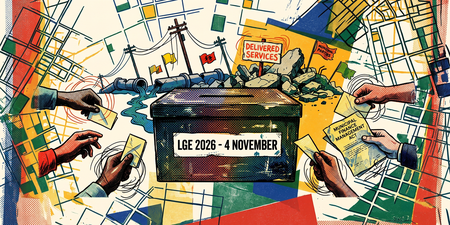
As political parties ramp up their campaigns ahead of the upcoming local government elections scheduled for 4 November, they may find themselves up against the most dominant party among voters: the “No Vote” party.
The Electoral Commission of South Africa (IEC) recently announced that its voter registration drives have led to more than 29 million people being registered to vote ahead of the upcoming local government elections. This is higher than the 26.8 million voters who registered before the 2024 elections.
But with the figure representing only an estimated 63.7% of the eligible voter population, and a steady decline in the number of voters who turn out on voting day, most South African voters are unlikely to vote at all.
Voter participation has steadily declined from a high of 89.3% in 1999 to an all-time low of 58.6% in 2024. These figures measure voter participation based on the number of registered voters who turn up to the polls. But when eligible voters who don’t register are accounted for, the largest party is the No Vote party.
/file/attachments/orphans/1782456119517-26June2026GroundUpV311_154527.png)
‘Worryingly low by international standards’
Professor Bruce Bartlett, an associate professor in the Mathematics Division at Stellenbosch University, crunched the numbers on how many of the voter-eligible population (VEP) actually voted in the 2024 elections.
He calculated that based on Stats SA census and mid-year population data, the VEP was actually between 37.3 million and 40 million people. In real terms, this means that of the entire population, only about 42% turned up to the polls.
This was down from his previous calculations of the 2019 elections, which found just 49% of voters turned up for the polls, an even further decline from the 2014 elections in which 57% of voters turned up.
When he compared South Africa to its international peers, including Brazil, France, India, the US and the UK, South Africa’s voter turnout as a percentage of its VEP was at the bottom. Brazil had the highest voter turnout at 73% in its 2024 election, followed by France at 68% in 2022, and the US at 67% in 2020.
“The results suggest that, when measured either as a percentage of the voting-eligible population or as a percentage of the voting-age population, South Africa’s voter turnout has been worryingly low by international standards,” he wrote in 2019.
“The municipal elections are always much lower turnout (compared with national elections), so turnout will likely be extremely low,” he told Daily Maverick.
/file/attachments/orphans/1784037773961-Voterturnoutmetros11_392597.png)
Youth disengagement a driving factor
The low voter turnout is driven in large part by youth disengagement. IEC data estimated that in 2024, just 27% of the population aged 18 to 19 and 49% of those aged 20 to 29 were registered to vote, compared with about 80% or more among those aged 40 and older.
The trend is likely to continue into this year’s local government elections. Young people aged 16-29 account for 26% of registered voters.
Data indicates this is largely driven by frustration and distrust in the current political system. Polling data from market research company Ipsos found that 47% of respondents felt no political party represented their views, and 38% had no interest in politics or elections. Forty percent of youth aged 18-34 said they did not trust the IEC.
“Many say that voting makes no difference… The situation does not change at all,” said Ipsos South Africa director and political analyst Mari Harris.
“People say politicians only promise things and deliver nothing of their promises. They complain that, as a ‘normal’ person, you only ever hear from politicians when it is election time. They disappear soon afterwards. People also say that politicians only care about their friends and family and organise work and other opportunities for them. These feelings are prevalent, even if people are going to vote on 4 November.”
/file/attachments/orphans/1784037972561-Voterturnoutmapv2_310225.png)
‘Democracy is a contact sport’
The dominance of the African National Congress (ANC) may also play a role. In her doctoral thesis, North West University lecturer in political studies and international relations Dr Naledi Modise found that one-party dominance had weakened accountability and contributed to voter dissatisfaction.
“In South Africa, the dominance of a single party has shaped voter perceptions and contributed to declining engagement in the electoral process,” she said.
The declining voter turnout could reflect a growing distrust in a country’s democratic institutions, Modise said.
“When voters question whether their participation matters, turnout is likely to decline regardless of the opportunities available within the electoral system,” she said.
/file/attachments/orphans/Vote-Pix-Am-Monday2_669638.jpg "A voter walks to St Michael’s Junior School voting station in Mbihli village in Sterkspruit in the Eastern Cape on Monday 1 November 2021. Only a minority of eligible South Africans chose to vote. The vast majority either didn’t register or registered but then didn't vote. (Photo: Felix Dlangamandla / Daily Maverick)")
Research reflects a growing dissatisfaction with democracy. A July 2026 study by the Human Sciences Research Council found that the share of young people who believed voting made a difference had also sharply declined from a peak of 58% among Born Free millennials in 2003/2008 to just 27% in 2024/2025. Among Gen Z, the decline was less sharp, but still noticeable, from 35% in 2014/2018 to just 23% in 2024/2025.
Mbali Ntuli, founder and chief executive officer of civic education non-profit Ground Work Collective, told Daily Maverick that the decline in voter participation was happening across age groups, although it was less visible in voter roll data for older generations, as many registered before previous elections, but stopped voting.
She attributes this to a lack of civic education and a growing frustration with record-high unemployment, lack of service delivery, and a stagnant economy.
“In general, South Africans across the board, whether young or old, are having a decline in their confidence in democracy as a concept because they can’t tie up what us having a political choice and voice has meant in terms of the economic trajectory, which is for any country always the big thing,” she said.
However, the disengagement in voting does not mean a disengagement in politics, as many are turning to alternative ways of engagement, such as volunteering or being part of ward committees.
“We have seen that most millennials and Gen Zs don’t think that democracy is the only way that they can make a difference in their country. The problem is they don’t really know what else there is aside from either abstaining or getting involved in other ways.
“It makes a better case for why we need to be doing more work to show them that democracy is a contact sport and everyone has to get involved,” she said. DM
/file/attachments/2998/DemocracyLocal_Notebook_600x250_author_341008.jpg)
Comments
Scroll down to load comments...