




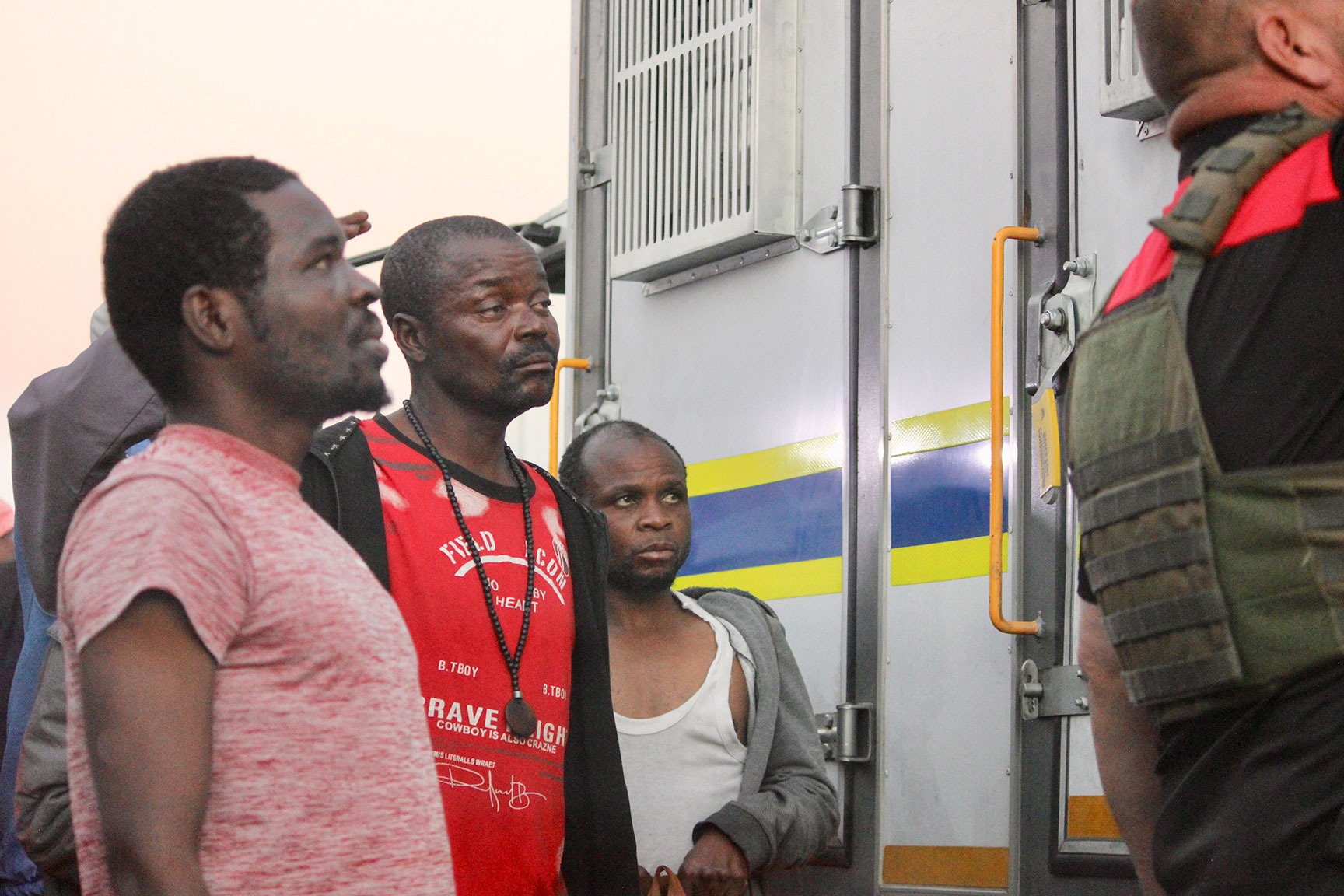
 Demonstrators hand over a man they believe to be an undocumented foreign national to the SAPS during the anti-foreigner unrest in Germiston CBD on Tuesday, 30 June. (Photo: Reitumetse Pilane)
The founder and chief executive officer of One Stone Capital Group, Tendai Musikavanhu, was returning from church on Sunday, 27 September, when he was accosted outside his Northcliff, Johannesburg, home by police officers who allegedly accused him of using fake identity documents after seeing he had a Shona surname.
Musikavanhu said the Uber he and his wife were in was stopped by the police. They asked the driver for his licence and then asked Musikavanhu and his wife for their identity documents.
“While she was getting her ID, the police officer turned around to me and asked, ‘What sort of surname is this?’ He was asking me, ‘Where are you from?’”
Both Musikavanhu and his wife are South African citizens. Born in the UK to Zimbabwean parents of Limpopo heritage, he has lived in South Africa since 1994 and is a naturalised citizen. However, when he explained this to the police, the officer dismissed it out of hand.
“He then says, ‘No, no, this is a Shangaan name. This is fake. Your ID is fake.’ And then he turned to my wife’s ID and said her ID is fake. And he asked me for my licence, and he said my licence is fake.
“He then says, ‘Okay, I’m going to have to detain you and arrest you until we can confirm to Home Affairs that these IDs are real.’”
Musikavanhu said his wife initially resisted the arrest until the officer threatened to use force.
Once inside the van, the officer allegedly interrogated him about his lineage, demanding he name five generations of ancestors to prove his South African heritage. Musikavanhu further claims the officer admitted police had a daily quota of 15 migration-related arrests to fill.
In a recording taped inside the police station, Musikavanhu can be heard telling the officer he is a South African citizen and asking why he is being detained.
“What kind of surname is this? You are a Shangaan,” the officer says in the recording.
‘Shangaan’ is a term that is used offensively to refer to the Vatsonga and foreign nationals.
Musikavanhu and his wife were eventually released without charge after his lawyer convinced the officers to let them go. But the experience left him irate.
“My question is, what about the South Africans who can’t afford a lawyer to stand up for them? Is this the standard practice that if you just don’t seem South African enough to the police officer, even though you give them a valid ID, that you now need to spend the night in prison? That doesn’t seem like the South Africa I know,” he said.
‘It’s happening all over’
Musikavanhu’s experience is not isolated. Nicolene Jonker, the councillor for Ward 88, where Musikavanhu lives, said he was the third resident who had approached her after being similarly targeted by the police.
“It’s happening all over. It’s Fairlands, Linden, Parkview. We had cases of residents taking pictures of SAPS vans stopping next to anybody… The Linden one that was reported to me, they’re targeting people walking on the street,” she said.
She added that initially, she noticed an increase in police officers targeting stores. Now they appeared to be targeting residents as well. Ward councillors are unable to intervene as the SA Police Service is a national entity.
“We do need to check if people are correctly in South Africa. I do understand that…But there’s a fear. There’s a fear they’re bringing down onto people, which I don’t really agree with,” she said.
/file/dailymaverick/wp-content/uploads/MC-Asylum-Ufrieda.jpg "Joburg CBD raids: Foreign national protest outside court")
‘Really traumatised’
Residents in Rosettenville reported similar experiences with the police. Speaking on condition of anonymity for fear of reprisal, an East African migrant with valid asylum-seeker papers recalled how an officer was initially friendly while chatting in isiZulu—until discovering he was not South African, at which point the tone shifted abruptly.
“He said, ‘Ah, you are the one who is creating the problem in our country.’ And then without asking me to produce my documents or whatever, he just sent me inside a van, without explaining the reason for me to get in the van,” he said.
/file/dailymaverick/wp-content/uploads/2025/08/ED_566118.jpg "Operation Dudula Tackles Illegal Occupation Of Buildings In Rosettenville")
He added that instead of being taken to the police station, he was taken on a ride while the officer negotiated a bribe. He said he paid R1,500 to be released. The officer never checked his papers.
A 2026 report from Lawyers for Human Rights found that such experiences are pervasive. The report found that migrants’ interactions with the police were “a significant site of corruption and abuse”, with migrants reporting that police frequently stopped them arbitrarily to demand payments of between R500 and R2,500, sometimes more, under the threat of arrest, detention and withholding confiscated documents. Individuals reported being detained in police vehicles and stations until payments were made.
“Most of the time when we get victimised by this law enforcement people… There’s no way we can go and claim about what these people have done to us, so we just keep boiling inside. We are really traumatised,” said the Rosettenville resident.
He added that many migrants do not report such incidents as they fear that doing so will result in further harassment by the police. He called for authorities to create confidential reporting mechanisms that allow witnesses to report details of police misconduct.
During the anti-foreigner protests earlier this year, demonstrators identified and handed over people they believed to be undocumented to the police, which the authorities warned against.

SAPS do not independently verify status
Gauteng police spokesperson Colonel Dimakatso Nevhuhulwi told Daily Maverick that SAPS is aware of the incident involving Musikavanhu, who had stated his intention to lodge a formal complaint against the police.
“The complainant will be afforded the opportunity to formally place his allegations on record, and the matter will be dealt with in accordance with the relevant processes,” she said.
“There is no blanket quota requiring police officials to arrest a specific number of people per day for immigration-related offences.”
She did not respond directly to questions about how police officers treated Musikavanhu.
/file/attachments/orphans/Naledi-Migration-30Sep2_665756.jpg "Police visibility during a March and March protest against illegal immigrants in Olievenhoutbosch on July 04, 2026 in Pretoria, South Africa. It is reported that the group is calling on the police to intervene on high crimes allegedly caused by illegal immigrants. (Photo: Gallo Images / Manash Jyoti Das)")
Nevhuhulwi said the SAPS conducts operations on those suspected of being in the country illegally in collaboration with the Department of Home Affairs, which is the entity responsible for verifying a person’s migration status. The police do not independently determine migration status, she said.
“SAPS remains committed to conducting policing operations within the confines of the law and to addressing any allegations of misconduct against its members through appropriate channels,” she said.
Nevhuhulwi said that Gauteng SAPS takes allegations of harassment, unlawful conduct, and demands for bribes by police officials seriously.
“Members of the public who allege that police officials demanded bribes, unlawfully detained them, or otherwise acted improperly are encouraged to lodge a formal complaint with SAPS so that the allegations can be investigated properly. Complainants may also be referred to the relevant independent oversight structures,” she said. DM
Comments
Scroll down to load comments...