




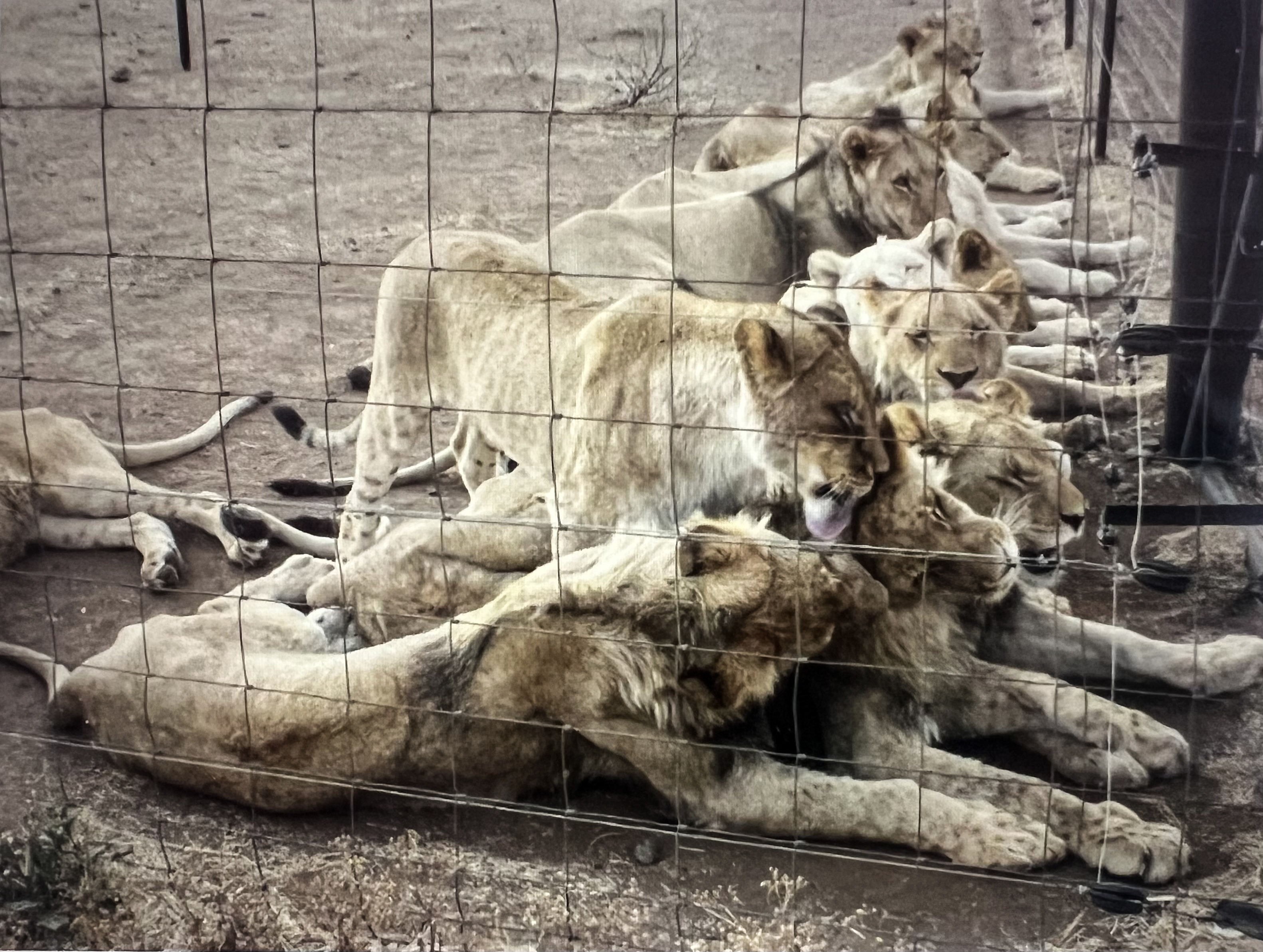
 Much of the early South African lion bone supply originated as a by-product of the captive-bred lion hunting industry, but the trade developed into a significant commercial stream in its own right. (Photo: EMS Foundation/Ban Animal Trading)
For years South Africa authorised the commercial export of captive-bred lion skeletons into Asian wildlife markets. Parliamentary replies now reveal that the government never conducted a dedicated retrospective assessment of whether that policy stimulated demand, facilitated laundering or increased risks to wild lions.
South Africa’s commercial lion bone trade emerged in the late 2000s at the intersection of two existing industries: the country’s large captive-lion breeding sector and East and South East Asian markets for the bones and derivatives of large cats.
/file/attachments/orphans/adam-lion-bones4_277263.jpg "South Africa’s lion-bone trade: The consequences government never considered. (Photo: EMS Foundation/Ban Animal Trading)")
How the trade developed
The first CITES permits for lion bone exports from South Africa were issued in 2008, with Laos and Vietnam becoming the principal destinations and smaller quantities going to Thailand and China. Researchers have documented how lion bone entered markets historically associated with tiger products, including medicinal preparations and tonics, with lion increasingly functioning as a substitute or supplementary source as international controls on tiger trade tightened.
Much of the early South African supply originated as a by-product of the captive-bred lion hunting industry, but the trade developed into a significant commercial stream in its own right. Between 2008 and 2015, South Africa issued permits covering more than 5,300 skeletons destined for East and South East Asia; subsequent research estimated that more than 6,000 skeletons, weighing at least 70 tonnes, had been shipped from Africa to the region since 2008.
At the 2016 CITES Conference of the Parties, South Africa retained the ability to export bones and other derivatives from captive-bred lions commercially, subject to an annual quota. The 2019 Gauteng High Court judgment setting those quota decisions aside as unlawful and constitutionally invalid marked an important rupture in the policy, and the government has since maintained a zero commercial export quota.
The trade may therefore have stopped legally. Its consequences, however, are considerably less clear and potentially far-reaching.
/file/attachments/2995/AlionpantheraleoinSouthAfrica_RogerPatdelaHarpe_945558.jpg "A close-up of a lion (panthera leo) in South Africa. (Photo: Roger & Pat de la Harpe)")
The study that was never done
In written replies to parliamentary questions submitted by ActionSA recently, the Department of Forestry, Fisheries and the Environment (DFFE) has now confirmed that it has not undertaken a separate retrospective evaluation of the consequences of the historical export of captive-bred lion skeletons.
More importantly, the DFFE states that it has never conducted a specific market-demand or consumer-behaviour study to determine whether South Africa’s authorised exports established or expanded international demand for lion derivatives.
That is quite an admission.
The government did not merely tolerate an already existing trade occurring beyond its regulatory reach. South African authorities issued the permits through which a substantial legal supply of lion skeletons entered international markets. Yet the department cannot now demonstrate that it systematically investigated what happened to those markets as a consequence.
Its explanation is essentially one of regulatory compliance: CITES did not require such a market-demand study before Appendix II exports could be authorised. That, however, does not resolve the broader question of responsible environmental governance.
/file/attachments/2995/AlionPantheraleoinTimbavatiGameReserveLimpopoProvinceSouthAfricaRogerPatdelaHarpe_480081.jpg "A lion (Panthera leo) in Timbavati Game Reserve, Limpopo Province, South Africa (Roger & Pat de la Harpe)")
CITES compliance is not the same as precaution
The DFFE instead points to the lion non-detriment finding, which concluded that South Africa’s wild lion population was stable and that legal international trade posed a non-detrimental risk to the survival of the species.
But a non-detriment finding performs a particular function under CITES. It assesses whether an export is detrimental to the survival of the species. It is not necessarily designed to determine how the creation of a legal commercial supply affects consumer behaviour, price, substitution between species, laundering opportunities or criminal trafficking networks.
Those are different questions.
Indeed, academic research had already identified precisely these concerns. Researchers studying South Africa’s lion bone trade described lion as an apparent substitute for tiger bone and warned in 2017 about potential laundering, misdeclaration and the relationship between legal and illegal markets for large-cat derivatives.
The appropriate policy question was therefore never simply: Can these exports legally take place under CITES? It was also: What might happen if South Africa deliberately introduces thousands of captive-bred lion skeletons into a commercial market historically associated with highly threatened big cats?
/file/dailymaverick/wp-content/uploads/2025/07/Ian-michler-1.jpg "This is the face of the commercialisation and brutality of South Africa’s predator breeding and captive hunting industries – a lion commodified, sold into canned hunting. (Photo: Ian Michler)")
Meanwhile, wild lions are being killed
The captive-breeding industry has repeatedly defended itself on the premise that supplying hunters and derivative markets with farmed lions reduces pressure on wild populations; however, there is now evidence that they are being deliberately targeted for their body parts, including inside Kruger National Park itself.
The South African National Biodiversity Institute’s (Sanbi) 2026 supporting assessment for the lion non-detriment finding records an increase in lion poaching in northern Kruger and, significantly, states that many of these incidents involved the removal of body parts. Eight lions were found poisoned in the Nxanatseni North region between January 2020 and July 2023, while the assessment says the trend continued into 2024, with several further lions poached and body parts removed. This is not confined to Kruger: The Endangered Wildlife Trust reports multiple lion-poaching incidents at Dinokeng Game Reserve in Gauteng since 2020, several of which also involved the removal of body parts, and identifies targeted poaching for claws and teeth as an emerging and increasingly localised threat to South African lions.

Against that background, SANParks’ confirmation that 72 Kruger lions have been illegally killed since 2017 – 37 poisoned and 35 snared – takes on a different significance. While those figures do not establish that every animal was killed for its derivatives, Sanbi’s own assessment confirms that at least some recent Kruger poaching incidents have involved precisely that: lions killed and their body parts removed.
Across the border in Mozambique’s Parque Nacional do Limpopo, targeted killing of lions for body parts escalated sharply during the same period in which South Africa was developing its legal lion bone export industry.
In January 2018, four young lions were poisoned and their faces and paws removed; by June that year, park authorities reported that seven lions had been poisoned during the preceding year and explicitly warned that some poachers were targeting lions for bones intended both for traditional use and export to Asian markets. A subsequent peer-reviewed study found that targeted poaching for body parts accounted for 61% of recorded human-caused lion mortalities in Limpopo National Park, with the pressure increasing markedly from 2014; seizures in Mozambique included lion teeth and claws destined for Vietnam.
The government therefore cannot credibly argue that the possibility of interaction between legal supply and illegal killing was unforeseeable. Its own 2018 justification for the lion bone quota of 1,500 skeletons explicitly contemplated the risk that demand might be diverted towards illegal sources. What Parliament has now established is that, despite recognising that possibility, the DFFE apparently did not establish the research framework required to determine convincingly whether that trade stimulated demand, displaced illegal supply, created laundering opportunities or altered the threat environment facing wild lions.
An absence of demonstrated causation provides little reassurance when the relevant causal relationships were never adequately investigated.
A fragmented enforcement picture
The parliamentary responses reveal a second weakness.
The DFFE says it is aware of 21 incidents involving snaring, poisoning and illegal killing of lions during 2025 and 2026. But when Parliament asked how many criminal cases were opened, how many investigations, arrests, prosecutions and convictions followed, what forensic or toxicological work was conducted, and whether organised or cross-border crime was suspected, the department referred those questions to the South African Police Service (SAPS) and the National Prosecuting Authority.
/file/attachments/orphans/adam-lion-bones1_628906.jpeg "South Africa’s lion-bone trade: The consequences government never considered. (Photo: EMS Foundation/Ban Animal Trading)")
Yet the DFFE separately confirms that lion-poaching incidents were reported to SANParks Law Enforcement and Environmental Management Inspectors and poisoning cases to the SAPS. What remains absent is an integrated picture connecting mortality, forensic investigation, criminal cases, prosecutions, trafficking networks and trade in lion derivatives.
For a country that became the dominant legal supplier of lion skeletons to Asian markets, that fragmentation should be a serious governance concern.
The unresolved legacy
The government ostensibly has committed itself to ending the commercial captive-lion industry, yet the latest reply says the minister is still being briefed on the Extended Ministerial Task Team report and its regulatory and socioeconomic implications.
The DFFE also points to inspections, CITES controls, inter-agency cooperation and the zero commercial export quota as safeguards against stockpiled bones entering illegal trade.
Those measures are important. But they do not substitute for a transparent accounting of the trade South Africa helped create, the stockpiles it left behind and the markets to which thousands of lion skeletons were supplied. The policy issue is therefore larger than whether individual permits complied with CITES rules at the time.
A state that authorises the commercialisation of thousands of bodies of a wild species assumes a responsibility extending beyond the administrative act of issuing permits. It must ask what markets are being encouraged, what behaviours are being normalised, what criminal opportunities may be created and what consequences may follow for animals beyond the immediate legal supply chain.
South Africa exported the skeletons. What Parliament has now exposed is that the government never adequately established what that decision ultimately produced. DM


Comments
Scroll down to load comments...