




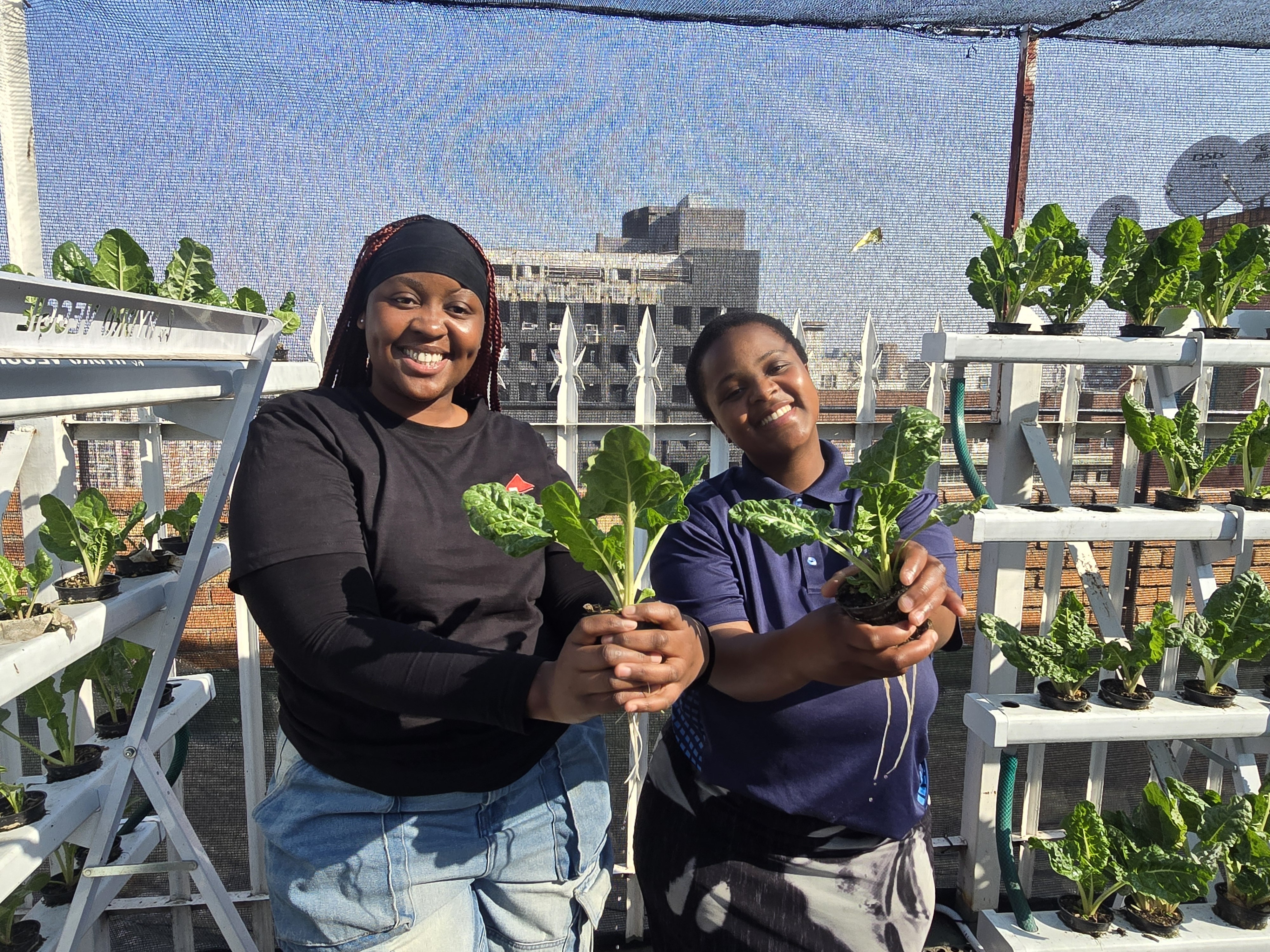
 Busisiwe Mkhwanazi and Nonhlanhla Radebe are volunteers in the garden. (Photo: Bridget Hilton-Barber)
A small hydroponic garden above the 12th floor of a Hillbrow high-rise is making a big difference to the lives of its residents. Set beneath an unruly herd of satellite dishes, the Lake Success Rooftop Food Garden is accessible via narrow stairs and complete with dizzying views over Hillbrow and its iconic Ponte City building.
Hydroponics is essentially growing plants without soil and it’s a great way to do green spaces in urban places. The plant roots are exposed to pumped nutrient-
rich water and because they don’t spend energy developing root systems, they grow 30% to 50% faster and produce higher yields while using up to 90% less water than traditional soil farming.
“We started the rooftop garden in 2012,” says Sipokazi Somzana, community development manager for Makhulong A Matala (Greener Pastures in Sesotho), the community development arm of the Johannesburg Housing Company (JHC). “The aim was to empower people, promote healthy eating and supplement incomes through sales.”
“Our approach is developmental,” says Lungisani Ntuli, general manager of Makhulong A Matala. “We teach skills that will help people to have sustainable enterprises and livelihoods.”
The project started off with container gardens in collaboration with the Food Gardens Foundation and the Johannesburg Development Agency. Later, Food and Trees for Africa, Jozi Food Farmer and Mbuli Gardens also joined.
Volunteers like Busisiwe Mkhwanazi and Nonhlanhla Radebe have been trained in gardening methods, garden management and basic business skills over the years, and passed these skills on. They live in the building and say the garden has brought them joy and taught them good skills.
“We tend the garden two or three times a week,” says Mkhwanazi. “It’s good to be outside. It’s good for our minds and we’ve learned how to plant seeds, grow seedlings and make compost.”
The women package and sell lovely fresh greens to residents and at local markets. And then they do it all over again, keeping the growing cycle going.
/file/attachments/2998/Alightweightframeholdstheverticalgardeninplace_458953.jpg "A lightweight frame holds the vertical garden in place. Photo: Bridget Hilton-Barber")
The garden has improved food security in the building, says Somzana. Rooftop hydroponic projects like these can be the first step towards cities that feed themselves.
With a long career in child welfare, social justice and advocacy, Somzana is involved in all the Makhulong A Matala projects that work to combat the isolation of inner-city high-rise living, from hydroponic gardens and educational integration programmes to tenant leadership structures and common community goals like the Lake Success Rooftop Garden.
“The idea is to foster a village spirit in the high-rises,” says Ntuli, explaining that neighbours need to look out for one another and cooperate to solve their collective problems.
During a period of massive post-apartheid inner-city flight and decay, the JHC took on huge financial and social risks to systematically transform hijacked, abandoned and decaying buildings into stable residential buildings. It believes in inner-city urban regeneration combined with compassionate social development. “The JHC started in 1995 and today we have about 29 buildings in the city that provide affordable homes for around 13,500 people,” says Ntuli.
/file/attachments/2998/11Ponteinthebackgroundspinachinthefront_289922.jpg)
Lake Success in 10 Pietersen Street was previously a hijacked building in the late ’90s. It was turned around by the JHC and the City of Joburg in the first of their Better Buildings Programme. They did a major clean-up and structural overhaul, and the first new tenants moved in in 2002, a major milestone for social housing in Hillbrow.
Today Lake Success is a clean, safe and regulated space. It is part of the Hillbrow Ekhaya Neigbourhood Improvement District, which was championed by property owners, local businesses and NGOs to secure and clean up public streets, improve safety and provide community support. DM
Bridget Hilton-Barber is a freelance writer who writes for Jozi My Jozi.
This story first appeared in our weekly DM168 newspaper, available countrywide for R39. The e-edition of DM168 is now free for readers who are signed into their Daily Maverick account. Click on the cover of the newspaper below to access the e-edition.
/file/attachments/2998/DM-25092026-001_751207.jpg)
Comments
Scroll down to load comments...