




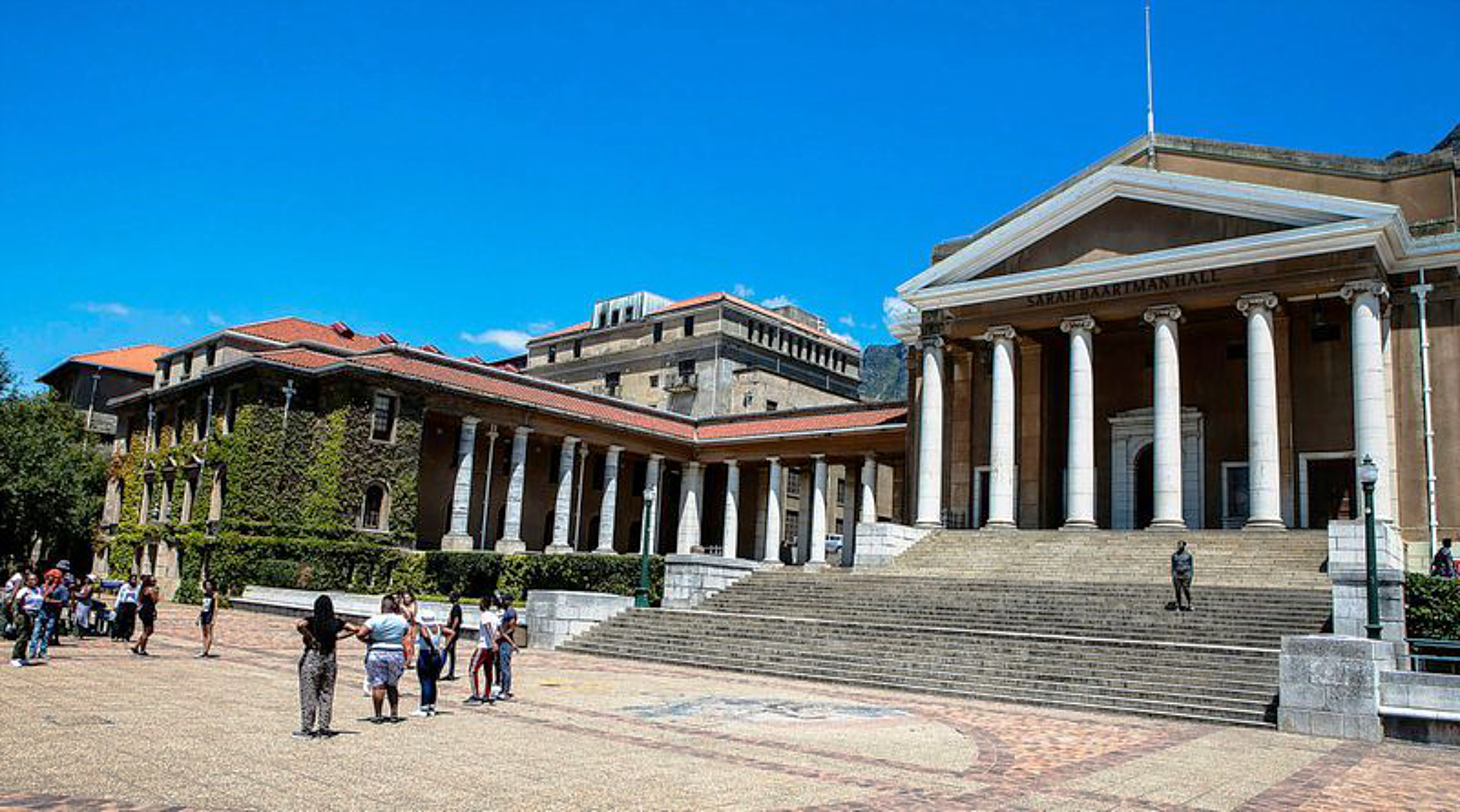
 University of Cape Town. (Photo: Gallo Images / Jacques Stander)
The world’s higher education leaders gathered on African soil as Times Higher Education launched its 2027 World University Rankings at the University of Cape Town (UCT).
Opening the Times Higher Education World Academic Summit, Times Higher Education chief global affairs officer, Phil Baty, said the rise of African institutions was no longer a side story. “It’s clear to all of us here, African universities are shapers not just of their own futures, but of all of our futures,” said Baty.
UCT clawed its way from joint 164th last year to joint 147th, marking its best position in seven years and its first time back in the top 150 since the 2020 edition. The South African university is also ranked as Africa’s top institution.
The University of Pretoria recorded its highest showing yet, rising from the 501-600 band to 451-500, making it one of five South African universities in the global top 500, alongside UCT, the University of the Witwatersrand (301-325), Stellenbosch University (326-350) and the University of Johannesburg (351-375). South Africa is the only country in sub-Saharan Africa to rank in the world’s top 200 and top 500, and eight of its universities are in the top 1,000.
The country's footprint has also widened, now recording 17 ranked universities, four more than last year, making it the second-most represented country in the region after Nigeria’s 29. The new entrants are Walter Sisulu University, Tshwane University of Technology, the University of Venda and Vaal University of Technology, all in the 1,801-2,000 band. Durban University of Technology also moved from the unranked group into the 1,201-1,400 band.
/file/attachments/orphans/Siya-Worldrankings-Universities4_264322.jpg "Mosebjadi Petje, Business Development Manager for Sub-Saharan Africa at Times Higher Education, says South Africa is performing well within Africa and expanding its global footprint. (Photo: Siyabonga Goni)")
During the discussion, Mosebjadi Petje, business development manager for Sub-Saharan Africa at Times Higher Education, discussed South Africa’s performance, sector trends and ranking influences. She noted that South Africa was performing well within Africa and was expanding its global footprint.
“We look at job-to-trade-faculty ratio as well, institutional income, as well as teaching reputation, where we send a survey to academics so that they can give their views on your university (do they believe that they are good in research?), so we use those metrics within a teaching pillar,” Petje told Daily Maverick.
Asked about the growth of South African universities in Africa and globally, Petje said, “We are seeing quite a movement within the ranking bands from South African universities, where they’re actually moving up, 124 places up, 200 places up; that really shows a great movement, and one particular university, for example, University of Johannesburg, has really been moving up consistently in their rankings.
“What I like about the University of Johannesburg is that it’s not among the elite universities in South Africa, but it is moving up the ranks, so that shows us that it’s not about, ‘I need to be in a big university’; it’s all about the impact that you’re demonstrating as a university,” said Petje.
UJ’s rise is not new. In 2025, Daily Maverick reported that UJ climbed 13 places, from 36th in 2024 to 23rd globally in the Times Higher Education University Impact Rankings, driven by strong performance in environmental sustainability, social inclusion, economic growth and global partnerships.

Embracing AI and facing its challenges
/file/attachments/orphans/Siya-Worldrankings-Universities3_815477.jpg "Panellists at the THE World Academic Summit, from left: Jun Liu, City University of Macau; Mosa Moshabela, Principal and Vice-Chancellor, University of Cape Town; Evelyn Welch, President and Vice-Chancellor, University of Bristol; Jianhua Yan, Vice-Chair of the University Council, Zhejiang University; and Trevor Young, Vice-President and Provost, University of Toronto. (Photo: Siyabonga Goni)")
Rankings were only half of the conversation. During the panel discussions, delegates noted that universities had to reimagine their roles, structures and curriculums in the age of AI. UCT Vice-Chancellor Professor Mosa Moshabela acknowledged the challenges of adapting, but urged universities to partner with government to adopt these tools and share them with society, particularly in South Africa.
“We are preparing our students for a future we have not yet experienced ourselves. What we have done is to make a decision that we want to make sure our students are trained in AI, and training at different levels of experience and expertise, and skill, depending on their starting point,” said Moshabela.
UCT has also changed how it treats AI in assessment. Universities often use tools to detect AI in student assignments, with students penalised as a result, Moshabela said. “We decided that we are going to turn off those AI detection tools, and the idea is to allow students… supporting them on how to use AI because … it is here, and we have to move quickly in terms of how to guide them on using it,” said Moshabela.
Other countries are moving in the same direction. In Canada, students are being given access to AI tools like Claude AI and ChatGPT. Trevor Young, Vice-President and Provost at the University of Toronto, said making access available is essential and students had to be trained.
Not everyone at the summit was convinced the transition would be smooth. Evelyn Welch, President and Vice-Chancellor of the University of Bristol, said there was a worry that AI would take jobs, and that universities also needed to check whether employers actually wanted students to know AI; however, she said universities should collaborate to excel in learning.
Industrial needs
Universities from China, widely recognised as leaders in the technological space, offered advice on what the world could learn from their higher education transformation. Shilong Pan, Assistant Vice-President at Nanjing University of Aeronautics and Astronautics, said education should grow with industrial needs.
“We’ve opened doors for more students, more people to go to college, and we also focus on the quality. We don’t do that in the university; it is industrial. At my university, we were funded in 1952 to serve the country’s aviation needs, and today we are still doing that, but in a much bigger way. So we connect the universities with industries so what students learn can be real,” said Pan.
Moshabela noted that South African universities lacked strong industry partnerships, citing UCT’s focus on teaching, and emphasised the need to break down barriers to foster industry collaboration.
Higher Education and Training Minister Buti Manamela agreed that industry had to be on board to help graduates enter employment and to ensure technology became part of learning. He tied it to the country’s unemployment crisis.
“Six out of 10 young people in South Africa are unemployed, and that is a big challenge. So universities, Technical and Vocational Education and Training colleges, and Community Education and Training colleges have become a gateway in dealing with unemployment. Our universities must ensure that we train for employment,” said Manamela. DM
Comments
Scroll down to load comments...