




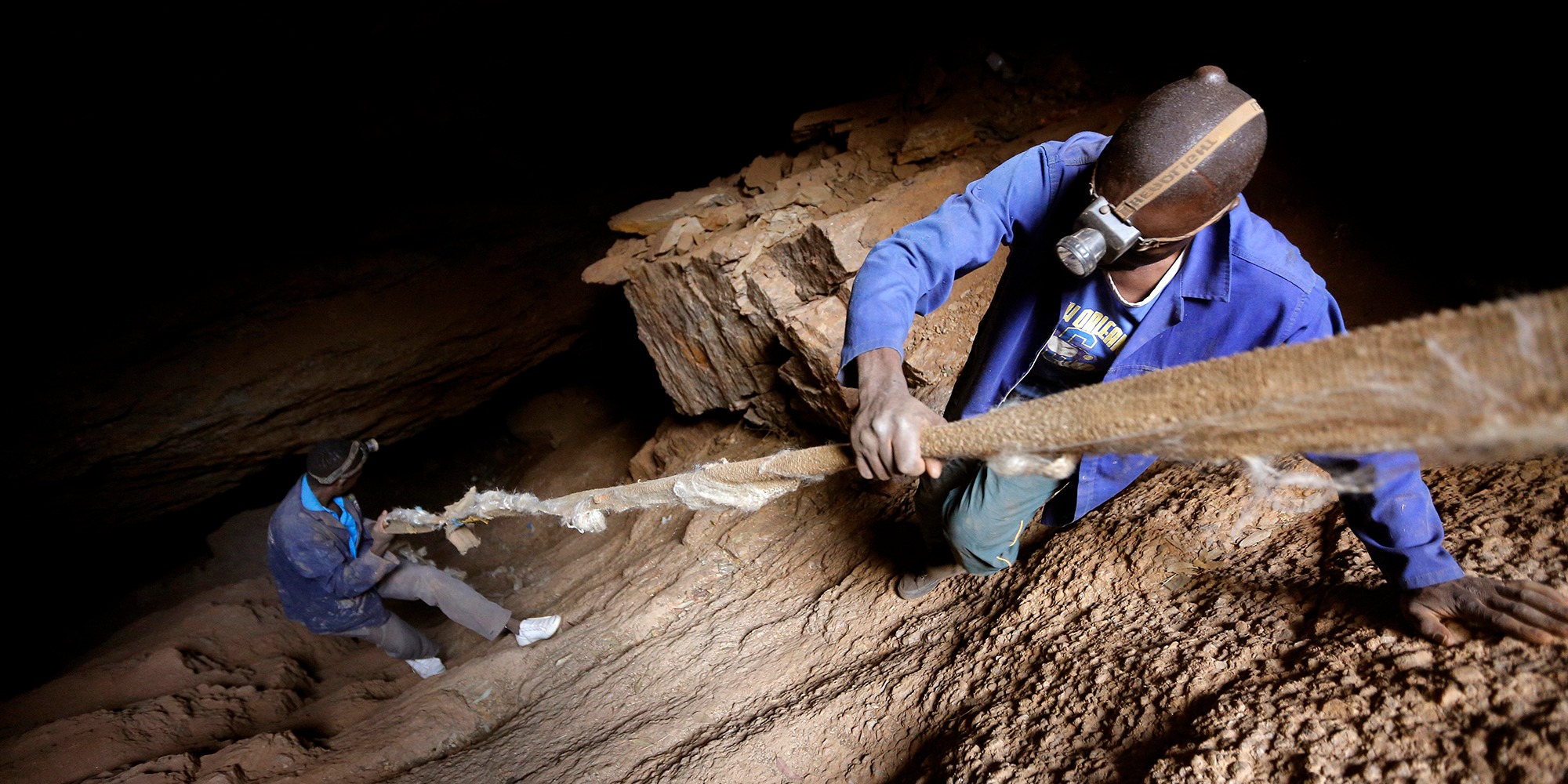
 Illegal gold miners climb down an old rope as they enter a disused commercial gold mine. (Photo: EPA / Kim Ludbrook
A new bill before Parliament proposes to increase penalties for mining without a licence to up to 30 years’ imprisonment and a fine of up to R100-million. Announcing Cabinet’s approval of the General (Mining) Laws Amendment Bill, Justice Minister Mmamoloko Kubayi noted that the rationale for the Bill’s steep new penalties is the link between illicit mining and kidnapping, human trafficking, child and forced labour, illegal firearms, rape and murder. No one disputes that such conduct by criminal syndicates requires a coordinated response, including criminal sanctions. The trouble is that the Bill Parliament is being asked to pass does not confine its punishment to that conduct.
Under the amendment, a person convicted of possession, sale and purchase of unpolished diamonds and a person convicted of processing, erecting and operating machinery, and exportation of unpolished diamonds both face up to 30 years’ imprisonment and a fine of up to R100-million. This amounts to a threefold jump in the maximum sentence from that proposed in the already draconian draft Mineral Resources Development Bill, and a penalty ceiling that collapses the distinction between these offences. It is more severe, in fact, than a standard life sentence of 25 years imposed for the most severe offences such as murder. The same maximum applies whether a court is sentencing a trafficking syndicate or a subsistence miner working in an abandoned shaft to feed their family. The minister’s justification describes one; the law punishes both identically.
This is not a technicality. It goes to the heart of what the Constitution permits the state to do to a person it has convicted.
Section 12(1)(e) of the Constitution guarantees the right not to be punished in a cruel, inhuman or degrading way – a protection reinforced by South Africa’s binding obligations under the Universal Declaration of Human Rights, the International Covenant on Civil and Political Rights and the African Charter on Human and Peoples’ Rights. In S v Dodo, the Constitutional Court held that where a sentence bears no adequate relationship to the gravity of the offence, the person being punished is reduced to a means to an end. The court tied that reasoning directly to section 10 of the Constitution, the right to inherent human dignity. Punishment that is disconnected from the offence does not just risk being harsh, it risks being unconstitutional.
The fine carries the same flaw, and it should not be dismissed as the lesser of the two penalties simply because it does not take a person’s freedom away. A R100-million fine, applied without regard to a person’s means, role or the actual harm caused, can strip someone of their livelihood as thoroughly as three decades in prison strips them of their freedom. If proportionality must govern how long the state may imprison someone, it must equally govern how completely the state may punish them financially.
The impact of the lack of distinction between on the one hand conduct such as an artisanal miner mining without a permit and, on the other hand, human trafficking and other activity by syndicates, further cannot be divorced from the historical and present context.
First, the history of colonial conquest excluded the African majority from access, control and the benefits of land and the minerals beneath their land and the continued exclusion of the majority of Black communities from the sector.
Second, the minerals regime continues to fail to ensure mining houses bear the environmental and socioeconomic risks of mine closure. The resulting combination of thousands of unrehabilitated mine sites and post-closure ghost towns with extreme levels of poverty and unemployment have created a vacuum into which breadwinners have the choice of starvation or unauthorised mining.
Third, the Department of Mineral and Petroleum Resources has to date failed to heed recommendations for addressing law, policy and governance gaps put forward by affected communities, civil society and also constitutional institutions such as the South African Human Rights Commission.
Fourth, at present there is no legislated and fully functioning permitting system that can accommodate the needs of the artisanal mining sector. There is only a proposed system in draft legislation which has fundamental flaws including a definition that excludes much of the artisanal mining sector (such as excluding underground mining), and effectively requires artisanal miners to shoulder the burden of environmental management without any support, training or resourcing.
Therefore, in present circumstances, the effect of the Bill’s indiscriminate authorisation of the most severe penalties would be to criminalise the limited avenues for economic survival of many due to circumstances beyond their control.
There is a legitimate and pressing need for the state to respond decisively to the harms associated with organised illicit mining, and Parliament is obliged to adopt effective measures to address the organised criminal networks responsible for the most serious forms of such conduct. However, a firm response is not synonymous with an indiscriminate one. The need to deter and punish serious criminality cannot relieve the state of its constitutional obligation to ensure that punishment remains rational and proportionate to the offence and the offender.
The legitimate objective of combating illicit mining must be pursued in a manner that distinguishes between fundamentally different forms of conduct, levels of participation and degrees of culpability. There is a material difference between those who organise, finance and profit from sophisticated criminal enterprises and those whose involvement is limited, peripheral or driven by circumstances of economic vulnerability. A sentencing framework that fails to recognise these distinctions risks imposing punishment based primarily on the broad label attached to an offence rather than on what the individual before the court actually did, intended and deserves to be punished for. DM
Lulama Madyaka, Mazi Choshane and Robert Krause are based in the Environmental Justice Programme at the Centre for Applied Legal Studies, Wits University.
Comments
Scroll down to load comments...