



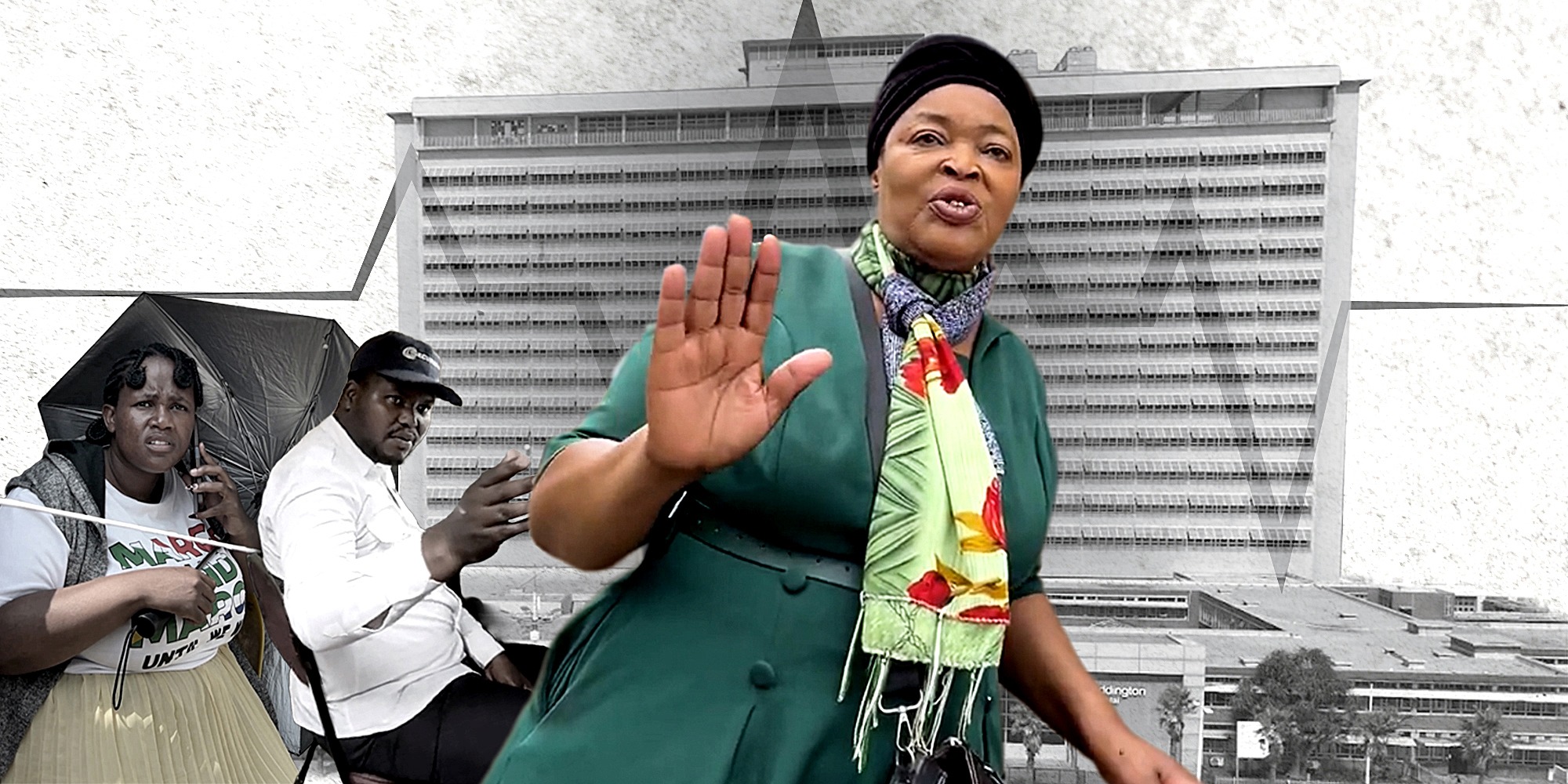
 March and March supporters stop patients at Lancers Road Clinic in Durban. (Poster design: Henry Nxumalo Foundation)
More than a year after making headlines for blocking immigrants from entering Addington Hospital in Durban, March and March supporters are still staking out clinics in the city. They demand identity documents from patients at the gate. They deny entry to those who do not comply. A video, recorded surreptitiously by Viewfinder, has captured one such interaction.
The video was filmed inside the gate of Lancers Road Clinic in Durban on Tuesday morning last week. It shows a March and March supporter demanding an identity document from this journalist.
“No, it’s from March and March,” the woman says, when asked if she was acting on authority from the clinic. “We want to see if it’s your country or not. Show me what I need.”
She appeared to call for back-up soon afterwards. She then led this journalist to the security guard manning the gate. The security guard also demanded ID, saying that he was acting on “instruction”. He did not answer when asked who issued this instruction.
A video, recorded surreptitiously, shows a March and March supporter demanding an identity document from this journalist on Tuesday last week. (Video: Viewfinder)
In July last year, the KwaZulu-Natal health department characterised this “vigilantism” as “illegal”, “unconstitutional” and posing “a serious risk to public health”. Court rulings in Gauteng have confirmed this interpretation.
Lancers Road Clinic is run by the eThekwini Municipality, which last year confirmed that individuals without IDs were not being denied access to basic healthcare services.
The fact that a government-contracted security guard at Lancers Road Clinic appears to be working with March and March supporters looks to be unlawful and at odds with the government’s official position.
Asked about the video, March and March’s activities and whether it had instructed the security guard to demand IDs from patients, Senzelwe Mzila, eThekwini municipality’s spokesperson, responded: “Thanks for bringing this matter to the attention of the municipality. The municipality is investigating the matter and, upon completion of that, will be able to respond to the allegations that you have made in your query.”
One citizen’s story of healthcare xenophobia
March and March has consistently indicated that it is concerned only with undocumented immigrants in South Africa. However, one man’s experience suggests that this is not always the case.
Gaby Bikombo, a naturalised South African citizen and a longtime advocate for migrant rights in Durban, was the one who showed Viewfinder to Lancers Road Clinic. He sat for an interview later that day.
Bikombo fled from war in eastern Democratic Republic of the Congo (DRC). He recalled scenes of terrible violence – mass killings, people being submerged in burning palm oil, artillery raining down, thousands fleeing on foot. He and his fiancée joined the fleeing masses. They arrived in Durban in June 1997.
/file/attachments/orphans/Daneel-Xenobarometer1_873027.jpg "Born in the DRC, Gaby Bikombo has lived in Durban for nearly 30 years. He obtained citizenship in 2022, but was blocked by March and March from entering Addington Hospital in July 2025. (Photo: Daneel Knoetze)")
“From Mozambique, I just followed the other people. They were coming to Durban. I did not know why. I could not speak a word of English,” he said. Today, he has lived here, uninterrupted, for nearly 30 years.
In 1997 he applied for asylum – he was not allowed to work or study, and his documents had to be renewed regularly. In 2001, he obtained refugee status and got formal work as a security guard. In 2006, he applied for permanent residency. He obtained it in 2009. In 2015, he applied for naturalisation. In 2019, he received a certificate of naturalisation. In 2021, he applied for a South African identity book. He received it the following year.
Bikombo is insistent on this point: he has a 13-digit identity number, just like any other South African citizen.
Two of Bikombo’s children, the older ones, are also citizens by naturalisation. The other two, the younger ones, are citizens by birth. All four were born at Addington Hospital. The youngest was born with autism. He is now 15. Bikombo used to accompany him regularly to Addington Hospital to pick up his medication.
That all changed on 3 July 2025.
“That is when we were blocked at the entrance,” he said.
“I knew they were stopping people who were not South Africans, but I did not believe that me, or my son, or my wife would be affected, because we all have green ID books.”
March and March members said that the boy could go in, but that his parents were not allowed, Bikombo recalls. Owing to his son’s autism, that was impossible.
“My ID says ‘country of birth: DRC.’ And they said, ‘You can’t go in, you are not born here.’”
Bikombo no longer goes to the Addington Hospital, and fears that worse yet is to come.
“The more the anti-migrant movement becomes better organised, better funded, able to use social media and able to mobilise and convince the politicians. That is what makes me extremely worried,” he concluded.
Health department and police inaction
Last week, Viewfinder conducted spot checks at three other healthcare facilities: Addington Hospital, the hospital’s Gateway Clinic and Beatrice Street Clinic, all of which are managed by the provincial department of health. At Gateway Clinic, a March and March supporter was at the gate. She also demanded identity documents from patients seeking to enter.
/file/attachments/orphans/Daneel-Xenobarometer3_711545.jpg "A March and March supporter at the gates of Gateway Clinic in Durban on Tuesday last week. (Photo: Daneel Knoetze)")
While the Department of Health has been clear about the illegality of this, the MEC for health in the province, Nomagugu Simelane, has said, “What happens beyond the gates is beyond [hospital staff’s] control”. In court papers, hospital staff have also been quoted as saying that what happens outside the premises is “solely the responsibility of the municipality or SAPS”.
Addington Hospital’s Gateway Clinic is within line of sight of the Point police station.
When asked, police spokesperson Colonel Robert Netshiunda confirmed that what March and March supporters were doing was illegal, but did not answer questions about the police’s apparent failures to act.
“If such is happening, we appeal to the victims to alert the police and police will act without fear,” he said.
Subsequently, he did not respond to forwarded letters from Lawyers for Human Rights (LHR) detailing how their clients were refused assistance at Point police station when they attempted to open such cases last year.
March and March disowns vigilante supporters
In July last year, March and March took ownership of the tactic of staking out clinic gates and demanding identification from patients.
“We are enforcing section 17 of the South African Constitution,” the movement’s chairperson, Teresa Nortje, was quoted as saying in The Citizen.
Last week, both March and March supporters confronted by Viewfinder again claimed to be acting on behalf of the movement.
But, in an interview this week, March and March spokesperson Sandile Dube distanced the movement from these supporters.
“[Since 30 June], that has never been our campaign,” he said, referring to the deadline March and March gave for undocumented migrants to leave South Africa.
“The checking of IDs, whether anyone is a foreign national or not, that is the work of the law enforcement agencies.”
/file/attachments/orphans/unnamed3_882657_755829.jpg "March and March spokesperson Sandile Dube attended the memorial services of the late activist Andile Mvuyelwa Somgxada held at EastRand Christian Centre Ministries in Katlehong on Wednesday, 15 July. (Photo: Reitumetse Pilane)")
He was pressed on whether March and March disowned the supporters that Viewfinder recorded and interacted with at Lancers Road and Gateway clinics.
“Give me the names of those people so that we can do a follow-up on that. And we’ll see if they are acting within or outside … for getting their side of the story.”
Viewfinder shared screengrabs with Dube identifying the March and March supporters in question. No further response had been received by the time of publication.
Healthcare blockades in context
One of the earliest documented cases of vigilantes turning immigrants away from public healthcare facilities dates back to August 2022, when members from Operation Dudula did so at Kalafong Hospital in Atteridgeville, in Pretoria.
In the subsequent months, Dudula has employed this tactic at other hospitals and clinics in Gauteng.
/file/attachments/orphans/ED_568388_654526.jpg "Operation Dudula picket outside Lilian Ngoyi Clinic in Diepkloof after the arrest of three members on August 11, 2025 in Soweto, South Africa. It is reported that the trio faces charges of public violence, trespassing, and violating the National Health Act after they allegedly stormed the maternity ward at Lilian Ngoyi Clinic demanding ID documents from patients to verify their nationalities. (Photo: Gallo Images/Sharon Seretlo)")
In 2025, Kopanang Africa Against Xenophobia (KAAX) took Operation Dudula to court. In November, KAAX secured a judgment from the Gauteng High Court in Johannesburg affirming that only immigration and police officers had the power to demand a private person produce a passport or other identity document.
The court interdicted Dudula from its members doing so and obstructing access to services.
In October 2025, the SA Human Rights Commission (SAHRC) also sought an urgent interdict against Operation Dudula and March and March for blocking access to healthcare facilities in KwaZulu-Natal, but the application was struck off the roll for lack of urgency.
SAHRC provincial manager Pavershree Padayachee said the organisation intends to reinstate the case. DM
This report was produced by the Southern Africa Accountability Journalism Project (SA | AJP), an initiative of the Henry Nxumalo Foundation working with Viewfinder and with the financial assistance of the European Union. It can under no circumstances be regarded as reflecting the position of the EU.
/file/attachments/2998/XenoBarometerLogoCMYK-2_676647.jpg)
Comments
Scroll down to load comments...