



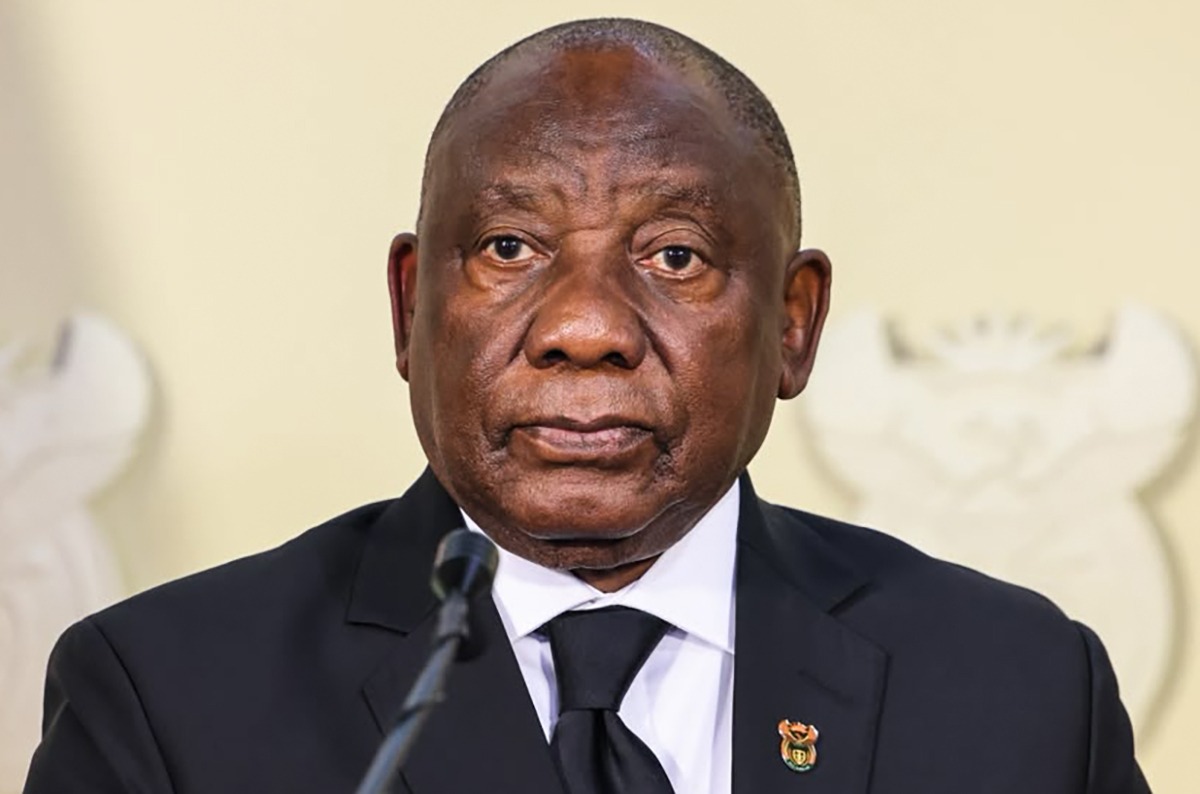
 President Cyril Ramaphosa addresses the nation on 26 September on the steps being taken by the government to confront gender-based violence and femicide. (Photo: Jairus Mmutle / GCIS)
On Tuesday evening, President Cyril Ramaphosa, in a heartfelt address, admitted the government had not done enough to protect women.
“What weighs on me most is that seven years ago, in this same month, I stood before the nation to speak about this same crisis,” Ramaphosa said, describing the violence and cruelty inflicted on women as a source of “pain and national shame”.
He was referring to the address he made to the country in September 2019 on gender-based violence and femicide (GBVF) following the murder of Uyinene Mrwetyana.
/file/dailymaverick/wp-content/uploads/cape-town-protest.jpg "People gather during the gender-based violence demonstration outside Parliament, following the rape and murder of UCT student Uyinene Mrwetyana on September 05, 2019 in Cape Town, South Africa. South African President Cyril Ramaphosa skipped the World Economic Forum to address thousands of Capetonians mostly all dressed in black, where he said laws were to be changed with regards to violence and rape against women. (Photo by Gallo Images/Brenton Geach)")
“Women should not have to live in fear because government has failed to repair a light, clear a public space, process evidence or enforce a law. Where the state fails women, we must hold ourselves accountable and correct those failures,” Ramaphosa said on Tuesday evening.
He highlighted that 11 women’s bodies had been found in Ekurhuleni since July, before naming victims from across the country, including young girls and an elderly grandmother.
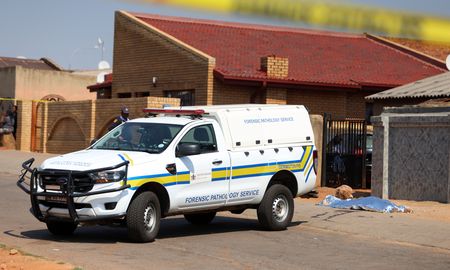
“There are others whose names we do not yet know,” said the President. “There are women lying tonight in government mortuaries waiting to be identified, waiting for someone to claim them, waiting to be taken home and laid to rest.
“Behind each of these terrible deaths was a human being – a daughter, a mother, a sister, a friend – whose life had value, whose future mattered and whose absence has left a family and a community grieving.”
Ramaphosa said women should not have to live in fear that they may be next and said stronger measures were needed to prevent femicide, acknowledging that policing alone would not end the crisis.
“We cannot police our way out of gender-based violence alone. We cannot arrest our way out of this crisis alone. And we cannot wait until a woman is murdered before the state intervenes.”
He said that although gender-based violence had been classified as a national disaster last year, institutions and programmes meant little if they did not work when women needed them.
Ramaphosa said the state needed to correct its failures towards women, including failures in policing, protection orders, forensic processing and the handling of cases.
“A woman who summons the courage to report abuse must not be turned away from a police station. A woman seeking a protection order must not be sent from office to office. A protection order must not become merely a piece of paper while an abuser continues to threaten his victim.
“A forensic sample must not sit unprocessed while a perpetrator remains free. A case must not collapse because a docket has been lost, an investigation has been poorly conducted, or a survivor has been treated without dignity.”
Four interventions
Ramaphosa announced four measures aimed at strengthening the state’s response to GBVF:
National case-recovery operation: The police and justice departments must audit unresolved murders, attempted murders, rapes and serious sexual offences involving women and children within 60 days, with recovery plans for priority and stalled cases within 90 days.
Forensic backlog: Police and forensic authorities must produce a funded plan within 60 days to reduce backlogs and establish turnaround standards for priority GBVF cases. Progress must be reported publicly every quarter.
Women’s safety audits: Municipalities must identify risks, including broken streetlights, unsafe public spaces, abandoned buildings and dangerous transport routes within 60 days. Urgent hazards must be addressed or placed in funded implementation plans within 90 days.
Alcohol-related violence: The government must develop a coordinated legislative and enforcement package to reduce alcohol-related violence, including stronger enforcement against unlicensed liquor outlets and establishments operating outside permitted hours.
Ramaphosa stressed that alcohol does not cause GBV or excuse violence, saying responsibility always lies with the perpetrator, but that harmful alcohol use can aggravate interpersonal violence.
The Inter-Ministerial Committee and National Council on Gender-Based Violence and Femicide will monitor the measures, with the first consolidated progress report due within 90 days and further reports to be published quarterly.
But for the families of the victims of the killings, the President’s words and promises have come too late.
Speaking outside the Thembisa Magistrates’ Court on Tuesday, 29 September, 49-year-old Ntombifuthi Nxumalo’s uncle, Vincent Nxumalo, said the family was struggling to come to terms with her death and was trying to make arrangements to take her body home to KwaZulu-Natal.
He also appealed to Ramaphosa to do more to protect women, ahead of the President’s address to the nation on Tuesday evening. Nxumalo’s remains were discovered at Mooifontein Cemetery in the Vusimuzi section of Thembisa on Saturday, 26 September.
She was the 10th of 12 women reported to have been murdered in Ekurhuleni since July. The body of a 13th woman was found floating in Moroka Dam in Soweto.
/file/attachments/orphans/Tumi-RamaphosaGBVEkurhuleni3_649380.jpg "Sindisiwe Nxumalo daughter of the victim and her auntie appears at Thembisa Magistrate's Court on September 29, 2026 in Ekurhuleni, South Africa. The suspect is accused of the murder of Ntombifuthi Nxumalo, whose body was discovered at Mooifontein Cemetery in Thembisa. (Photo: Gallo Images/OJ Koloti)")
Task team
The SAPS has appointed a task team to investigate the murders. While acknowledging similarities in the victims' profiles and crime scenes, the police warned against speculating that a serial killer is at large in Gauteng.
Geographically, the cases cluster around Kempton Park, Clayville, Tembisa and the R21, with outlying incidents recorded in Dawn Park and Springs. Police have publicly identified 10 of the 13 victims. At least four were reported missing before their bodies were found.
Nxumalo was last seen leaving a tavern before community members living near the cemetery heard a woman screaming and pleading for her life. She was found with serious head injuries, and the police suspect she may have been stoned.
Her alleged killer, 36-year-old Victor Matome Rampedi, appeared in the Thembisa Magistrates’ Court on Tuesday, facing a murder charge. Rampedi was arrested after allegedly fleeing to Tzaneen, Limpopo.
/file/attachments/orphans/Tumi-RamaphosaGBVEkurhuleni1_860879.jpg "Victor Rampedi appears at Thembisa Magistrate's Court on September 29, 2026 in Ekurhuleni, South Africa. The suspect is accused of the murder of Ntombifuthi Nxumalo, whose body was discovered at Mooifontein Cemetery in Thembisa. (Photo: Gallo Images/OJ Koloti)")
It remains unclear whether he knew Nxumalo. Rampedi, who remains in custody, told the court he intends to apply for bail. The matter was postponed to 6 October.
“As a man, I’m saying that it’s enough. It’s enough,” said Vincent Nxumalo. “They must stop it.”
His niece, he said, was a kind person who lived with and cared deeply for her five children. He called for stricter enforcement of trading hours for taverns and other drinking establishments.
A shocking statistic
The Ekurhuleni killings come against a wider backdrop of femicide in South Africa. In 2023/24, 3,422 women were murdered in the country.
South Africa’s intimate-partner femicide rate is five times the global rate, with the South African Medical Research Council estimating that three women were killed by an intimate partner every day in 2020/21.
The research also points to a crisis of accountability: police failed to identify a perpetrator in 44.2% of femicide cases in 2020/21, more than double the 19% recorded in 1999.
Arrests have been made in connection with four of the 13 Ekurhuleni killings, and Ramaphosa said police had identified further persons of interest in other cases and were examining forensic material, including DNA, blood samples, clothing and cellphone records.
/file/attachments/orphans/oped-Taylor-firearms2_499145.jpg "Police investigate the crime scene where the body of the ninth woman was found in Villa Liza, Ekurhuleni, on 17 September 2026. (Photo: Felix Dlangamandla)")
He acknowledged widespread fears about the possibility of a serial killer, but said police had not found evidence to confirm that the cases are connected.
“Seven years from now, no President should have to stand before this nation and say these same words again.
“We owe every woman and girl in South Africa a country in which she does not have to calculate where she may walk, what time she may travel, what she may wear, whom she may trust or whether saying no will put her life in danger.”
‘Seven years too late’
Amnesty International South Africa executive director Shenilla Mohamed said the measures announced by Ramaphosa would only mean something if they resulted in action and consequences for inaction.
/file/dailymaverick/wp-content/uploads/Shenilla-Mohamed-1.png "Shenilla Mohamed")
“We note the President’s announcement of four ‘immediate’ measures to tackle gender-based violence and femicide; however, it comes seven years too late. These are not new issues, and as a country we have been talking about ways to tackle the high numbers of GBVF, especially since 2019 when women took to the streets to protest, and yet here we are again in the face of continued attacks against women.”
Mohamed also called for femicide to be codified as a crime in South Africa, arguing that its absence from the criminal law makes it harder to track and address systematically. DM
Comments
Scroll down to load comments...