




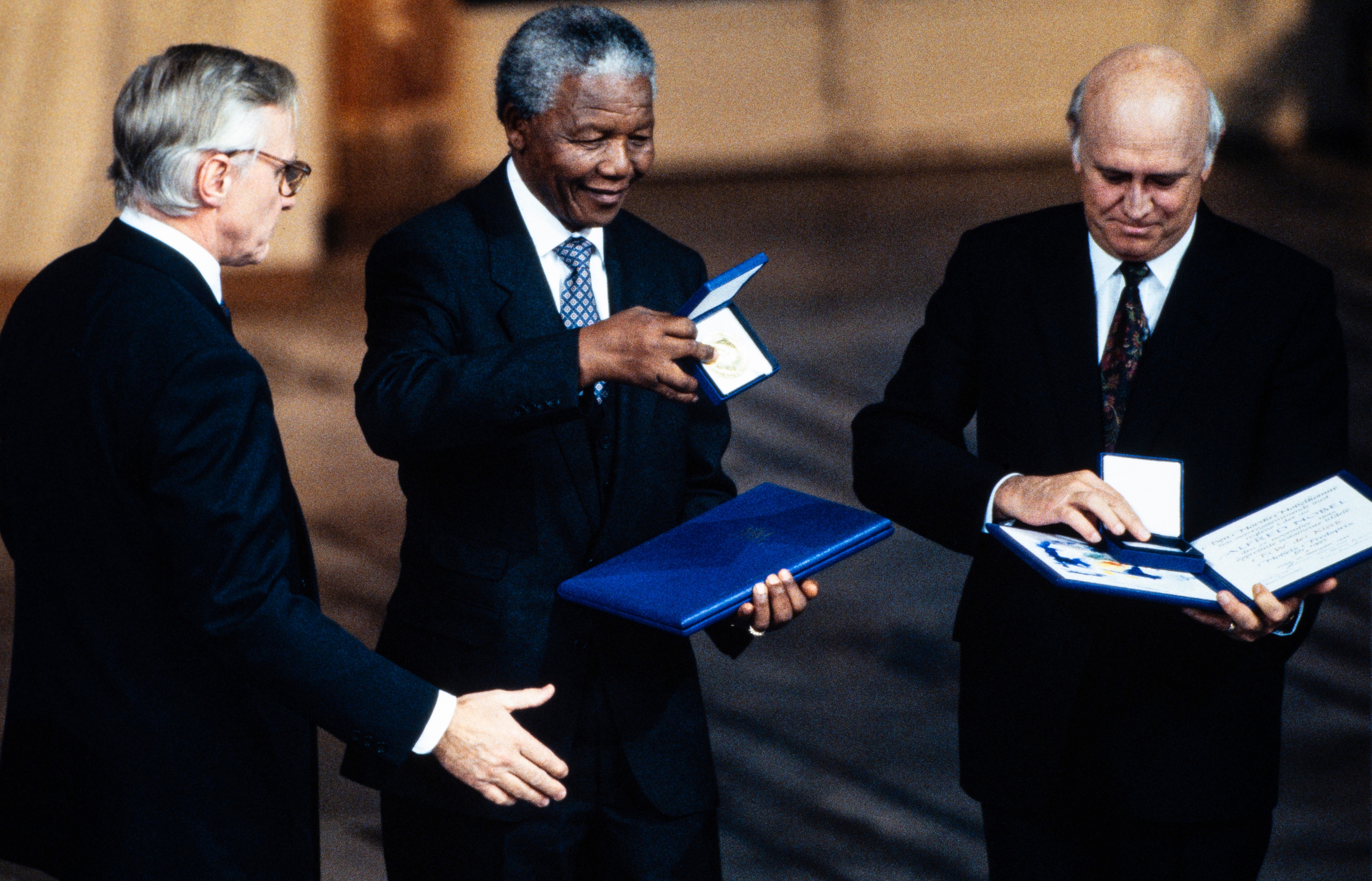
 Nelson Mandela and FW de Klerk, the then South African president, receive the Nobel Peace Prize at City Hall in Oslo, Norway, on 10 December 1993. (Photo: David Levenson / Getty Images)
South Africa signed the Biological and Toxin Weapons Convention (BTWC), the first multilateral treaty to ban an entire class of weapons, on 10 April 1972, and ratified it in November 1975.
Fifty-plus years later, and as concerns mount about the use of chemical and possible use of biological weapons in what has become known as grey warfare in Ukraine and elsewhere, it is an appropriate time to reflect on the rise and decline of South Africa’s biological weapons programme, the only country in Africa to develop biological (and nuclear) capabilities.
There are profound lessons to be learnt about how to – and how not to – govern the dismantling of high-consequence programmes such as these. In this six-part series, we focus on the biological programmes that went by the benign name of Project Coast, a covert endeavour that collectively represents some of the worst practices when it comes to building and dismantling a biological weapons programme responsibly.
Read part one of the series here.
Project Coast built on a prior but more limited chemical weapons programme that focused on producing mustard gas for the Allied battle against Hitler’s Nazi Germany in the 1940s.
The mustard gas was produced at a state-owned factory at Klipfontein outside Johannesburg and Firgrove near Somerset West, Cape Town.
Renewed interest in developing chemical and biological weapons came from the desire to develop alternatives to using live ammunition for crowd control (images of police shooting unarmed high-school students in Soweto in 1976 gave South Africa deservedly bad press) and the fear that Angolan and Cuban troops would use Soviet-made chemical weapons against South African soldiers fighting the Namibian/Angolan border wars and needing, therefore, protective medical countermeasures.
Formally led by the Surgeon-General of the South African Defence Force (SADF) – Lieutenant General Nicolaas Niewoudt between 1977 and 1988 and Lieutenant General Daniel Knobel between 1988 and 1997 – Project Coast was run in practice by Dr Wouter Basson, a young military officer and talented cardiologist.
/file/dailymaverick/wp-content/uploads/2021/09/MC-Book-Herwitz_1.jpg "The story broadcasts itself in the manner of a non-fiction novel. Wouter Basson, 'Dr Death' of the apartheid state, is now happily practising medicine in the Western Cape. (Photo by Gallo Images / Foto24 / Lisa Hnatowicz)")
After undertaking tours to assess programmes elsewhere, Basson designed a biological weapons programme for defensive and offensive purposes despite the claim by Knobel (in his testimony to the Truth and Reconciliation Commission or TRC) that it would be used for defensive purposes only.
Loosely overseen by a special committee, Project Coast was created under the guise of a putative civilian research and development operation.
The programme was compartmentalised into four civilian front companies: Delta G Scientific (chemical agents); Roodeplaat Research Laboratories (biological agents); Protechnik (defensive protective CBW equipment and countermeasures); and Infladel (finance and administration).
/file/attachments/2986/000004767_368380.jpg "P.W. BOTHA, one of the Prime Ministers of South Africa in the apartheid era (1978 - 1984) and the State President from 1984-1989).")
With resources from the SADF, and the full support of both Minister of Defence Magnus Malan and President Pieter Willem Botha (known as PW), Basson was free to recruit, as William Finnegan put it in The New Yorker a “global network of spies, ex-soldiers, sanction busters, smugglers, and bio-warriors to obtain the chemicals, toxins, viral cultures, specialized equipment, and expertise necessary to develop his program”.
Several biological and biochemical products would emerge from Project Coast’s research. The low-hanging fruit were poisons prepared for assassination purposes.
The scientists handed over to the security police and military officers cigarettes, chocolates, lipstick and envelope flaps contaminated with anthrax; milk and beer with botulinum; household items including underwear laced with organophosphates; and other items identified as assassination weapons by Knobel at the TRC hearings.
/file/attachments/orphans/GettyImages-72539642_133639.jpg "Nelson Mandela, campaigning at ANC, South AFrica, 1994. (Photo By Tom Stoddart / Getty Images)")
Attempts were apparently made to spread cholera and yellow fever by contaminating the drinking water of a Namibian refugee camp. Although it was never carried out, thallium, a toxic heavy metal that can permanently impair neurological functions, was intended to slowly kill Nelson Mandela before his release from prison in 1990.
At the chemical wing of the programme, both irritating agents and incapacitating agents were considered, made and weaponised.
The substance called CR (dibenzoxazepine), a crowd control agent more potent than the common tear gas used globally, was made and loaded into weapon delivery systems.
Between 1987 and 1994, the state’s arms manufacturer Armscor’s (today’s Denel) subsidiary Swartklip Products loaded CR powder into hand and rifle grenades, mortar bombs and artillery shells for use in the G5 system, which has a range of 40km. The substance would cause eye irritation, temporary blindness, pain and coughing. Production surged just before South Africa turned democratic in 1993.
Incapacitating agents were developed for use on prisoners of war. Fatal doses of the surgical muscle relaxants called Scoline and Tubarine were administered to Swapo (Namibian) POWs as a solution to camp overcrowding. They first tried strangulation, but this proved too traumatic even for seasoned murderers.
Between 1979 and 1987, more than 200 guerrilla prisoners were killed. The victims’ incapacitated bodies were loaded, three at a time, into a small plane at a remote airstrip on the Skeleton Coast of Namibia, flown hundreds of miles out to sea and dumped into the Atlantic Ocean from an altitude of 12,000 feet.
Roodeplaat scientists worked on anti-fertility measures that could be administered to black people. Close to 20% of Roodeplaat’s projects were devoted to fertility control.
The effort should be seen against a background where apartheid leaders had the longstanding dream of deliberately slowing down the growth of the country’s black population and, by way of the immigration assistance scheme introduced in the 1960s, boosting the immigration of West European Protestants (Jews, Catholics and darker-skinned people were not welcome) to change the demographic ratios in a country open to large-scale social engineering.
Had the research been successful, widespread sterilisation of black women without their knowledge was the goal.
Roodeplaat wanted to eventually develop bacterial agents that would selectively kill black people. Programme director Adriaan Goosen said this was “the most important project for the country”. He said it was backup leverage to keep the apartheid government in power and to maintain the peace between the “races”, a view also shared by Knobel.
However, Basson confirmed to the TRC, as indeed any scientist would, that, “[T]here is no biological, no genetic, no physical base on which one can develop an ethnic weapon.” A fanciful, wild and diabolical eugenics-driven research effort, Project Coast’s scientists nevertheless continued with the research, but thankfully, nothing came of it.
/file/dailymaverick/wp-content/uploads/2023/06/1864435.jpg "Oped-Suttner-ChangeP5-TW")
President Botha suffered a mild stroke in January 1989 and was succeeded by Frederick Willem de Klerk (known as FW). Domestic resistance, international sanctions and the collapse of the Soviet Union – the ANC’s biggest backer – created the context for de Klerk to negotiate the country out of the dead-end of apartheid, and towards a rights-based democratic order.
The new arrangement required greater civilian control over the military. Basson was forced into early retirement in 1993, and De Klerk would order an internal investigation and subsequently, the shutting down of the country’s biological and nuclear weapons programme. In 1995, Joe Modise, Nelson Mandela’s Minister of Defence, rehired Basson. DM
Wilmot James, a former MP (South Africa), is a professor at the School of Public Health, senior adviser to the Pandemic Center and director of the Africa Initiative at Brown University, Providence, Rhode Island. He is also a member of the advisory panel to the Signature Initiative to Mitigate Biothreats in Africa (Simba), a collaboration between the G7-led Global Partnership Against Materials and Weapons of Mass Destruction and the Africa CDC. Brendan Beng was a 2025 and 2026 summer intern and Andrea Uhlig a research associate at the Pandemic Center.
Comments
Scroll down to load comments...