




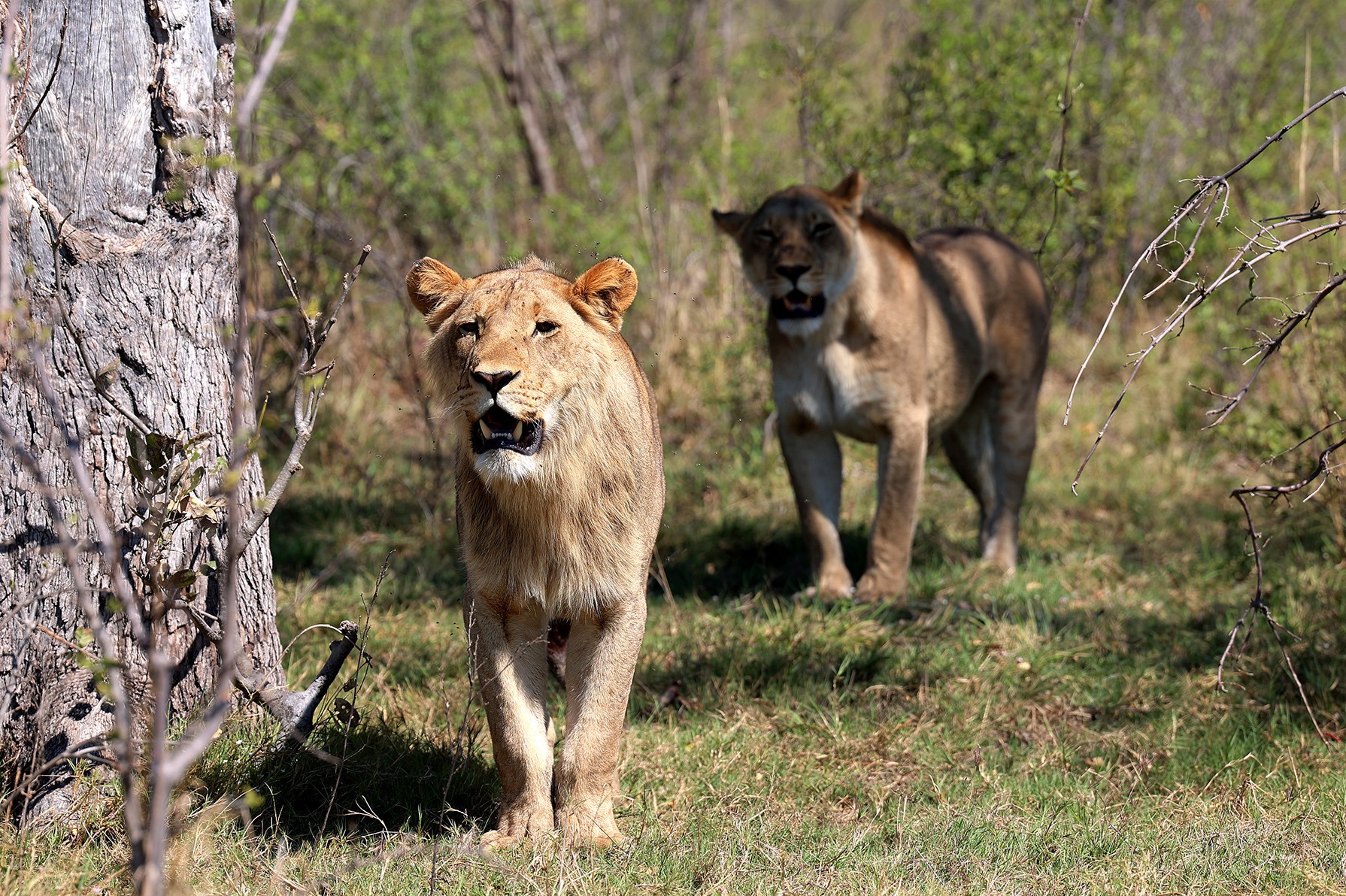
 Several species including lion remain under severe threat in the Okavango Delta. (Photo: Clifford Roberts)
It’s mid-morning on the outskirts of Gunutsoga Village where Kutlwano Teko and a handful of herders have gathered to release their cattle from a canvas-lined boma. A cold night has relented in the face of the sun’s momentary gift of a mellow warmth.
One of the men, Dimbindo Kuyakenge, unhooks an overlap in the barrier and folds it back to create an opening. The head of a curious bovine appears in the gap before leading its body down a narrow channel and out into the bush to graze. Another follows, then another – an automatic outpouring accompanied only by the gentle coaxing of one herder inside to nudge stragglers out.
Though each proceeds gingerly, the animals still find themselves cloaked in a cloud of fine dust that none trampling the summertime soils of the Okavango Delta floodplain can escape.
It was yet another uneventful evening for Kutlwano and his fellow herders, which for a long time has been unusual. The past few decades had seen increasing numbers of their livestock killed by lions, and I had travelled to this remote place to find out what had changed.
/file/attachments/orphans/Roberts-Botswana-lions-herdersMAIN_410413.jpg "The boma ensured another uneventful night for cattle and herders.")
From the start, retribution for cattle losses was severe as farmers retaliated. In 2013 alone, about half the population of local lions simply vanished, presumably killed. Researchers identified 28 as having died by poisoning. The knock-on effect for other species multiplied the effects.
This was the human-wildlife conflict on steroids – a case certainly not limited neither to these parts nor to Panthera leo.
Things were dire for conservationists, but for the farmers it was clear that little was going to change. This is the way living has been made here for generations, despite the challenges associated with a place dominated by wetland grazing, predators and the threat of disease.
“I was a farmer and my grandfather was a farmer,” Kutlwano tells me as the last cattle drain out of the boma.
The animals pause briefly in the open, seemingly getting their bearings like a cinema crowd suddenly emerging into daylight.
/file/attachments/orphans/Roberts-Botswana-lions-herders2_850905.jpg "Dimbindo Kuyakenge keeps an eye on cattle emerging from the boma. (Photo: Clifford Roberts)")
/file/attachments/orphans/Roberts-Botswana-lions-herders1_482813.jpg "Kutlwano Teko, CLAWS Lead Ecoranger and herder trainer. (Photo: Clifford Roberts)
<br>
<br>
<br>
<br>")
To make matters worse, youngsters who traditionally had fulfilled the role of herders were increasingly leaving for an easier life in urban areas. Some, like Kutlwano, loved being out in the veld, but they were a dwindling number. The only option for farmers was to let animals roam with less and in most cases, no supervision across the unfenced wilderness.
Lay of the land
The Okavango Delta is one of the world’s largest inland systems of its kind. As its floodplain waxes, it can span 16,000km² – an area just smaller than Beijing municipality. The river basin itself covers a massive 725,000km².
Yet, despite having been named in 2014 the 1,000th World Heritage Site, the delta’s inhabitants were facing challenges that have continued to metastasise around villages like nearby Gunutsoga on its eastern panhandle.
Among the people with a front-row seat to this unfolding destruction was Vince Shacks, group impact head for a pioneering conservation tourism group, Wilderness. He’d been studying crocodiles in the region and was repeatedly encountering mass vulture deaths related to poisoned carcasses.
/file/attachments/orphans/Roberts-Botswana-lions-herders7_184602.jpg "The Delta is expansive and beautiful, but these characteristics can belie its status as environmental battleground. (Photo: Clifford Roberts)")
He wondered if biologist friend Dr Andrew Stein, a US-raised big cat specialist working in Africa and founder of the CLAWS Conservancy, would be keen to get involved. Andrew agreed.
“I had these ideas I always wanted to try,” he recalls. “So, I came out here with a grad student. We hired a couple of local guys from the village. And then we started talking to people and instead of trying to prosecute people for using poison, [we started] with compassion.
“These people are using poison because they see no alternative. [We wanted to] give them other opportunities so that even when poison’s available, they choose not to use it because we’re never going to stop it.”
Small beginnings
The approach focused on technology and traditional practice. Trackers were put on the lions, creating virtual fencing that helped alert herders via mobile app to their presence; and then the team initiated naming ceremonies. “We asked people to give [the lions] a name in their local language so that they felt a connection to each individual animal.
/file/attachments/orphans/Roberts-Botswana-lions-herders4_355867.jpg "Farmers across the region have adopted various strategies to keep animals from their crops, including rock-filled tins serving as a simple, but effective alarm system.
<br>(Photo: Clifford Roberts)")
(Photo: Clifford Roberts)
/file/attachments/orphans/Roberts-Botswana-lions-herders5_211692.jpg "Smoke from burning chillies is a potent irritant and way that farmers keep elephant in particular from their seedlings. (Photo: Clifford Roberts)")
“If you use poison, you say all lions are bad; get rid of all of them. That’s different from ‘Mayenga is over here, and she’s got three cubs, and Motoankanda’s over here, this male, and he’s, you know, he’s got this other pride over here’.
“When you start sharing stories about individuals, it creates a different dynamic of the relationship between people and the animals.”
To date, the programme has signed up 380 farmers, Andrew says. “We’ve dispersed over 70,000 alerts over the last seven years.”
Along with that, the CLAWS team has also helped develop cattle management practices, presenting herder training courses. They brought people from Zimbabwe to talk about herding; established grazing committees that allow for planned, environmentally responsible grazing; and land restoration. Herders were identified, hired and trained in rangeland ecology, basic veterinary care and protection against predators.
The lion alert system and the herding programme were both launched in 2019. “We now have four herds comprising 700 cattle.”
/file/attachments/orphans/Roberts-Botswana-lions-herders3_469499.jpg "Dr Andrew Stein, founder of CLAWS lion conservancy. (Photo: Clifford Roberts)")
In this time, they’ve had just three losses to lions in four years. The last confirmed lion poisoning was 2019 – seven years ago. And the lion population has grown from the 40 they knew of in the beginning to more than 100.
“When the lions are left alone and they’ve got space and there’s lots of wild prey for them – around here you’ll even see zebra mingling with the cattle – then they come back very fast,” Andrew says.
Hearts and minds
Winning farmers over to this perspective was and remains a slow process. Back in 2019, when the herding project started, most people turned them down, Kutlwano recalls. It began with a local chief. “He agreed to bring his cattle [into the project]… after that few months, [others] who’d rejected it before came when they saw those people benefiting, and said: ‘You guys! You are doing an amazing job. That job is very good.’
“Now, we are growing. We have 96 farmers that join in this project.”
An integral part of the process was facilitating a better market. The Delta farmers operate in a suboptimal or “red zone” area, which means limited herds and low demand for their meat.
“The market [for them] is very minimal,” says Andrew. “If you’re in the green zone you can export and all of this stuff. But here, people are left behind. So, when we talked to farmers and they said, well, why should I pay a herder when our beef isn’t worth very much [we realised we needed to] work on that too.”
/file/attachments/orphans/Roberts-Botswana-lions-herders8_884240.jpg "Kebadiretse \"KB\" Kanjenje, chef at Wilderness Vumbura Plains. (Photo: Clifford Roberts)")
An important step was CLAWS’ success in getting the herds on its programme receiving certification from the international Wildlife Friendly enterprise network – the first cattle in Africa to do so.
Next was finding a customer who bought into the vision.
“All of these [safari operators] are selling this image through ecotourism. Their product is a pristine environment where they’re working in harmony with the communities to ensure natural resources get managed and conserved.
“[But] if you’re buying beef from some farm that has, like, the cattle in pens and they’re not roaming free and they’re not protected and maybe the farmers are shooting predators every once in a while, how do you tell that to your guests?”
The alternative, he sketches, is giving guests the opportunity to meet the herders, hear the story, see the cattle and hear how challenging it is to be here. “The fact that they’re making active, certified decisions, like not killing lions, you’re directly incentivising people to protect these cats and that benefits their business too.
“It’s very holistic.”
The first one
The first agreement happened last year. Wilderness Vumbura Plains lodge agreed to a quarterly supply of beef from local farmers, although Andrew quickly adds that “it’s early days”.
“We’re still working out the supply chains [with] a business consultant to do a full business model of how we might be able to scale this up so that more farmers and communities can get involved.
“But, it’s a really exciting time. And I just feel fortunate, like I have all these great guys that believe in what we’re doing and they’re doing hard work out here. This is not easy work to be out with the cattle all day, especially when it’s raining and hot in October and they’re getting those cattle in and bringing them back and keeping them safe.”
/file/attachments/orphans/Roberts-Botswana-lions-herders10_710105.jpg "Schalk Pretorius of Beef Boys in Maun, Wilderness Group Impact Head Vince Shacks and CLAWS founder Andrew Stein. (Photo: Clifford Roberts)")
Currently, cattle are delivered to Beef Boys, a butcher and distributor in Maun, about 150km away. The company has long been the main distributor for Wilderness. Typically, during the year, farmers provide cattle for sale, which are then acquired and transported by truck to be processed and distributed to the lodge.
It’s a circuitous trip that routinely takes about 10 hours in one direction alone, along gravel roads, but this often changes, especially in the rainy season. Logistics are being worked out and other plans considered. “We just finished a feasibility study for having a slaughter facility here in the village,” Andrew says. “Obviously, managing such a facility is a whole other thing [and] there’s a reason it hasn’t been done before. But I think there’s a lot of potential.
“As we expand and there’s more farmers interested, I think that it becomes more feasible.”
Other perspectives
Apart from the tenuous truce between farmers and lions, the incentive for farmers to participate has also come down to money. Here, Beef Boys’ Schalk Pretorius says while animal condition varies seasonally, the training and focus on the wild-reared beef – from veterinary controls to general treatment – has translated into outstanding grades for the herds, even though they’re small.
Eastern panhandle farmers generally enjoy a 10% premium on the median.
Back at the lodge, I realise during a conversation with the chef just how careful any strategy – never mind the most audacious kinds asking farmers to lay off the lions – must be here.
Wilderness’s concession in a 60,000ha space requires partnership with a community trust, which is made of representatives from five of the surrounding villages. Most of its staff – like Vumbura Plains head chef Kebadiretse “KB” Kanjenje, born in nearby Sironga Village – hail from the area. Her husband works at the lodge too, but he also owns cattle.
What do you think of the herder programme behind a portion of the beef she serves up, I ask her. “If it benefits the farmers, it’s good,” she responds.
The bigger picture
As anyone engaged in this kind of work knows, wins can feel few and far between, but in August there was a palpable air of excitement ahead of a special dinner at Okavango Brewery in Maun – despite the frenetic activity to get things done in time.
The event organiser fussed. Were the flowers ready? Where was the welcome table?! Can’t we move these chairs somewhere out of sight?
In the twilight, a string of bistro lights twinkled over several long tables decked beautifully under the outdoor pagoda. The scene was finally set for Panhandle to Plate – celebrating innovation for conservation. Partnering for the occasion was CLAWS and the Wildlife Friendly network, but also others engaged in initiatives working to similarly “holistic” paths. There was the Ecoexist Trust, which drives elephant-aware farming and developed a route to market for grain farmers to supply the brewery; the Nkashi Trust, involved in science, traditional ecological knowledge and community-led conservation; and, representatives of an initiative to develop honey supply from rural beekeepers.
But why now? I wanted to know of Liesel van Zyl, head of positive impact and product development for Go2Africa, the company that initiated the event along with CLAWS.
“Botswana has some of the most high-end lodges in Africa, and communities that live alongside the northeast of the Delta are not benefiting as much as one would think that they should,” she says.
/file/attachments/orphans/Roberts-Botswana-lions-herders9_492679.jpg "Among guests at the Panhandle to Plate function were, from left, Gosa Lekoko (Travel for Impact), Liesel van Zyl (Go2Africa), Chief O Ledimo (senior chief in Maun, Catja Orford (CLAWS), Chief H Dowe (acting senior chief in Seronga), Dr Andrew Stein (CLAWS), Dr Graham McCulloch (Ecoexist),
<br>(Photo: Clifford Roberts)")
“A lot has been happening behind the scenes [to change that]. A lot of these NGO and conservation partners have been going for over 10 years. The tourism industry is a couple of decades old. And there’s been a shift with the NGOs from not just focusing on conservation, but to focus on making sure communities are also benefiting,” she says, adding that, similarly, the tourism industry has begun to shift towards supporting the NGOs.
“At the same time, the Botswana government has said to lodges… we want you to start looking local.
“[Now] it’s at this tipping point… [Tonight, we have] 20-plus key tourism leaders, private sector, chiefs, community members and NGOs. [We’re] saying to the tourism industry: look at what’s coming; look at what’s possible. Start to have conversations with your procurement, with your impact teams to say, let’s figure out how we can start supporting.
“At the same we’re also talking about developing a capacity-building hub. My passion project is going to be to get that off the ground because if we can build training, market readiness, product development, a connection with lodges… it would be unique in this space.
“It really could be a model for other areas,” Liesel says.
Back on the panhandle, tomorrow morning will again see Kutlwano, Dimbindo and others head out for the day along the Delta’s dusty paths, back to the bomas for their cattle.
Life is rarely easy out there, Andrew Stein reminds me. “I spend my days in the office, writing reports and compiling funding proposals. These guys are at it in the bush, every day – rain or shine.”
At least for now, I think, the night’s sleep would have been better than they’ve had in a long time, and for many of the creatures in that part of the bush too. DM


Comments
Scroll down to load comments...