





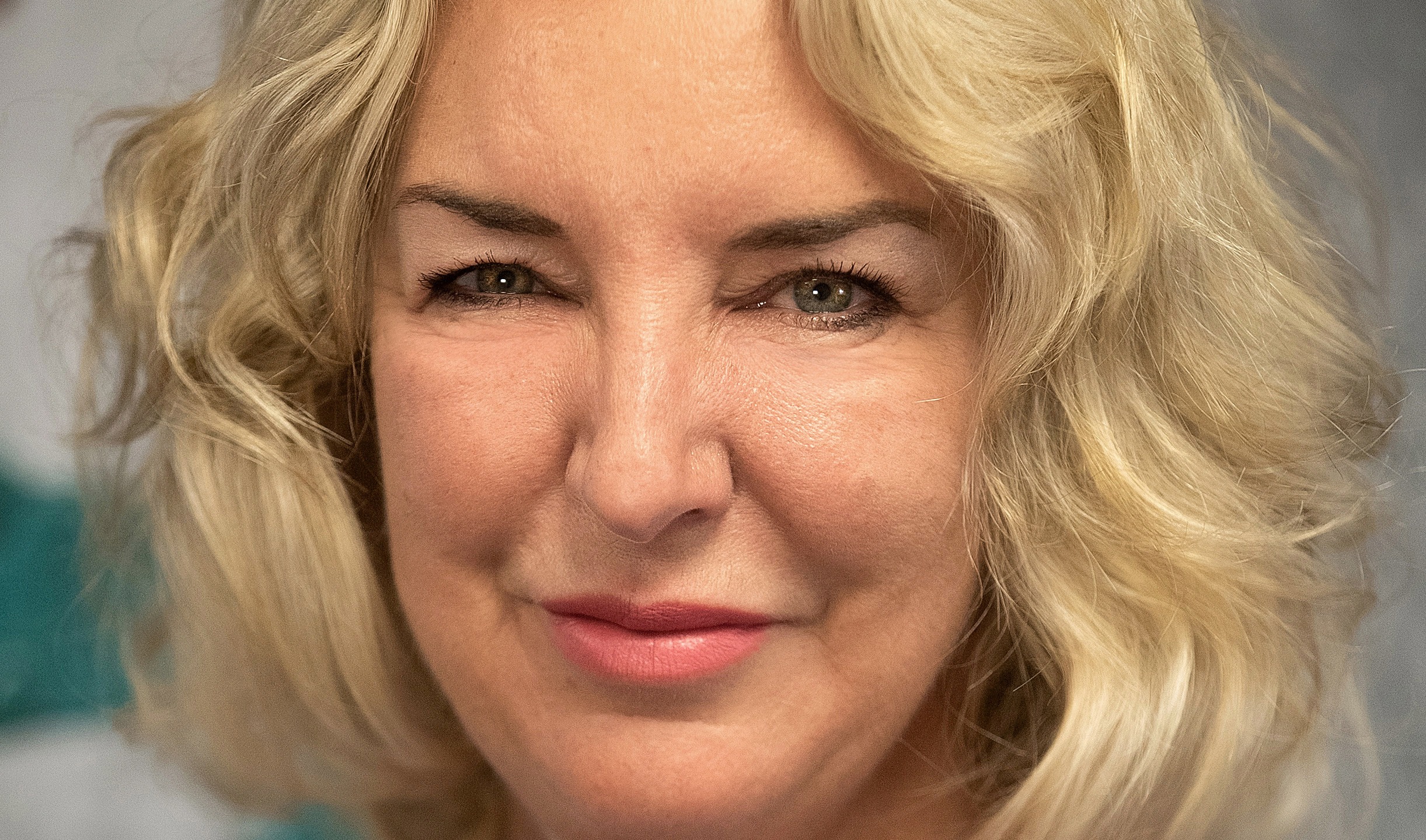
 Professor Karen Sliwa-Hahnle was born in Germany but moved to South Africa in 1992 and has worked as a public healthcare cardiologist for the past 34 years. (Photo: Tao Heffner)
 This World Heart Day, Daily Maverick sat down with cardiologist Professor Karen Sliwa-Hahnle who has 872 publications (550 of those peer-reviewed) in the cardiovascular field – the most prolific on the subject on the continent. She is a professor of cardiology at the Department of Medicine at Groote Schuur Hospital, and the Director of the Cape Heart Institute at the University of Cape Town.
Her areas of expertise are heart failure, structural heart diseases such as cardiomyopathy and cardiac disease in pregnancy.
She’s won numerous awards, which she did not want mentioned. More significant to her is the supervision of 38 master’s and PhD students. She’s done meaningful research – on a low budget – which is no small feat, she added.
But most important to her are the patients in the public sector. Virtually all of them return for treatment. Encouraging them, helping them apply for social grants, and talking about their lives mean the most to her. Plus, they are all rather nice. Somehow they are not miserable, despite having a chronic illness, she says.
Sliwa-Hahnle developed a medical therapy for heart disease in pregnancy. It saves lives. It is the reason she got the Order of Mapungubwe, the highest civilian national honour, in May 2026. The medication bromocriptine is the only proven specific intervention for peripartum cardiomyopathy.
Both of her daughters became doctors who work in the public sector.
/file/attachments/orphans/MC-Sliwa-Hypertension1_682715.jpg "Professor Karen-Sliwa received the Order of Mungubwe in May 2026 for developing the only current medical therapy for cardiomyopathy in pregnancy - an issue that affects one in 1,000 pregnant people.
<br>(Photo: Supplied / Source)")
Africans and heart failure
A Lancet study released on 30 August in 2026 by Sliwa-Hahnle and other researchers looked at heart failure in 17 countries in Africa. Africans still present 10 to 20 years younger than other cases worldwide. One in five people die within six months of their presentation.
It’s worse than cancer, she said, because 22% of cancer patients do not die within six months.
The study showed that untreated high blood pressure and historical disease affecting the African population are important factors. However, there is evidence that coronary artery disease, due to changing to diets that are rich in fat, may be more important.
Half the patients in the study were treated with an SGLT2 inhibitor, a new drug that is saving lives, she explained. But why are the patients still dying on good medical treatment?
“The message is: once your heart muscle is damaged severely, even relatively, [receiving] state-of-the-art and recommended therapy is not saving everybody.”
Check your blood pressure
Heart failure is not really recognised, she said. If someone is short of breath, they may think they have asthma or tuberculosis. People may borrow an asthma pump from a neighbour because they do not have time to go to a doctor, or if the clinic is far away, or they are not on medical aid.
“A big problem for hypertension and heart failure is really the lack of awareness. Many people think it’s a disease you only get when you’re old.”
What happens if high blood pressure is untreated in your thirties? If you have high blood pressure for years before you check it, by the time you are 50 you have damaged your heart, kidneys and eyes. Then you get a stroke or a heart attack, and thereafter live with heart failure, she said.
Sliwa-Hahnle said people should check their blood pressure, cook their own food, and not use a lot of salt. Many people know that – but it is a big step moving from knowing to implementing changes. It’s not all doom and gloom, because she remembers how it was 20 years ago with far fewer people walking for exercise, whereas now it is much more common. The prevention of hypertension could be similar.
At a Soweto clinic, she studied who got tested for hypertension. A 42-year old man went to the clinic five times, presenting with a bad headache. He was not overweight. He was sent home with Panado. No one checked his blood pressure. The concept that men could have hypertension at a younger age, while at a healthy weight, was not known.
Black people have a sensitivity to high salt content in food. Salty food is now very common, so many black people have high blood pressure.
Often, working class people do not have the ability to wait in a long line at a clinic, or the finances to afford a private doctor. However, pharmacies offer blood pressure testing at a low cost, with no appointment needed, she said.
/file/attachments/orphans/MC-Sliwa-Hypertension4_634245.jpg "The study Professor Sliwa-Hahnle authored examined heart failure admissions, management and post-admission care across 50 hospitals in 17 African countries. It included 15 main authors and 49 investigators.
<br>(Photo: Supplied / Source)")
Heart failure hurts your whole home
In South Africa, diabetes now kills more people than HIV and tuberculosis. Hypertension follows as the second biggest killer. Strokes and heart disease are in the top 10.
“It is a huge burden, and to some extent one could manage it better, one could prevent it better. It’s a human being component: the patient who doesn’t know he’s a patient,” said Sliwa-Hahnle. “Then there is the primary healthcare programme, still influenced by the HIV and TB pandemic, as well as Covid, and the nurses [who] may not have realised hypertensive heart disease is now the second biggest killer.”
If someone has a stroke, a family member has to do home-based care. If someone has renal failure, they need someone to accompany them to the hospital.
“It is a big out-of-pocket expenditure for a family who has the damaging consequences of high blood pressure. People don’t realise that while it’s obviously sad for the person, but it’s also very difficult for the entire family and it can push them into poverty.”
This is one of the ways Sliwa-Hahnle convinces her patients to take their tablets: by making it clear how the disease affects their entire support network. No one enjoys being a burden. And no one thinks about the cost of nappies after a stroke.
“Dying of heart failure is really a miserable death. I mean you have water in your lungs, you can’t breathe, your legs are swollen. Dying of a heart attack is not nice for your family, but you just go,” she said. “So prevention is always better. It’s not that there’s a quick fix afterwards.”
Pregnancy and a weak heart muscle
Daily Maverick asked Sliwa-Hahnle what the different terms mean in cardiac care.
What happens if you have hypertension? You go into heart failure. The heart muscle thickens. The heart is not pumping. When a patient arrives for the first time with heart failure, this is known as de novo acute heart failure. The patient probably had mild heart failure for a while before, but this is when it is first documented.
The heart is a big muscle. If this muscle becomes weak, this is known as cardiomyopathy. There are many reasons why a heart becomes weak – longstanding high blood pressure, diabetes, virus infections, toxins like alcohol or drugs, and pregnancy. Sliwa-Hahnle’s main area of expertise is in heart disease and pregnancy. One in a thousand people who give birth get a weak heart muscle. They can present with heart failure.
If you have coronary artery disease, and then get a heart attack, this is ischemic heart disease. It means the perfusion of your heart is not working, because the arteries are blocked. The heart is not getting enough blood. Then a part of the heart is dying – that is how the heart attack happens.
Bias towards public service
Sliwa-Hahnle acknowledged that she is a bit biased about the public healthcare system in South Africa. She has worked at public hospitals for 34 years.
She started at Chris Hani Baragwanath in Johannesburg in 1992. From 2010, she has worked at Groote Schuur in Cape Town.
“I’m a big fan of public service. You can always improve things. Don’t get me wrong, but I think in general South Africa is not doing as bad as many people think. We have one of the few universal healthcare [coverages] in Africa, and at least you do usually get your diabetic, your heart, hypertension medication. You get it. It’s not like [in the] US where you have to pay, or in India [where] you have to pay.”
/file/attachments/orphans/MC-Sliwa-Hypertension3_681975.jpg "Professor Sliwa-Hahnle pictured with the Nigerian PhD students she has supervised. She told Daily Maverick that supervising students who go on to do more research and become professors themselves is some of her most meaningful work.
<br>(Photo: Supplied / Source)")
The wait times at clinics can be long and medication can be out of stock, but patients do get tablets without payment – which is a really big achievement, she said. For those on medical aid or who pay out of pocket, hypertensive medication can easily end up at about R1,000 a month.
At a heart clinic she worked at they tried to do appointments, but because most people took public transport, they either arrived very late or early. They would often have no patients, and that was also a waste of resources, she said.
The key to staying healthy
The National Strategic Plan For The Prevention And Control Of Non-Communicable Diseases (2022-2027) has the goal of having 90% of those with high blood pressure being aware that they have it, 60% of those being treated, and 50% of those on treatment being under control.
In 2025, Heart and Stroke Foundation South Africa reported that 19% of men and 29% of women were aware that they had high blood pressure. Hypertension affects roughly 45% of men and 48% of women over the age of 15.
“It’s not more doctors, more nurses, more national plans, more prescriptions. It’s about a mental thing. We have to change the minds of people. You have to change your own mind about wanting to stay healthy as long as possible and what it takes.”
She said that if she were president, she would implement awareness programmes and focus on adherence issues. She did a study where they measured drugs in patients’ systems. They found that 50% of those who receive tablets did not take them. It simply wasn’t in the blood.
To control hypertension, people need insight into why they need to take the medication. People do not like taking more tablets on top of their daily regimen, they do not want tablets lying around for children to eat accidentally, they may not like the side effects, or they may think taking medication makes them seem weak, she said.
Public tracking and public health
There are ways South Africa could do mass testing of blood pressure. Health checks at work, or for 18-year-olds leaving school.
“You will be surprised,” she said, “at how many are obese already or have slightly elevated blood pressure.”
A campaign could also just be a sampling; checking 1,691 people during a day at a taxi rank. This is something she has already done. Published in 2008, A time bomb of cardiovascular risk factors in South Africa: Results from the Heart of Soweto Study “Heart Awareness Days” checked the blood pressure of everyone waiting for a taxi, as well as their glucose levels and cholesterol. The research found that almost 80% of people had at least one major risk factor for heart disease.
As a cardiologist, Sliwa-Hahnle has a list of simple things that could improve public health.
More ECG machines (which AI can read), more blood pressure machines, and more community hospitals would make a difference. The last is training healthcare workers in point-of-care ultrasound readings as a screening tool – because nowadays you can check the heart at point of care.
These affordable interventions would mean people did not wait so long for a result in a hospital.
/file/attachments/orphans/MC-Sliwa-Hypertension2_836295.jpg "Professor Karen Sliwa-Hahnle and her husband, Dr UR Hahnle, with the Order of Mapungubwe, the highest civilian national honour in South Africa.
<br>(Photo: Supplied / Source)")
Policy level changes
In 2013, South Africa introduced a policy that saw the reduction of salt in food, and in 2018 the country introduced the sugary beverages tax, both of which resulted in population-level changes. However, the commercial determinants of health, poverty and rapid urbanisation seem to have overtaken some of the policy interventions.
Sliwa-Hahnle thinks that South Africa can be proud that the country has introduced those policy interventions, as few other countries have done so.
Sodas are cheap enough for people to drink daily. Beverages with a high sugar content should be a once-a-week treat at most, she said. If unhealthy foods and drinks are taxed at twice the rate, the money generated should go directly into subsidising milk, fruit and all vegetables. There should be no taxes for unprocessed foods – or there should be a subsidy for them. If she were president, she would also subsidise the price of olive oil.
Styrofoam takeaways boxes are terrible for the environment, she said; they break down into microplastics, fish eat the microplastics, it goes into the food we eat, and it also leads to low sperm count. Eating hot food from a styrofoam container causes inflammation in the body. Sliwa-Hahnle said that the inflammation from ultra-processed food was a driver leading to hypertension. There was a link between eating processed foods, eating microplastics via your food, and that pushing up your blood pressure. DM
Comments
Scroll down to load comments...