



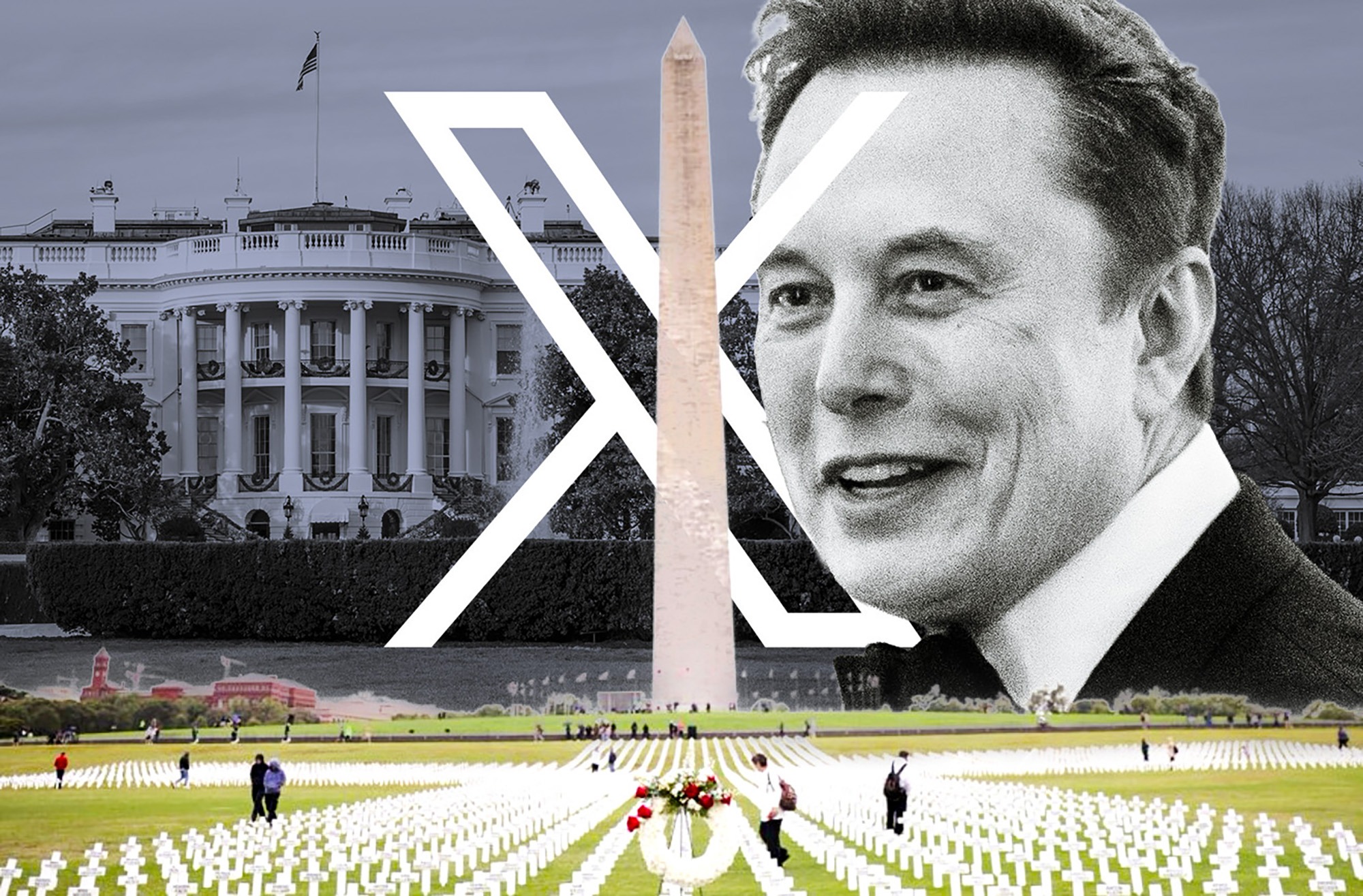
 Illustrative image: Elon Musk. (Photo: Kevin Dietsch/Getty Images) | White House. (Photo: iStock) | A view of the approximately 3,000 white crosses planted on the National Mall in Washington, DC, over the weekend of 25-26 September. (Photo: Ernst Roets / X)
Watching the “launch” of the White Cross Project in Washington, DC, last week and the responses to it was like living in two parallel realities. That is a sadly common experience for many South Africans. We are, after all, a country adept at living with cognitive dissonance.
By our reading of the data, this event did not tap into the pre-existing “white genocide” narrative, nor into the US culture wars, to the degree that past white genocide conversations did. Instead, it was a mostly South African conversation with a little international amplification. This says to us that the organisers did not have access to the amplification machinery Elon Musk brought to the white genocide narrative in early 2025 when he promoted it to a mostly American audience while still part of Doge, including the period when President Cyril Ramaphosa met Donald Trump in the White House.
/file/attachments/orphans/Screenshot2026-09-28at153326_339094.png "Op-ed-Findlay & Aldu Cornelissen
<br>")
Two versions of the same memorial
Between 20 and 28 September, organisers planted 3,000 white wooden crosses in Washington, DC, which organisers say represent farm-murder victims of all races going back decades. Murmur Intelligence analysed the 5,681 posts on X specifically mentioning the “White Cross Project” this week, from roughly 2,700 accounts. What emerges is not one conversation but two, running in parallel.
In the first version, the memorial is framed as bringing attention to the issue of rural safety. Lex Libertas, AfriForum alum Ernst Roets’ organisation behind the project, and its supporters framed the crosses as a tribute to farm-attack victims of every race. “The White Cross project aims to highlight all people who have been victims in farm murders, no matter what race,” read one widely shared post.
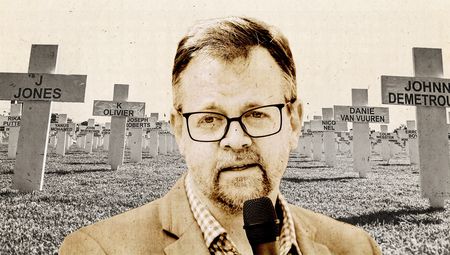
In the second version, the memorial is framed as racialised political theatre staged for a US audience. The most reposted critical content came from mainstream South African outlets. IOL reported on Afrikaners accusing the organisers of “using farm murder victims as political props”. The Citizen reported on South Africa’s ambassador to the US, Roelf Meyer, rejecting claims of political persecution against white farmers. One critic accused Lex Libertas of “selling a false ‘genocide’ story for money and headlines”.
/file/attachments/orphans/Op-ed-FindlayAlduCornelissen6_361826.jpg "A view of the approximately 3,000 white crosses planted on the National Mall in Washington, D.C. over the weekend of September 25–26, 2026 (Photo: X/ Ernst Roets)")
The phrase nobody on the stage used
The sharpest dividing line was a two-word phrase. Critics argued that the memorial feeds the “white genocide” conspiracy theory. The organisers pointedly avoided the term. Roets’ own posts that week never used it. In a recent interview with News24, Solidarity’s Jaco Kleynhans described their successful attempts to convince the US government not to refer to a ‘genocide’: “I think we’ve changed the thinking on some issues in the American government, like the use of the word genocide. We said, no, no, don’t talk about genocide – we have a serious crime problem and rural safety. But please don’t talk about genocide, don’t use that word. And the American government has stopped using that.”
/file/dailymaverick/wp-content/uploads/2025/02/04-jaco-kleynhans-2.jpg "Jaco Kleynhans. (Photo: X)")
Within the Lex Libertas community on X, fewer than one post in 200 mentioned “white genocide”. Strikingly, most posts that did use the phrase came from supporters insisting it had never been said. Martin van Staden of the Free Market Foundation told the vigil that in two days “no one has uttered the words ‘white genocide’”, and the clip was widely reposted among the organisers’ amplifiers. Among South African conservative commentators, the most active pro-memorial bloc, nearly 12% of posts mentioned the phrase, overwhelmingly to deny that the organisers had used it.
For the organisers, avoiding the word keeps the focus on crime and rural safety. For critics, it is beside the point: choosing white crosses, a US political stage and allies such as the New York Young Republican Club signal the narrative without naming it.
Both things can be true at once: the organisers avoided the term, yet some of their US amplifiers still framed the event as part of a broader culture war.
/file/attachments/orphans/Op-ed-FindlayAlduCornelissen4_338783.jpg "A view of the approximately 3,000 white crosses planted on the National Mall in Washington, D.C. over the weekend of September 25–26, 2026 (Photo: X/ Ernst Roets)")
A much smaller, much more South African fight
The contrast with 2025 is stark. When Ramaphosa met Trump in the Oval Office, the online conversation about farm attacks, “white genocide” and Afrikaner refugees was orders of magnitude larger than anything the White Cross Project has generated. It was also overwhelmingly American. US accounts far outnumbered South African ones, and Musk sat at the very centre of the network, the account everyone else was reposting and responding to.
/file/dailymaverick/wp-content/uploads/2025/05/GettyImages-2216313099.jpg "US President Donald Trump presents printed articles reporting murders of white South Africans while accusing South Africa President Cyril Ramaphosa of state-sanctioned violence against white farmers in South Africa during a press meeting in the Oval Office at the White House on 21 May 2025 in Washington, DC. (Photo: Chip Somodevilla / Getty Images)")
This time the pattern was inverted. The large majority of participants were South African, with Americans a distinct minority. US conservative outlets such as One America News and the UK’s GB News carried the story abroad, but from the edges rather than the centre.
And Musk was conspicuous in his absence. He did not post about the White Cross Project, and nobody reposted him on the topic. Supporters tagged him repeatedly, often alongside @POTUS (President of the United States), but 2025’s most influential amplifier never answered.
/file/attachments/orphans/Screenshot2026-09-28at152855_717609.png "Op-ed-Findlay & Aldu Cornelissen
<br>")
What it means
The White Cross Project produced strong feelings but modest reach. Without Musk’s megaphone, the claims around farm murders stayed a domestic argument over race, crime and who gets remembered.
That argument is unresolved. Neither side denies that rural safety is an issue. What they disagree on is whether farm murders stand out statistically, and whether a field of white crosses in Washington honours those victims, or recruits them.
As South Africans, our strength lies in our ability to see each other. Our challenge now is to overcome these parallel realities that many have a vested interest in reinforcing. DM
Kyle Findlay is the co-founder of Murmur Intelligence and LLMEKNOW. Aldu Cornelissen, the technical mind and co-founder of Murmur Intelligence, a Cape Town-based consultancy, is a pioneer in AI-driven pipelines and analytics of complex unstructured data.
Comments
Scroll down to load comments...