



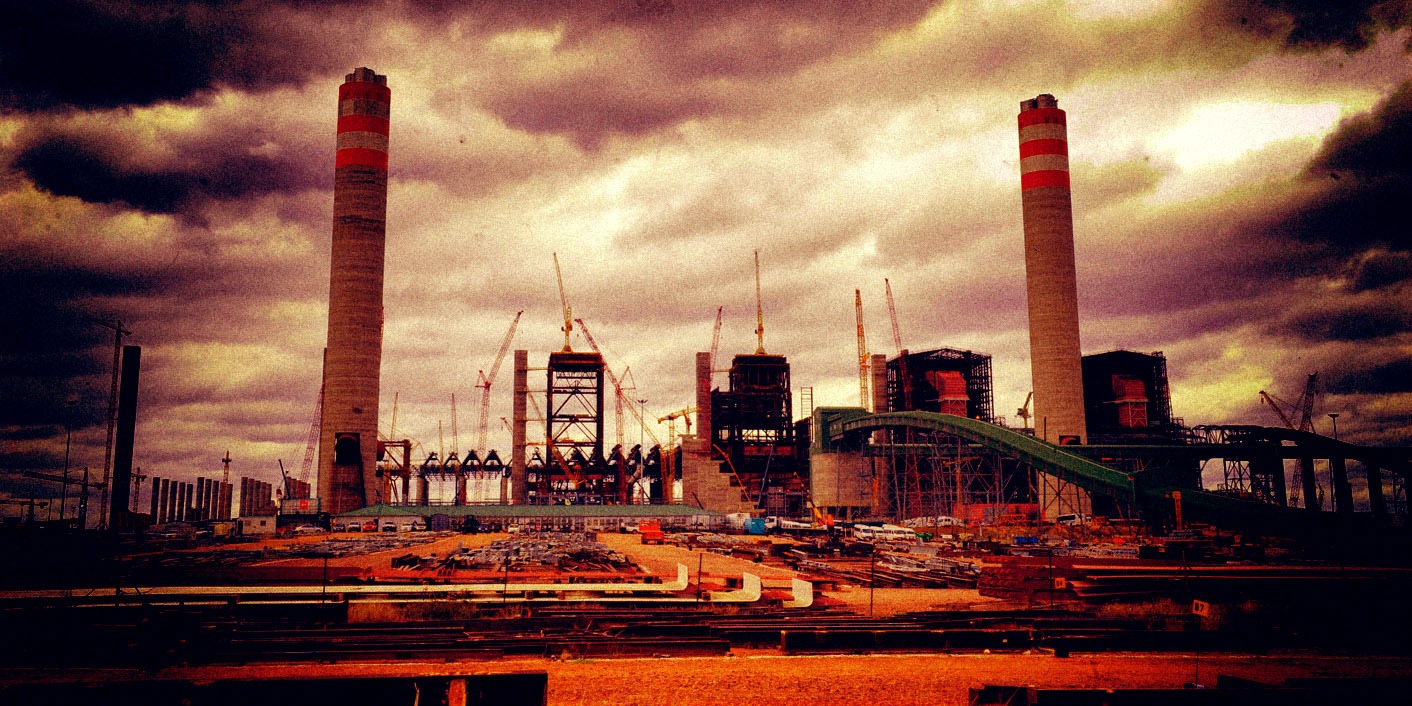
 The Medupi Power Station near Lephalale in Limpopo. (Photo: Werner Beukes / Sapa)
Eskom’s 10 September 2026 media statement says Kusile’s “approved construction budget” remains at R160.5-billion, with R155.5-billion spent, while Medupi’s approved construction budget remains at R145-billion, with R131.1-billion spent. It then criticises Daily Investor and MyBroadband for citing much higher figures of R233.4-billion and R176-billion, respectively.
By presenting its own narrowly defined approved construction budgets as if they settle the question of what these projects have actually cost, while omitting major capital and consequential cost items, Eskom creates a materially incomplete and misleading picture.
The questions Eskom will not answer
On 15 September, in response to Eskom’s media statement, EE Business Intelligence requested clarification as to whether its Medupi and Kusile cost figures included the following direct capital costs incurred (or still to be incurred) by Eskom:
Owner’s development costs, including water supply costs, and grid upgrade and connection costs for evacuation of the power generated;
Capitalised interest during construction;
Rate-of-exchange variation claims, cost price escalation claims, claims for scope variations and extra work, and settlement of all outstanding and disputed contractor claims; and
Cost of flue gas desulphurisation (FGD) plant at Medupi to comply with South Africa’s SO2 minimum emission standards committed to by Eskom in terms of a World Bank loan.
EE Business Intelligence also requested whether the following direct consequential costs incurred by Eskom had been included in its cost figures:
Rework and repair costs, including modifications to the boilers and coal grinding mills at Medupi and Kusile, replacement of the Medupi Unit 4 exploded generator, and repair of the duct failure that took out Kusile Units 1, 2 and 3;
Lost sales revenue due to the extended outages of Medupi Unit 4 and Kusile Units 1, 2 and 3 due to plant failures; and
Additional diesel costs incurred by Eskom resulting from extended open-cycle gas turbine (OCGT) usage due to late completion of Medupi and Kusile.
EE Business Intelligence finally requested rough cost estimates for each item listed above not included in the approved construction budgets of R160.5-billion and R145-billion respectively.
Eskom’s Media Desk replied that its 10 September 2026 media statement “constitutes Eskom’s response”. When asked explicitly whether Eskom was refusing to respond to the clarifications requested, there was no further response or clarification.
Eskom’s deemed refusal is telling. If the utility wants to lecture journalists on the importance of “truthful, fair and responsible journalism”, it should be prepared to state clearly what its own numbers contain and what they leave out.
Capitalised interest during construction
One major omission is beyond dispute: capitalised borrowing costs.
Eskom’s own 2016 integrated report recorded approval of Medupi’s R145-billion P80 business case excluding capitalised borrowing costs of R43.7-billion. The same report recorded Kusile’s R161.4-billion P80 business case as likewise excluding capitalised borrowing costs.
The significance of this exclusion grows with every year of delay since 2016, noting that the commercial operation date (COD) of the last unit at Medupi (Unit 1) was in 2021, and COD for the last unit at Kusile (Unit 6) was 2025. Interest during construction is a cost that balloons when a megaproject takes many years longer than planned.
/file/dailymaverick/wp-content/uploads/2025/03/GettyImages-1252663729-1.jpg "High-voltage cables in front Eskom’s Kusile coal-fired power station in Mpumalanga on 5 May 2023. (Photo: Waldo Swiegers / Bloomberg via Getty Images)")
Water and grid: a power station does not exist in isolation
Medupi’s location in water-scarce Lephalale required major water augmentation infrastructure, and further water infrastructure is required for its FGD retrofit. Eskom’s own current plans still identify delivery of the Mokolo-Crocodile Water Augmentation Project Phase 2A as necessary for Medupi FGD.
In addition, both Medupi and Kusile required major transmission integration works to evacuate about 4200 MW from each power station into the national grid. Eskom’s own Transmission Development Plan historically listed Medupi-related generation-integration schemes separately, including more than R13-billion of planned transmission works across several phases. It separately identified R2.8-billion for the first phase of Kusile integration – and expressly warned that costs beyond the planning period were not included.
These are not trivial capital costs. Whether such expenditure sits on the Generation project ledger, Transmission’s books, or with another state entity does not alter the economic reality. An approved “power station construction budget” may legitimately have a defined accounting boundary. But if Eskom wants to correct media claims about what Medupi and Kusile cost, it needs to disclose that boundary.
The R41.7bn Medupi elephant
A further striking exclusion from Eskom’s budget figures is Medupi’s FGD plant. In its 10 September 2026 statement, Eskom expressly separates future FGD installation from completion of the station’s generation capability. Yet Eskom’s own 2026 integrated report now puts the Medupi FGD retrofit at R41.7-billion.
FGD was not conceived as some optional extra. Eskom committed to SO2 abatement under its World Bank financing arrangements, and the retrofit forms part of meeting South Africa’s statutory minimum emission standards (MES) and environmental obligations. The World Bank has repeatedly recorded the FGD commitment as part of the Medupi financing arrangements.
/file/attachments/orphans/Op-ed-Yelland-Eskom-Medupi-Kusile1_625698.jpg "Medupi Boiler Units 6, 5 and 4 as at June 2012 ( Mitsubishi Hitachi Power Systems Africa)
<br>(Photo: Supplied / Source)")
Failures carry costs too
Then there are the consequences of serious plant failures. It has been widely reported that design problems with the 60 coal grinding mills (30 at Medupi and 30 at Kusile), the 12 boilers (six at Medupi and six at Kusile), and the dust extraction and ash handling systems required major repairs and rework.
Medupi Unit 4 was out of service from a generator explosion on 8 August 2021 until its return to service on 6 July 2025 – almost four years without roughly 700 MW of new baseload capacity.
At Kusile, the October 2022 flue-duct failure rendered Units 1, 2 and 3 unavailable, removing about 2,100 MW for much of the following year. Eskom itself said this was equivalent to several stages of load shedding pressure on an already constrained system.
Those events not only caused direct repair and rework expenditure, but also incurred costs that do not sit neatly inside a construction-project budget: foregone electricity sales and the cost of replacing missing generation with expensive diesel-fired power, not to mention the indirect costs to the South African economy of load shedding.
To be clear, lost sales revenue and extra diesel costs to Eskom are not capital expenditure. They are direct consequential and economic costs. But if the question is what Medupi and Kusile have cost Eskom and South Africa, simply making them disappear from the discussion is artificial and misleading.
Eskom acknowledged that the Kusile outages worsened the energy shortfall and contributed to greater pressure on OCGT usage. Long before that, World Bank analysis warned that until Medupi’s units entered service, Eskom would have to operate expensive peaking plants at substantially higher load factors than planned.
Quantifying exactly how much diesel expenditure and lost sales can fairly be attributed to Medupi and Kusile delays requires a transparent counterfactual model. Eskom is uniquely placed to produce one, but it has not done so publicly.
Consider the simple basic arithmetic
For Medupi, add R43.7-billion of capitalised interest during construction disclosed for Medupi in 2016, and Eskom’s current FGD estimate of R41.7-billion to Eskom’s headline budget of R145-billion, to get a total of more than R230-billion – excluding water supply and power evacuation infrastructure, and the consequential costs resulting from plant failures and late completion.
For Kusile, add R43.7-billion of capitalised interest during construction disclosed for Medupi in 2016, to Eskom’s headline budget of R160.5-billion, to get a total of more than R202-billion – also excluding water supply, power evacuation and consequential costs.
It should be noted that the above numbers come from different reporting vintages and should therefore not be presented as a final accurate total. But they demonstrate precisely why Eskom’s R145-billion headline for Medupi and R160.5-billion for Kusile provide an inadequate answer to the cost question.
Nearly two decades of accountability deferred
Construction started at Medupi in May 2007 and at Kusile in August 2008. Early schedules had all six Medupi units in commercial operation by 2014, with all six units at Kusile in operation by 2015. However, Medupi’s final unit only reached COD on 31 July 2021, and Kusile’s final unit on 29 September 2025. Eskom further says contractual and project close-out activities continue towards July 2028.
These are not ordinary schedule slips. They are massive project failures involving design and execution shortcomings, extensive rework, labour disruption, contractual disputes, corruption-related matters and repeated schedule revisions – problems Eskom itself acknowledges.
Eskom may be technically correct that R233.4-billion and R176-billion are not its approved construction budgets. But that is not the same thing as demonstrating that they are unrealistic estimates of the broader all-in costs.
Indeed, when financing costs, FGD, water and grid infrastructure, and the direct financial consequences to Eskom of prolonged delays are considered, the broader estimates begin to look conservative – even if their precise methodology remains open to scrutiny.
Eskom needs to open the books, define the scope and publish a proper reconciliation. Until then, its media statement looks less like transparency than sleight-of-hand: criticising others for using broader numbers while refusing to disclose the exclusions embedded in its own.
Against that history, South Africans deserve more than carefully bounded construction-budget numbers. After almost two decades, South Africans are entitled to a complete accounting of Medupi and Kusile. DM
Chris Yelland is managing director, EE Business Intelligence.
© Copyright 2026 – EE Business Intelligence (Pty) Ltd. All rights reserved. This article may not be published without the written permission of EE Business Intelligence.
Comments
Scroll down to load comments...