




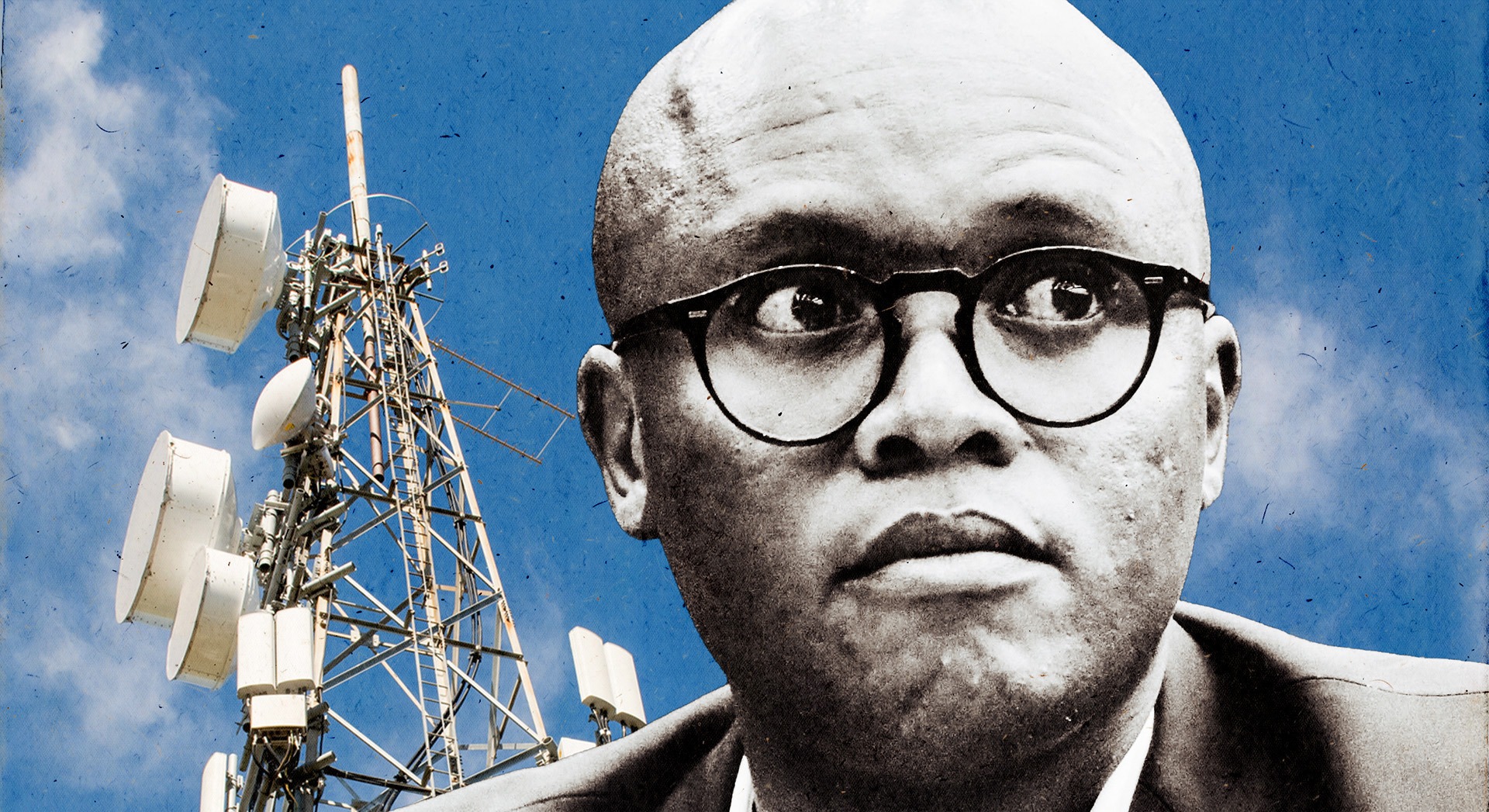
 Illustrative image: Minister of Communications and Digital Technologies Solly Malatsi. (Photo: Gallo Images / OJ Koloti) | Cellphone tower. (Photo: iStock)
“You always have to expect the Starlink question,” said Deputy Minister of Communications and Digital Technologies Mondli Gungubele when asked whether he had been briefed ahead of his fireside chat on stage at Bloomberg’s 2026 Africa Business Media Innovators conference at Arabella in Kleinmond on Monday.
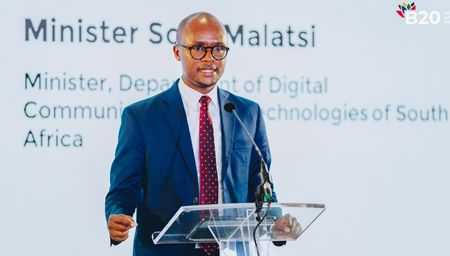
Asked whether South Africa needed more investment in the communications industry – building a case against the government’s insistence on enforcing equity ownership rules – Gungubele retained his composure:
“We always need more. That’s why the president is crisscrossing the world saying, ‘We are ready’... Ready for business because we want more... We want to speak about multinational cooperation, private investment and we are saying ‘in South Africa you know where we come from’... It should not be ridiculous, therefore, to say when you invest here, can you get along with us, work with us in this journey of improving, minimising inequality.”
Then he stared directly down the barrel of the nearest camera and addressed Elon Musk directly about the Starlink question. “I hope he is listening,” the deputy minister said to the digital film.
“What is 30%? [The black ownership requirement under BBBEE regulations.] If you take into account it’s 70% value that you’re going to make in terms of his profit and everything, right? He would have had an opportunity to work here, sell his business [products] and invest very significantly in the country of his birth.”
/file/dailymaverick/wp-content/uploads/2025/09/13109208.jpg "Elon Musk has recently experienced a few setbacks – and a black eye – but things appear to be going right for him in some areas of his business life. (Photo: Francis Chung / EPA / POOL)")
Not on the same frequency
When Daily Maverick asked him in an interview afterwards to clarify the department’s stance on the legacy Wireless Open Access Network (Woan) – conceived two spectrum auctions ago under the then minister, Stella Ndabeni-Abrahams – Gungubele instead pointed to a policy framework scrapped last Friday.
“If you do not allow SMMEs to have access to levers of economy like spectrum, you are actually suicidal in terms of thinking that you want to be one of the leading economies in the world.”
Wait, what’s a Woan?
Good question… It is a shared wholesale telecommunications network where a single network infrastructure is used by multiple retail service providers instead of competing companies building separate infrastructure.
The concept was initiated and planned by the government through the Department of Communications and Digital Technologies under the SA Connect programme and the Integrated ICT Policy White Paper – the spectrum auction bidders had to pool a small percentage of their allotment so that government could distribute it to SME network operators to administer open access networks in underserved areas.
At least, that was the plan.
The regulatory framework and licensing process were driven by the Independent Communications Authority of South Africa (Icasa). However, plans to officially launch and license the national Woan were ultimately delayed and officially scrapped at the weekend before full implementation.
Gungubele did not seem privy to Malatsi’s movements at the weekend, even though the minister issued a media statement announcing the formal finalisation of an amendment to the 2019 Policy on High Demand Spectrum and Policy Direction on the Licensing of a Woan on the DCDT’s official media WhatsApp group.
“Spectrum that sits unassigned is not neutral,” said Malatsi. “Every year it remains unused is a year of coverage not extended, congestion not relieved and investment not made. This amendment removes an obstacle.”
If you turn/scroll all the way to page 132 of National Government Gazette No 55,438, you will find the grand plan in three moves.
/file/dailymaverick/wp-content/uploads/2023/03/NTE_8205.jpg "Minister in the Presidency Mondli Gungubele. (Photo: Ntswe Mokoena / GCIS)")
First, the minister formally revokes the reservation of high-demand spectrum (in the 700MHz, 800MHz, 2600MHz, and 3500MHz bands) originally earmarked for a single wholesale network.
Then he withdraws the ministerial directive that instructed Icasa to license a Woan, and finally he releases the unassigned spectrum back to Icasa to license under its statutory powers.
“The decisions about how and to whom this spectrum is licensed are for the regulator, and they remain entirely with the regulator,” the statement continued before inflicting what can be interpreted as a brutal blow to the former regime:
“More than seven years since, no such network has been licensed and the spectrum identified for that purpose has remained substantially unassigned.”
Revealing the hand
The move was ice cold, but Malatsi has a point. The 2022 competitive spectrum auction raised R14.4-billion for the national fiscus while enforcing strict Level 4 BBBEE contributor status and 30% ownership by historically disadvantaged individuals as pre-qualification conditions.
In the explanatory note, the minister cites international failures of single wholesale models, such as Rwanda’s decision in June 2023 to end KTRN’s 10-year wholesale exclusivity due to slow roll-out and low uptake.
Malatsi’s primary goal is to decisively kill off a failed policy experiment and release trapped national assets into the economy, relying instead on established mobile network operators to build out infrastructure, while enforcing wholesale access and facilities leasing via regulatory oversight rather than a single state-backed vehicle.
It’s a game of economic poker and the Vodacom/Maziv merger terms and conditions demonstrate Malatsi’s nerve at the table. Well played. DM
Daily Maverick sent questions to Malatsi to clarify his decisions. Here is his response in full and unedited:
The amendment brings finality to the wholesale open access network as conceptualised at the time.
As indicated in the press statement on Friday, the decisions about how and to whom this spectrum is licensed are for ICASA to make and they remain entirely with the regulator.
The amendment does not direct ICASA to license the spectrum, and does not prescribe how any licensing process should be designed.
Those matters fall within the ICASA powers under sections 30 and 31 of the Electronic Communications Act, 2005, and the regulator exercises them independently.
The amendment does not affect the requirement, under the Next Generation Radio Frequency Spectrum Policy for Economic Development, 2024, that the Authority set aside spectrum for use by the State Digital Infrastructure Company.
It is worth emphasising that the policy objectives that apply to the assignment of high demand spectrum are retained.
These include the obligation on licensees to lease networks and facilities and provide wholesale capacity to other licensees, subject to the Authority’s oversight; universal access and universal service obligations in rural and under-serviced areas; the prohibition on a single entity controlling the spectrum; and compliance with empowerment requirements. DM
Comments
Scroll down to load comments...