



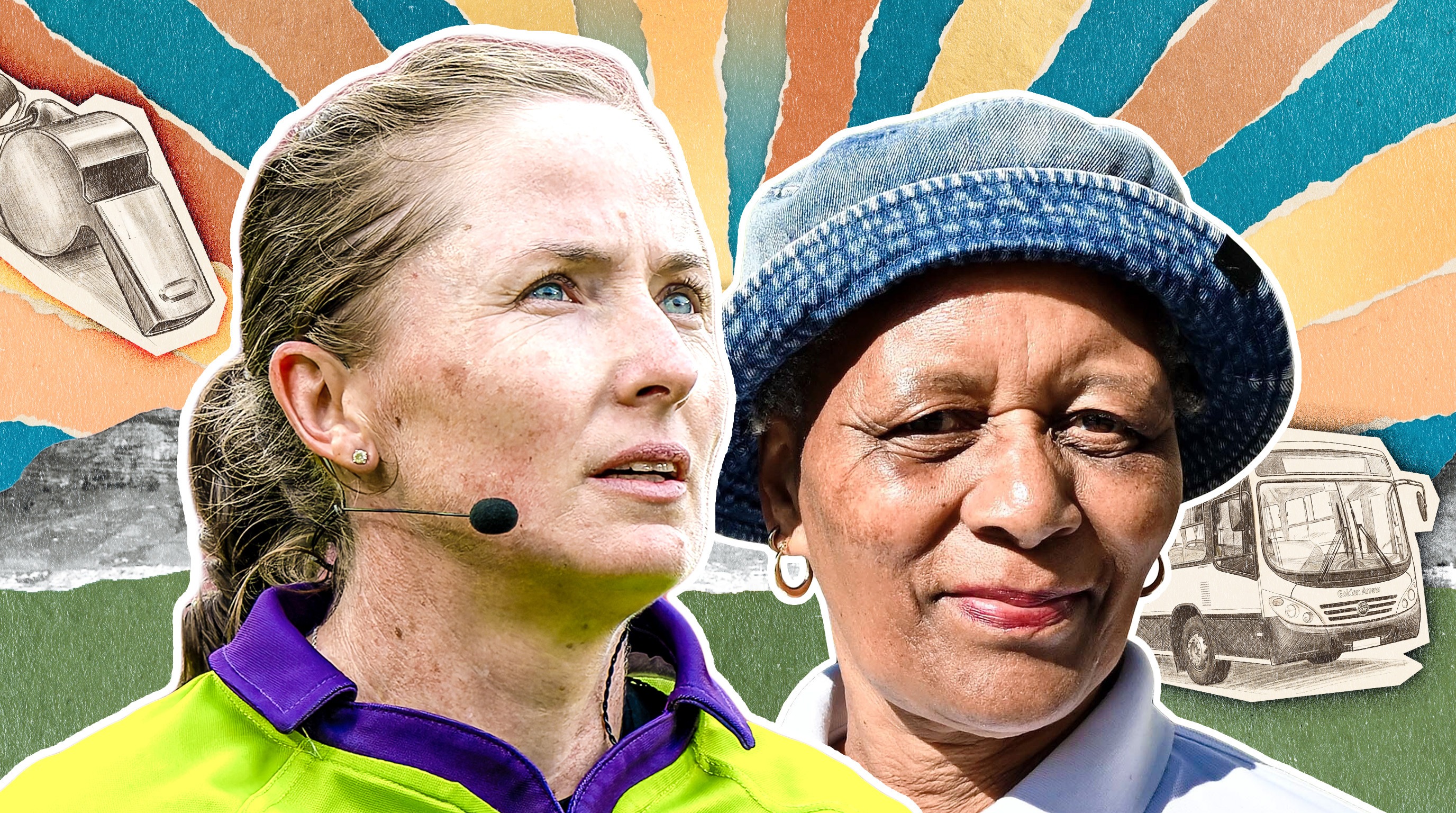
 Aimee Barrett-Theron (Photo by Anton Geyser/Gallo Images) | Joyce Witbooi (Photo: Nasief Manie/Spotlight/Daily Maverick | Table Mountain (Photo: iStock) | Whistle and bus elements generated with Google Gemini Flash Image 2.5.
/file/attachments/orphans/Cancer-Breast02_113897.jpg "South Africa's cancer story")
South Africa’s beloved, world-renowned rugby referee Aimee Barrett-Theron was diagnosed with breast cancer just days before her 39th birthday in June 2026. Initially, she did not panic after discovering a lump in her breast, as she is healthy and fit, with no family history of breast cancer. But five days after being examined by her doctor, she received the news.
“It might be weird to say, but it was a relief to get an answer so quickly even though it wasn’t the answer I wanted,” says Barrett-Theron, who grew up in Durban and started her own rugby career playing for the KwaZulu-Natal women’s team.
/file/attachments/orphans/Cancer-Breast03_487253.jpg "First professional female referee of South Africa Rugby, Aimee Barret-Theron poses for a photo during an interview in Pinelands on December 07, 2021 in Cape Town, South Africa. It is reported that in October, Barret-Theron was the first South African womenís referee in the United Rugby Championship. (Photo: Gallo Images/Rapport/ Edrea du Toit)")
Barrett-Theron is the first South African woman to be signed as a full-time professional rugby referee.
“I have two lumps in my breast and then some cancer in my lymph as well. So that’s why the treatment plan is quite aggressive,” she says.
Her diagnosis is stage two; with cancer stages one through to four describing how far the disease has spread in the body. Barrett-Theron says that after being diagnosed, her outlook was: “Doc, what’s the plan? Let’s go”. She says she is intent on “getting back on the field” soon, as she tackles the disease systematically as she would a high-stakes fixture.
/file/attachments/orphans/Cancer-Breast7_213025.jpg "Assistant referee Aimee Barrett-Theron (South Africa) in action during the United Rugby Championship match between Lions and Hollywoodbets Sharks at Ellis Park on February 21, 2026 in Johannesburg, South Africa. (Photo: Anton Geyser/Gallo Images)")
Wearing a black cap, Barrett-Theron is speaking to Spotlight and Daily Maverick from her home in Pinelands, Cape Town. She takes the Zoom call in her family’s spare room, which doubles as her study where she watches rugby games for later analyses. She lives with her wife Zaandré and their three-year-old daughter Harper, who occasionally joins mum on the field after major games.
/file/attachments/orphans/Cancer-Breast8_261934.jpg "Rugby referee, Aimee Barrett-Theron wins won Technical Official of the Year during the 19th Annual South African Sport Awards at Sun City Superbowl on August 23, 2026 in Sun City, South Africa. (Photo: Adnaan Mohamed/Gallo Images)")
A day before our conversation, Barrett-Theron returned from Sun City where she was named Technical Official of the Year at the South African Sport Awards. “Such a nice surprise and a nice little booster,” she says. “When my name was called, I was just like, wow! Putting on my blazer and going up on stage, just the cheers I got, the support, the people who came up to me afterwards. It was exactly what I needed, given the time that I’m in.”
Midway through chemotherapy treatment
Despite her bright countenance, during our interview Barrett-Theron says she is experiencing “chemo fog”. She is halfway into her chemotherapy treatment plan, which started the first week of July. Given the chemo side effects, she says every day is different and hard to predict. “Some days I can almost carry on as normal,” she says. “I’m still active, seeing friends and working. And some days I can’t get out of bed. But you only know when you wake up.”
/file/attachments/orphans/Cancer-Breas103_746282.jpg "Global incidence of cancer by type of cancer for females 2024")
Alongside her professional refereeing career, she is a biokineticist specialising in sports performance and rehabilitation.
Barrett-Theron’s chemo plan at the Life Vincent Pallotti Hospital in Pinelands involves a a six-hour intravenous infusion every three weeks.
Wryly, she notes, she has a beautiful view of Table Mountain from her seat in an armchair in the chemo ward. “You take the perks with essentially the poison that’s going into your system,” she says. “I try and make it as productive as possible, I’m not going to sit there and mope. Actually, I’ve had some wonderful conversations with the people on either side of me when I’m in the chemo ward.”
“My first time there, I noticed that I was the youngest, probably by about 15 to 20 years. And that was quite hard. But later, I saw people around 18, 19, 20 years old. And yes, it was a reminder to me that everyone’s on their own journey, and it could affect anyone at any stage,” she says.
/file/attachments/orphans/Cancer-Breast05_312236.jpg "Female mortality crude rate per 100 000")
Of her six-hour infusion, she says: “It’s pretty much just working through all the different drugs and flushing out the system and putting the next one in. And then there’s a wonderful big injection that goes into my leg. And then they give you medication to help you manage your side effects as best as possible.”
“I never in my wildest dreams anticipated the response. Every single message, I’ve read them all. For me, it was important to use my profile to inspire women in this situation as well. To use it as a positive, I mean if you can put cancer and positive in the same sentence.”
An outpouring of kindness after Barrett-Theron went public with her diagnosis – she has posted on Instagram that she is stepping back from rugby to focus on her health – stirred deep emotions for her. “I never in my wildest dreams anticipated the response. Every single message, I’ve read them all. For me, it was important to use my profile to inspire women in this situation as well. To use it as a positive, I mean if you can put cancer and positive in the same sentence.”
‘Mummy’s silly hair’
How did she explain her diagnosis to Harper? “We had age-appropriate conversations,” says Barrett-Theron. “You know, mom’s a bit sick at the moment, so I’ll be sleeping. And she has been so sweet, bringing me her toys to make me feel better. The next step was losing my hair. And obviously toddlers are not polite; they’re pretty direct. So I explained mummy’s sick, I’m going to lose my hair. And she was like, okay. And now she calls it mummy’s silly hair, putting this sweet perspective on it.”
After losing her hair, removing her cap on the Sea Point promenade was a milestone: “The day I shaved my head, we went out to the promenade for a walk. It was a beautiful sunny day; the promenade was just the place to be. And I decided, this is my new look. I’m in control of this, I’m going to take my cap off and just be natural, be bold,” she recalls.
According to the World Health Organisation’s Global status report on cancer 2026, there were 2.4 million new cases of breast cancer worldwide in 2024 (this is roughly the entire population of Lesotho) with survival outcomes largely determined by how early it is diagnosed and treated. Breast cancer is the most diagnosed cancer in women in South Africa, accounting for roughly one in four cases. The International Agency for Research on Cancer estimates that more 13,000 women in the country newly develop breast cancer every year, while the disease claims about 5,000 lives.
As an employee of SA Rugby, Barrett-Theron has access to private healthcare. In South Africa’s public sector, however, backlogs often impede access to such timely life-saving interventions.
/file/attachments/2998/JoyceWitbooi007_462929.jpg "Joyce Witbooi - she is an amazing breast cancer survivor who supports people in her community, helping them travel to hospitals for cancer treatment.
<br>
<br>Photos by Nasief Manie/Spotlight
<br>")
Breast-cancer awareness
At the foot of Table Mountain in Groote Schuur Hospital, Joyce Witbooi meets with Spotlight and Daily Maverick inside a pause room off the hospital’s main corridor. With slow deliberation, the 66-year-old grandmother recounts being diagnosed with breast cancer at Groote Schuur in 2010. Witbooi, who prepared tea and cleaned at an inner-city business before her retirement, also detected the lump herself. Having heard breast-cancer awareness messaging on the radio, she says she scheduled an appointment with a public-sector doctor.
“I’m one of the few people in my community who is supportive about cancer,” says Witbooi. “People hide it; it’s a secret. At funerals they say, ‘How did God bring this onto our family?’.”
Witbooi relays how her own husband, Buthi, hid what she suspected had been a lung cancer diagnosis from her. Buthi visited the Mitchells Plain District Hospital in secret, she says, before he passed away two years ago.
Costs and waiting time
Witbooi recalls the day of her own stage-one diagnosis: in the Golden Arrow bus back from the hospital to her home in Philippi East, she did not cry. She waited three months for breast surgery. Three weeks after the operation, she started chemotherapy for six months, followed by radiotherapy.
/file/attachments/orphans/JoyceWitbooi011_660590.jpg "Joyce Witbooi who was diagnosed with breast cancer at Groote Schuur Hospital in 2010 now helps breast cancer patients navigate the public healthcare system. (Photo: Nasief Manie/Spotlight/Daily Maverick)")
“The chemo, it is not an easy journey. You’re getting weak and tired and you don’t feel like eating,” she says. Witbooi says her treatment cost R35 per hospital visit, which accumulated rapidly. The hospital put her on a payment plan though, and she paid off her debt in monthly increments of R50.
Groote Schuur spokesperson Esethu Madlwabinga says that the hospital’s fees are based on a structure set out by the Western Cape Department of Health and Wellness, which takes into account each patient’s financial capacity. “Some patients may be required to pay a nominal fee for services while others qualify for fully subsidised care,” she says.
Madlwabinga adds that between 500 to 600 new breast cancer cases are diagnosed at Groote Schuur each year. Treatment extends over months with different treatment plans depending on the tumour’s make-up, its size and the patient’s overall health. Currently, the waiting time for breast cancer surgery at Groote Schuur is about eight weeks, she says, with between 50 and 70 patients waiting for surgery at any given time.
Cancer survivor and warrior
Sixteen years after her diagnosis, Witbooi is healthy, her words laced with humour. Known as a “cancer warrior” in her community, she helps breast cancer patients navigate the public healthcare system. For instance, she helps arrange free transport offered to cancer patients and brings them meals at their homes. She also founded the Sinethemba Survivors (“we hope”) support group, and three years ago qualified as a peer support volunteer through the breast cancer awareness non-profit Reach for Recovery. With pride, Witbooi reaches into her handbag to show me her peer support volunteer certificate.
In this capacity, Witbooi presents motivational speeches to breast cancer patients at the Mitchells Plain and Khayelitsha district hospitals. At Groote Schuur, she visits patients, particularly after surgeries linked to Project Flamingo, the non-profit that coordinates free breast-cancer operations by medical specialists who volunteer their time on weekends.
Project Flamingo
“Project Flamingo does operations, maybe eight people on a Saturday, each month,” says Witbooi. “They’re special [volunteer] doctors. So after the operations, we visit the patients in the wards to give them care bags and to talk to them. Sometimes they’re so glad to see me, because maybe they don’t have other visitors. And I give them my number, in case there is something they want to ask to me. Not about medication, that’s the doctor's side; about the journey, the side effects, emotional support.”
Cape Town specialist breast and endocrine surgeon, Dr Liana Roodt, established Project Flamingo at Groote Schuur in 2010. Since then, it has expanded to Tygerberg Hospital in Cape Town, George Hospital, Livingstone Hospital in Gqeberha, Cecilia Makiwane Hospital in Mdantsane, Robert Mangaliso Sobukwe Hospital in Kimberley, and Charlotte Maxeke Johannesburg Academic Hospital. The project has been instrumental in decreasing waiting times for life-saving surgery and treatment. It would have coordinated around 100 surgeries this year at Groote Schuur, and a total of 320 around South Africa.
Reflecting on their ethos, Roodt says: “In the public sector, delays occur throughout the entire patient journey – not only for surgery, but also in diagnosis, imaging, biopsy, pathology, staging investigations, oncology appointments and treatment. These cumulative delays are often measured in months rather than weeks and have a direct impact on patient outcomes.”
/file/attachments/orphans/Cancer-Breast01_603676.jpg "Dr Siphiwe Mhlanga and Dr Hunadi Molabe (right) are part of Project Flamingo's volunteer doctor team at Groote Schuur. They perform breast cancer surgeries over weekends in their off time, to reduce waiting time for these life-saving operations. (Photo: Lou-Ann Stone)")
Support and love to all affected
Spotlight and Daily Maverick spoke with Barrett-Theron at the end of August, in the week leading up to the second Test match of the Rugby’s Greatest Rivalry tour – between the Springboks and the All Blacks – at the Cape Town Stadium. Barrett-Theron said she planned on attending the game.
“I got tickets before I found out about my cancer diagnosis,” she said. “And yes, I am still planning on going. I’ll probably have to wear a mask. And I’ll avoid people in general [as chemotherapy compromises the immune system]. It’s going to be nice to take my ref hat off, and to just all out support the Springboks.
Wrapping up our conversation, Barrett-Theron added that she wanted to send a message of support to everyone affected by cancer.
“Chemo treatment can be so isolating; everyone’s going on with their own lives and doing normal things. And you’re like, ‘Oh, well actually I’m feeling quite terrible’. So yes, I also just want to connect with other people who have been affected by cancer, whether it’s personally or within their family or close friends. I’d love to put out support to everyone dealing with this.” DM
‘SA’s cancer story’ is a special series of articles on cancer in South Africa jointly produced by Spotlight and Daily Maverick. This is the first article in the series.
In upcoming articles, the series will delve into issues such as accessibility and affordability of different cancer treatments, cancer care in rural South Africa and whether cancer rates are increasing in South Africa. The reason for starting the series with the stories of Witbooi and Barrett-Theron is that cancer does not appear in a vacuum. It develops in the bodies of individual human beings, within the deeply personal contexts of their lives.
Comments
Scroll down to load comments...