




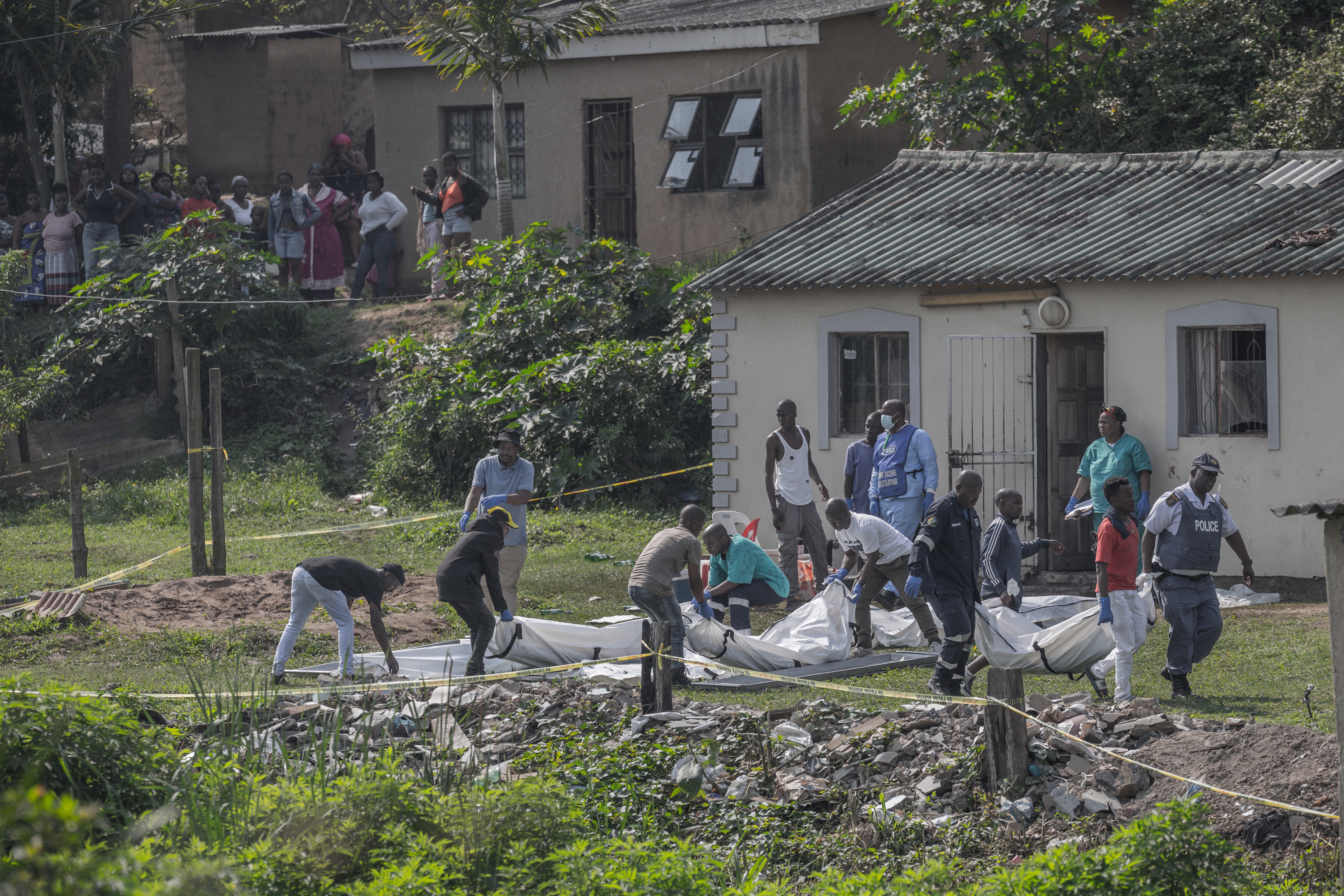
 South African forensic pathology personnel are helped by community members to carry the bodies of victims after a mass shooting in the Ziko area of KwaMakhutha, south of Durban, on 23 September 2026. Twelve people, including a pregnant woman, were killed. (Photo: Rajesh Jantilal / AFP)
On the evening of Saturday, 26 September, shots rang out at Dora’s Tavern in Carletonville, Johannesburg, when eight men, armed with AK-47 rifles and pistols, stormed the establishment and opened fire on patrons.
The attack resulted in the deaths of 17 people – 13 men and four women, while 15 others were injured.
/file/attachments/orphans/Lerato-Carletonville-Massacre2_278918.jpg "Members of South Africa's Forensic Pathology Service and South African National Defence Force (SANDF) inspect and secure the scene where gunmen armed with assault rifles stormed a bar in Johannesburg on September 27, 2026. Gunmen killed at least 27 people in two mass shootings in South Africa's two main cities, police said on September 27, 2026, in the latest violence to hit the crime-weary country.
<br>The first incident occurred at around 1930 GMT on September 26, 2026 when eight gunmen armed with assault rifles stormed a bar west of Johannesburg and shot 17 people and wounded 15 others.
<br>The suspects opened fire on customers drinking outside and then moved inside to continue shooting, police said. (Photo: EMMANUEL CROSET / AFP)")
The South African Police Service (SAPS) in Gauteng is now on the hunt for the eight attackers who allegedly stole phones off some victims before fleeing the scene in two unidentified vehicles. The SAPS also reported that two vehicles were set alight at the time of the mass shooting.
Several hours later, a similar scene unfolded about 1,300km away when armed men opened fire on party-goers in Lwandle, Cape Town, shortly before 2am on Sunday, 27 September.
Western Cape police said 10 people died in the incident – five at the scene and the remaining five while being taken to hospital. Eleven people were wounded in the mass shooting.
‘Alarming trend’
When viewed in isolation, this weekend’s shootings could appear to be uncommon events, but the Global Initiative Against Transnational Organised Crime (GI-TOC) says the incidents were part of an alarming trend that had seen at least 196 people killed in mass shootings in 2026 alone.
The latest mass shootings come days after armed men stormed a house in KwaMakhutha, Durban, killing 12 people, including a pregnant woman, in the attack.
It is considered a mass shooting when three or more people are killed in a single event.
Julian Rademeyer, senior adviser at GI-TOC, told Daily Maverick that this weekend’s killings were a concerning spike in mass shootings related to organised crime.
“We have had 41 mass killings in South Africa since January this year; that’s plus or minus 196 people killed. We do believe it is an undercount because some incidents go underreported, but this is our attempt to try to get a grip on the scale of this. On these numbers, it’s frightening. If it’s an undercount, it’s terrifying,” Rademeyer said.
While the SAPS’s latest quarterly crime stats showed a decline in murder nationwide, with the count illustrating a 5.9% decline between 1 April and 30 June, organised crime and gang violence remain a problem.
/file/attachments/orphans/Lerato-Carletonville-Massacre8_787324.jpg "A map sHowing mass killings in South Africa in 2026")
Rademeyer said the spike in mass killings was largely driven by individuals and syndicates trying to control specific criminal markets or territorial areas.
With 17 people killed in the Carletonville shooting, the incident has surpassed the 9 June 2026 Jumpers massacre in Cleveland, Johannesburg, in which 13 people were killed, to become the deadliest mass casualty event in South Africa in 2026.
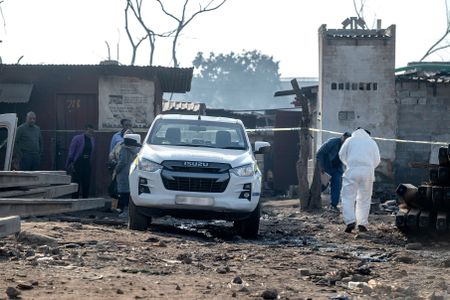
Joburg killings motive
Addressing the media at the scene of the Carletonville Massacre, deputy provincial police commissioner Major General Fred Kekana said that the incident may have been a retaliatory attack for an incident in August in which one person was killed and another wounded.
“It’s linked, from our view for now, to a retaliation by another group because one of the deceased here is one of the people we were looking for and [was] apparently linked to the other incident,” Kekana said.
The deputy commissioner added that police managed to obtain a “clear picture of the suspects” during investigations at the scene.
/file/attachments/orphans/Lerato-Carletonville-Massacre3_327305.jpg "A dog walks among debris at an entertainment venue in Somerset West on September 27, 2026, after armed gunmen stormed the premises. Gunmen killed at least 27 people in two mass shootings in South Africa's two main cities, police said on September 27, 2026, in the latest violence to hit the crime-weary country.
<br>In a shooting at an entertainment venue in a township outside Cape Town early on Sunday, gunmen killed 10 people and wounded 11 more. Five of the victims were declared dead at the scene while the others succumbed to their injuries while being taken to hospital. (Photo: GIANLUIGI GUERCIA / AFP)")
While Kekana didn’t indicate whether the incident was linked to organised crime, and SAPS have not released an official motive, Rademeyer raised two possibilities: illegal mining or extortion.
“I suspect it will turn out that Carletonville was linked to illegal mining... That is very much in the goldfields area... so the assumption at this point is that I would think this might be linked to illegal mining, or extortion is the other option,” he said.
In August, the National Intervention Unit killed an alleged illegal mining kingpin during an intelligence-driven tracing operation in Carletonville.
“The deceased suspect was known to police as one of the dangerous illegal mining kingpins operating in the Carletonville area. He is believed to have played a central role in the ongoing conflict between two rival illegal mining groups in the area,” an intervention unit statement said.
“The real tragedy of that is these are often sort of reprisal attacks or some form of vengeance, or in some cases they may be targeting a specific individual, and then bystanders get caught up in the crossfire,” Rademeyer said.
SAPS challenges in combating organised crime
As criminal networks continue to launch attacks across the country, the SAPS is battling to tackle organised crime, undermined by a lack of resources, crippling fear within communities and systemic internal corruption.
Rademeyer said that in many rural communities and informal settlements, local police officers simply did not possess the firepower or protection needed to confront syndicate operatives armed with military-grade weapons.
Compounding this fear is the reality that syndicates have systematically infiltrated local law enforcement precincts.
“Tragically, in many cases, police stations have been infiltrated by corrupt elements and are on the payroll of, for instance, illegal mining networks or gang networks. You know, they use police vehicles to ferry gold ore in some instances.”
Rademeyer said that beyond this, policing strategies themselves were flawed. Multiagency operations often resulted in the mass arrests of low-level workers – the “cannon fodder” of criminal enterprises—while leaving the ringleaders, financiers and illicit supply chains entirely untouched.
A uniquely South African crisis?
According to Rademeyer, when compared internationally, South Africa’s wave of mass killings presents a distinct and complex challenge.
He said that in many high-violence regions across Latin America, mass killings were predominantly tied to a single dominant illicit industry: the narcotics trade. But in South Africa, the violence is driven by a wide ecosystem of competing criminal enterprises, ranging from gang wars and illegal mining to protection rackets, extortion and taxi violence.
“So I think that’s the unique South African challenge that we face. And a state which seems to be, you know, somewhat hamstrung in how it responds to this because of the levels of corruption, the lack of resources, the disarray in … police crime intelligence,” he said. DM
Comments
Scroll down to load comments...