



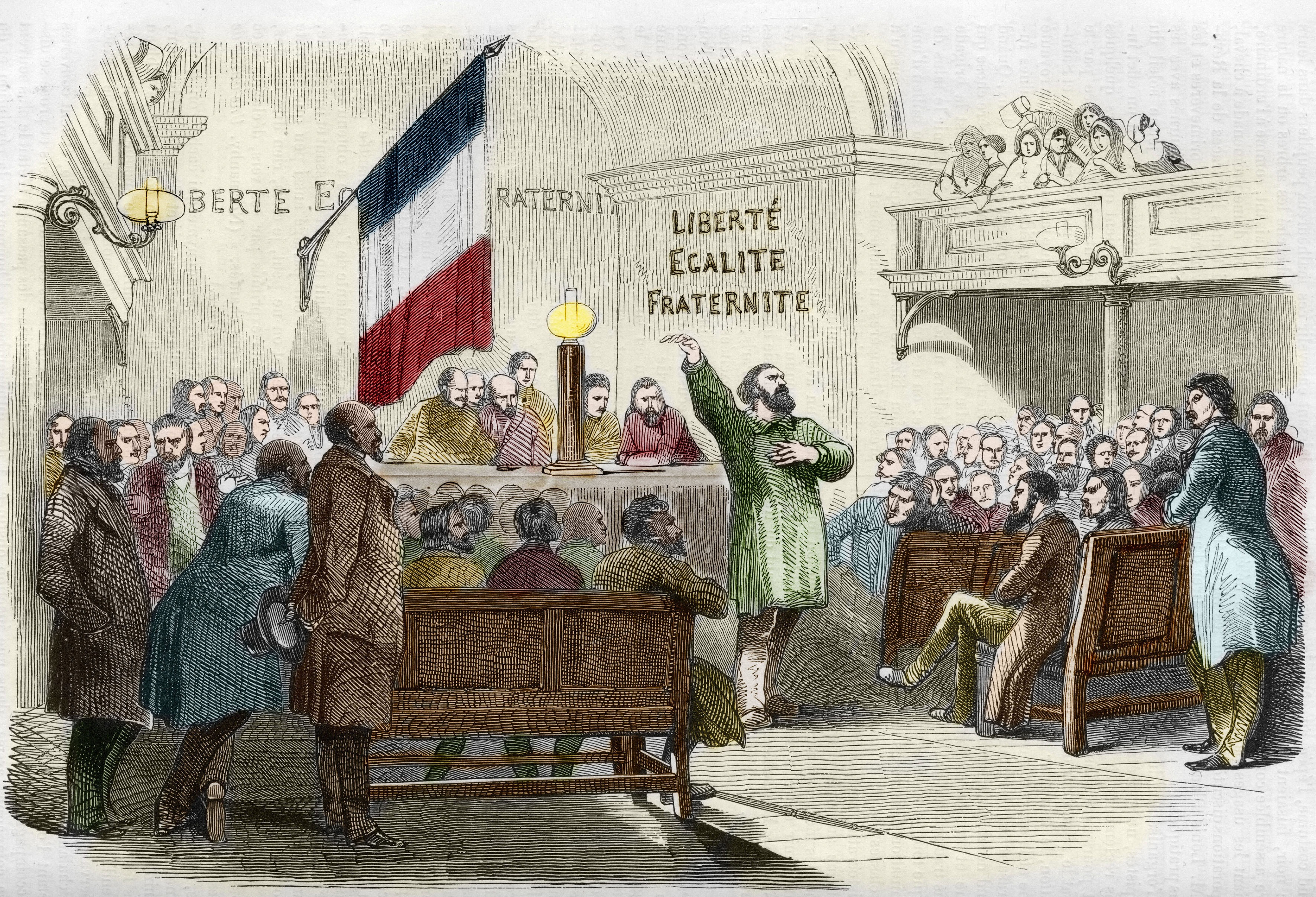
 An engraving of the Republican Club meeting in Paris in 1848. Unknown artist, 1801-1900. Location: Private Collection Medium: Engraving. (Photo: Bridgeman Images via AFP)
Consider such well-known political slogans from the past:
“Bread, Peace, Land” (from the Russian Revolution);
“It’s the Economy, Stupid” (Bill Clinton’s first presidential campaign);
“We Never Had it so Good” (UK Prime Minister Harold Macmillan in 1957);
“Fight Back” (the South African Democratic Party’s slogan years ago);
“A Chicken in Every Pot” (US President Herbert Hoover’s ill-fated campaign slogan just before the Great Depression);
“A Better Life for All” (the famous ANC campaign slogan);
“Workers of the World – Fight and Unite for a White South Africa” (the Communist Party’s chant in the Rand miner’s rebellion of 1922);
“Ein Volk, Ein Reich, Ein Führer” – One people, one realm, one leader (the German National Socialist Party’s slogan in 1932);
“In Your Heart You Know He’s Right” (Republican Party presidential candidate Barry Goldwater’s slogan in 1964);
Make America Great Again (the Trump campaign motto);
Liberté, Égalité, Fraternité – Liberty, Equality, Fraternity (the French Revolution);
“Life, Liberty and the Pursuit of Happiness” (the American Revolution).
Slogans such as these from the past 250 years set out political positions that became well understood as standing for bigger ideas. Short phrases such as these obviously were not scholarly examinations of political alternatives and detailed policy platforms. Instead, they were designed to connect with the yearnings of people, connecting at an emotional, sometimes even subconscious level.
The power of such slogans often relies on the use of a triplet, a hendiatris. Classical Roman and Grecian rhetoric often aligned three deities in triplets to add power to their message.
Triplets also figure elsewhere such as with Abraham, Isaac and Jacob, or the Father, the Son and the Holy Ghost – demonstrating the device’s power. Speechwriters and speechgivers still understand the device’s power and continue using it. Think of Abraham Lincoln’s “of the people, by the people, for the people”, to name just one example of a triplet that has become a global phrase.
The magic of such slogans – whether in electoral battles or revolutionary movements – is that they seem to deliver a simple clarity that can allude to much larger meanings, and sometimes very dark ones. Audiences are thus encouraged to imagine the rest of the discussion such as who will be the winners and who will be losers in any political struggle.
/file/attachments/orphans/Brooks-Politicalslogans13_462110.jpg "United States Senator and nominee for president, Barry Goldwater (1909 - 1998) speaking at an election rally in Madison Square Garden, New York City, USA, 28th October 1964. (Photo: William Lovelace/Daily Express/Hulton Archive/Getty Images)")
/file/attachments/orphans/Brooks-Politicalslogans14_829794.jpg "A bustling black and white halftone print depicting a large crowd gathered at an outdoor fairground or public event. Numerous tents and banners, including those for 'Ford Bro' and 'Fred Robinson', are visible, capturing the lively atmosphere of a late 19th-century assembly. (Photo: iStock)")
There is no need to spell out the so-called real causes of listeners’ discontents and misfortunes – whether it is the corrupt super-rich, immigrants or a particular ethnic, racial and religious minority or even gender orientation – in boring detail. To do that risks alienating potential supporters put off by complex or morally challenging specifics.
Instead, such slogans are meant to mobilise and consolidate support from potential supporters or among those already in the speaker’s corner. In this way, the latter are assured they’re in “the know” about what’s really going on.
The disengaged voter
In the context of American politics, commentators and politicians of the right castigate minorities, lower-income persons, undereducated individuals and – often – women as easily swayed, so-called low-information voters tempted by promised government giveaways.
Meanwhile, those on the left can be heard arguing that low-information voters are a mirror image of that portrait. They are really those out-of-touch, older, rural and small-town, undereducated people clinging to outdated, conservative pieties.
Here is where the impact of low-information or disengaged voters conjoins with political slogans and memes. Political scientists and polling specialists estimate that in the US, 15% to 20% of eligible voters fall into that category. In countries with lower levels of literacy and income levels, percentages may be still higher.
(We are all probably familiar with individuals who have said, even as they stand in line to vote, that they still don’t know who they are going to vote for, or perhaps they like the look of candidate A vs candidate B better. That is the low-information voter, personified.)
/file/attachments/orphans/Brooks-Politicalslogans11_264152.jpg "Cyril Ramaphosa (Presidentof South Africa) during the ANC Siyanqoba Rally At FNB Stadium on May 25, 2024 in Soweto, South Africa. Political parties are making their final pushes to win your vote ahead of Wednesdayís elections. (Photo: OJ Koloti/Gallo Images)")
Meanwhile, in South Africa, since the inception of a non-racial democratic system, there has been a steady decline in the percentage of eligible voters actually voting, one election after the other.
Perhaps potential voters have turned away from the bother of politics to deal with the real exigencies of their lives instead. Others may have decided that voting and politics generate little or no change in their circumstances. Accordingly, they withdraw from the nation’s political life, muttering: “Politicians, they’re all the same. Nothing will change.” In this sense, anomie about the relevance of political circumstances continues to grow.
Around the time of the 2024 US election, the YouGov polling organisation described the low-information/disengaged voter: “Disengaged voters can be thought of as people who are registered to vote but do not follow politics closely. Demographically, disengaged voters more often are younger, more often are women, and are less likely to have a college degree than politically engaged voters…
“Although Americans have been characterised as uniquely engaged in civics and political society, this characterisation does not apply to all voters. Politically disengaged voters – often called low-information voters – can be thought of as people who might vote but do not follow politics closely and may have little civic knowledge.”
/file/attachments/orphans/Brooks-Politicalslogans12_425620.jpg "Herbert Hoover (1874 - 1964), Republican Party candidate for the Presidency of the United States of America, listening to a one valve radio set. (Photo: Topical Press Agency/Getty Images)")
It is reasonable to assume that, broadly speaking, disengaged voters are similar elsewhere, even in competitive local elections such as this year’s in South Africa (or America’s midterm one) in just a few weeks.
Such voters – given their numbers and assuming they voted – could hold the balance of power. This would be true even if they came to the polling station without examination of the current issues, let alone having undertaken a thorough reading of party manifestos or platforms.
If so, will many candidates’ electoral fates actually depend on how disengaged voters carry out this key civic function? If so, what is the role of journalists, commentators, educators and civic leaders in changing that dynamic somehow?
Collectively, perhaps such people spend too much time analysing or interpreting the granular textures of political party platforms and manifestos, but give too little attention to a fuller discussion of the serious financial and economic structural issues confronting whoever takes office.
Let us be real about it. No party or candidate will be able to solve every problem, deliver on every promise made and repair all the damage that has been done over the past years in the US or South Africa. But will those disengaged voters understand this conundrum?
But the almost inevitable inability to achieve even modest miracles from one round of voting may actually feed further voter apathy and feelings among the low-information/disengaged voters that politics is distant from citizens’ real concerns, thus fuelling a negative feedback loop even more inimical to citizen perceptions that politics and political decisions can actually have real effects.
/file/attachments/orphans/Brooks-Politicalslogans2_181370.jpg "Former US President Bill Clinton and former first lady Hillary Clinton applaud during the opening ceremony at the Obama Presidential Center in Chicago, Illinois, USA, 18 June 2026. The Obama Presidential Center in Chicago will serve as a civic hub, museum, library, and education project commemorating the presidency of Barack Obama. (Photo: EPA/VICTOR HILITSKI)")
Civic education
If this is the reality, real voter education, carried out collectively by political parties, civic institutions and the media, has a crucial task. Rather than simply exhorting citizens to vote or explaining the mechanics of voting, public education about active citizenry should focus on defining for voters the issues that must be addressed by whoever wins an election, and how such questions must be tackled by serious politicians and administrators.
This is a task that is well beyond the competing voices of political parties, and politics must be more than just a catchy slogan, or a clever meme or social media video. In fact, this should be a continuing feature of public education for all citizens, not just during the last two months before an election.
/file/attachments/orphans/Brooks-Politicalslogans8_788786.jpg "Picture taken on September 30, 1960 at New York showing British Prime Minister Harold Macmillan speaking as part of the UN General Assembly. (Photo: AFP)")
/file/attachments/orphans/Brooks-Politicalslogans7_253641.jpg "A volunteer hands out election booklet of the 'New People' party, in Moscow, Russia, 04 September 2026. Russia will hold its State Duma parliamentary elections from 18 to 20 September 2026. (Photo: EPA/MAXIM SHIPENKOV)")
/file/attachments/orphans/Brooks-Politicalslogans6_775958.jpg "British Prime Minister Harold Macmillan with US President John F. Kennedy, in Key West, March 1961 (Photo: Ann Ronan Picture Library / Photo12 via AFP)")
Admittedly, such a task is difficult, but it is central to the success of a nation. Political elders of the past understood this. In the US, as a cautionary tale, the teaching of what used to be called “civics” in virtually every high school in the country has increasingly fallen by the wayside.
And we see the baleful result in an increasingly uninformed electorate, battered by misinformation, disinformation and the general chicanery of bots via social media from political conjurers and professional sophists increasingly filling the airwaves, even as public debate and discourse shrivels. DM
Comments
Scroll down to load comments...