




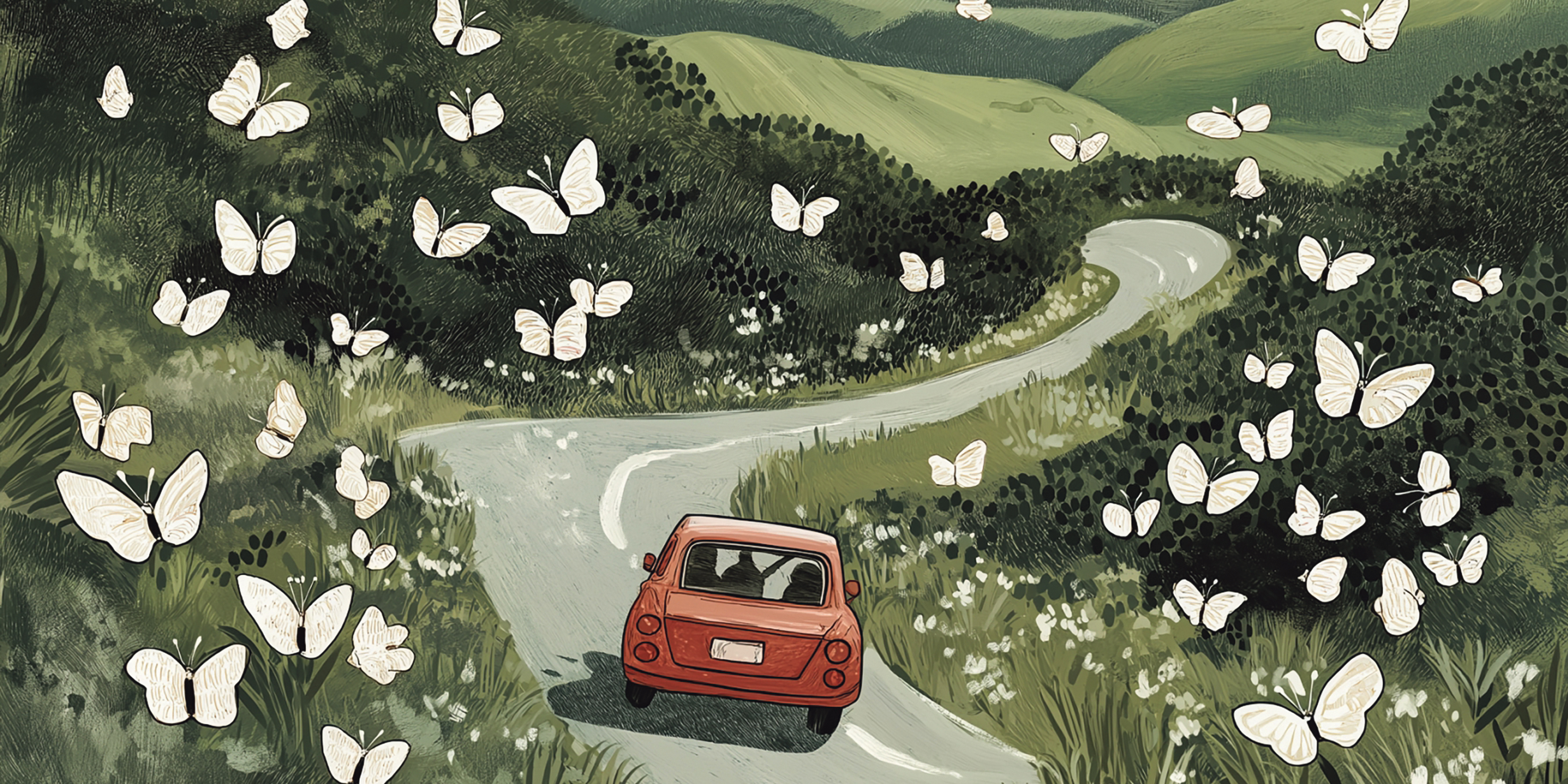
 (Illustration: Midjourney AI)
In the documentary series Life on Earth, Sir David Attenborough said: “In our hands now lies not only our own future, but that of all other living creatures with whom we share Earth.” Perhaps because for the first time in human history, our species holds in its hands the future of the planet and, as a result, the future or non-future of generations yet to be born. This includes not only our Homo sapiens offspring, but the offspring of all other animals and plants as well: we’ve got our finger on the button of our very own voyage to kingdom come.
To be fair, some of the ways we have begun to damage our planet were born from ignorance. For example, we just didn’t know what would happen to the ozone layer, the region of Earth’s stratosphere that contains a high concentration of ozone gas (O₃) and absorbs most of the sun’s harmful ultraviolet radiation. The layer developed a serious thinning, often referred to as a “hole,” because manufactured chemicals released chlorine and bromine into the atmosphere. But it is now healing thanks to global bans, a sign that we can indeed work together to protect ourselves and other species.
In 2015, the late US senator James Inhofe walked into the Senate holding a snowball and used it to argue that global warming wasn’t real, saying: “Look, it’s cold outside – how can the planet be warming?” Senator Sheldon Whitehouse responded by explaining that a single cold day – or even a single snowy week – doesn’t prove or disprove climate change and global warming.
Weather refers to what’s happening outside now or this week, whereas climate is the average weather over many years, in a region or across the planet. Think of it like this: weather is your mood today and climate is your personality over time. As Whitehouse put it: “You can believe NASA and their satellites, or you can believe the senator with the snowball.”
In France, wine-growing is slowly crawling north; the traditional southern winelands are becoming too hot and too dry while the north is getting milder and more temperate. Rising temperatures and severe droughts are altering wine profiles. Climate change and global warming are as real as the nose on your face.
Poets too sound the alarm, whether directly or indirectly, by praising our blue planet. Jay Parini’s Some Effects of Global Warming in Lackawanna County intones: “The maples sweat now, out of season. / Buds pop eyes in wintry bushes / as the birds arrive, not having checked / the calendars or clocks.”
Joy Harjo writes in Remember: “Remember the sky that you were born under, / know each of the star’s stories. / Remember the moon, know who she is. / Remember the sun’s birth at dawn, that is the / strongest point of time.”
But we’re not moving towards any dawn, are we? We’re instead hurtling in the opposite direction towards dusk, towards what we know is coming to kill us. The UN says Earth will soon pass the 1.5°C Paris Agreement warming limit.
/file/attachments/2998/5bf70b22a687621c6f90134711f8f03d_103088.jpeg "Image: iStock")
For a long time, people thought lemmings would get so overcrowded that they’d form huge groups and jump off cliffs into the sea to kill themselves. It was nothing more than a myth. But looking at how we’re wrecking the only planet we’ve ever had, with no spare Earth waiting for us, it kind of feels like we’re the ones actually “jumping off cliffs” to kill ourselves, and for what reason? No one can say. Only – in our case – it’s no myth. It has been scientifically recorded: we’re cranking the heat up on ourselves to end it all.
In the 1980s, politician Al Gore became one of the first prominent government leaders to warn the public about climate change. His opponents dismissed his concerns. George HW Bush (the father) even mocked him by calling him “ozone man”.
By 2008, political debate over environmental concerns had become even more heated. Politicians who supported expanding oil and gas production began using the slogan “Drill, baby, drill” at their rallies. Donald Trump picked up the catchphrase during his 2024 campaign and continues to use it repeatedly now that he has returned to the presidency.
Today, terms such as “tree hugger” are still used judgementally by some to deride environmental activists. They use them to suggest that protecting forests and wildlife harms businesses and threatens jobs. The label often portrays ecologists as unrealistic or overly emotional folks who value trees and animals more than economic growth or human livelihoods.
Many activists argue, however, that environmental protection and economic prosperity are not incompatible, and sustainable policies can preserve natural resources while creating secure, long-term employment.
But, as the voice in Fatimah Asghar’s poem I Don’t Know What Will Kill Us First: The Race War or What We’ve Done to the Earth puts it, continuing the title: “so I count my hopes / “the bumblebees / are making a comeback, one snug tight / in a purple flower I passed to get to you; / your favorite color is purple but Prince’s / was orange & we both find this hard to believe; / today the park is green, we take grass for granted.” I don’t know, either. Except that we do take the grass for granted.
We pave over meadows to build, spray wildflowers off our roadsides and treat a mown front lawn like a status symbol instead of what it really is – a living system. In so doing, we take food away from bees and butterflies, break up the habitats animals depend on and hurt the systems that keep soil healthy, air clean and our food supply stable.
And it’s the same everywhere. We cut down old forests for timber and palm oil, drain marshes to build houses, dump plastic and sewage into rivers and oceans, and burn fossil fuels until what has begun to happen to our fate becomes inevitable. DM
The Sound of the Stars (excerpt)
When I slept at my grandfather’s, in his hut,
I would sit with him, outside in the cool.
I would ask him about the sound which I heard,
which I sometimes seemed to hear speaking.
He’d say it was stars that were speaking.
“The stars say Tsau! They say Tsau! Tsau!”
By Stephen Watson
(The Lava of This Land:
South African Poetry
1960–1996, Northwestern
University Press, 1997)
Mountain
And when winter fell on the Malotis late that year,
The darkness, a mile above our heads, howled
And clobbered our names against the wind.
Flakes brushed our faces like foliage,
Rocks cut our hands, our resolve,
Dislodging visions of home.
We trekked on awhile
Until, near dawn,
The mountain
Swallowed
All of
Us.
By Rethabile Masilo
(Things That Are Silent,
Pindrop Press, 2012)
Rethabile Masilo is a Mosotho poet from Lesotho who lives in Paris, France.
This story first appeared in our weekly DM168 newspaper, available countrywide for R39. The e-edition of DM168 is now free for readers who are signed into their Daily Maverick account. Click on the cover of the newspaper below to access the e-edition.
/file/attachments/2998/DM-25092026-001_751207.jpg)
Comments
Scroll down to load comments...