




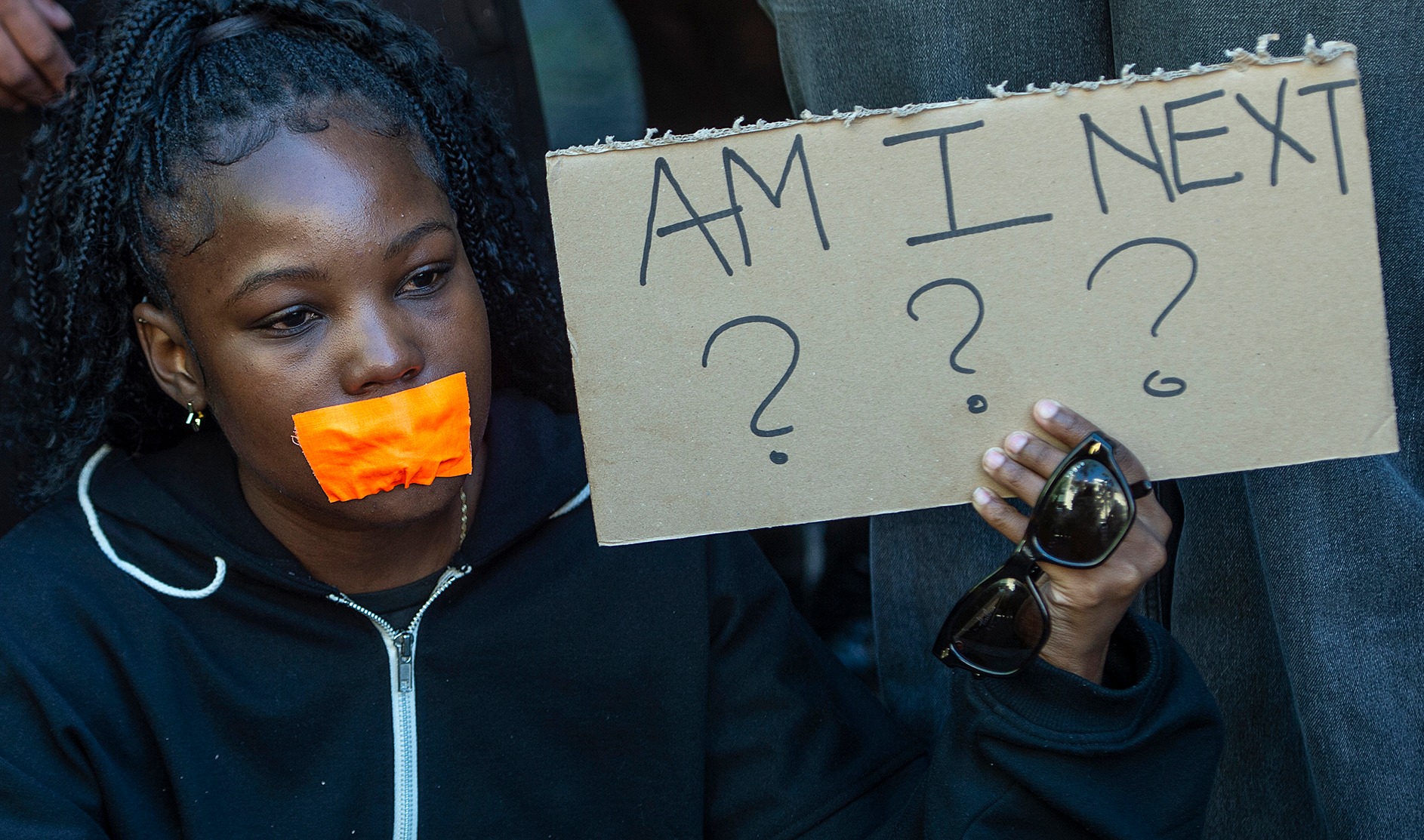
 Silent Protest Against Gender Based Violence. (Photo: Gallo Images / Brenton Geach)
What has the world become when more than half the population of women in South Africa cannot freely participate in ordinary activities they love like jogging without fear of being killed? What kind of society forces women to negotiate with danger every time they step outside? It is a painful reality that many women do not merely live their lives; they continuously have to negotiate their safety, before they can even think about enjoying what they love. This shows that women in South Africa are not free, which is a structural issue. All that Elizabeth “Tsontso” Moselakgomo wanted was to have a peaceful moment, enjoying what she loves, running. What was meant to be a fulfilling moment, like many other runs she takes, was that day viewed by a heartless coward (s) as an opportunity to brutally violate and take her life. What freedom do women in South Africa have?
One cannot help but ask: Are women being punished merely for existing? What have women done to deserve such extraordinary levels of cruelty? The answer, of course, is nothing. Yet women continue to bear the burden of having to navigate their existence, explaining, defending, and protecting themselves against crimes they did not invite and do not deserve. Perhaps the more disturbing question is not what women have done, but what has happened to the hearts of perpetrators who commit these acts. What kind of anger, entitlement, or trauma allows someone to believe they have the right to take another person’s life? What allows a human being to look at another human being and see not a life of equal value, but someone to control, punish, or harm?
The evidence increasingly tells us that these are not simply individual acts of rage or brokenness. The SAMRC’s latest national femicide research found that intimate partners accounted for 60.1% of femicides in 2020/21, reinforcing how deeply violence against women is embedded within relationships shaped by unequal perceptions of power. At its core is a patriarchal system that continues to normalise male entitlement, privilege male authority, and undermine women’s autonomy. The very system that makes men to disregard and disrespect women. This clearly calls for socialisation of men and boys. As long as there are no reforms and a lack of tolerance for patriarchy, South African women can never be free. We alarm when it's femicide, we need to also alarm when we see men’s entitlement over women: a controlling man, a boy who forces her girlfriend and sleeps with her without her consent.
We raise awareness. We march. We campaign. We share stories. We mourn. We demand justice. But still, the killings continue, even more. It appears every headline is answered by another tragedy, every plea by another life lost. It raises a haunting question: Are we doing enough as a country? How long will women continue to be killed as though their lives are disposable? How long will society mourn today and move on tomorrow? How many names must be spoken, lives lost, before enough becomes enough? A world where women cannot live freely, where women have to constantly look behind their backs to check who is following them, is not a women's issue alone. It is a societal failure.
Perhaps, as a country, we need to concede that maybe we have not done enough. Until we show that we have zero tolerance for GBVF, women in South Africa will continue to live in fear, without freedom, and will continue to endure and pay a costly price of losing their lives. GBVF should not be tolerated in the country, regardless of its nature or form. There is also a need to scrutinize the language surrounding women's safety in South Africa. The current language that says women should not do this and that to keep themselves safe is placing the burden of preventing GBVF on women. The focus should rather be on those who perpetrate it. This calls for a whole-of-society approach, with zero tolerance for GBVF. Government, specifically the criminal justice system, needs to reconsider how GBVF cases are handled. We also know from research that there are major gaps in how South Africa’s criminal justice system handles cases, leading to high case drop-off rates, with only a small fraction of reported cases resulting in final convictions.
Despite the current laws, the continued violation of women in South Africa may suggest that incarceration and some of the minimum sentences some perpetrators get when convicted are not a strong enough deterrent for would-be perpetrators of GBVF. We recognize that there are laws that were enacted to address GBVF, however law reform is needed in South Africa. The government needs to take decisive action and introduce harsher sentencing for perpetrators. The discovery of multiple bodies of dead women in Kempton Park signifies that we are living with serial killer (s) amongst us. Clearly, people who exhibit such extreme and dangerous behavior represent a grave risk to society. Protecting the public requires decisive action to remove them from the community and prevent further victimization. However, spotting psychopaths is not an easy task, as they possess psychopathic traits such as deception, charm, and manipulation that allow them to conceal their true nature, making it difficult to identify before serious harm occurs. For this reason, protecting communities requires more than conventional policing. It calls for law enforcement units with expertise in criminal profiling, behavioral analysis, intelligence gathering, and complex investigations. The restoration and strengthening of such specialized police units is needed and could play an important role in preventing violent crime and safeguarding society. Until every woman can walk, run, work, travel, and exist without fear; until we stop shifting the burden of keeping safe on women, but approach women’s safety as a societal issue; strengthen the law enforcement and criminal justice system, including holding accountable those who perpetrate and implementing harsher sentencing against GBVF perpetrators, we would not have done enough as a country. DM
Authors: Pinky Mahlangu and Yandisa Sikweyiya