




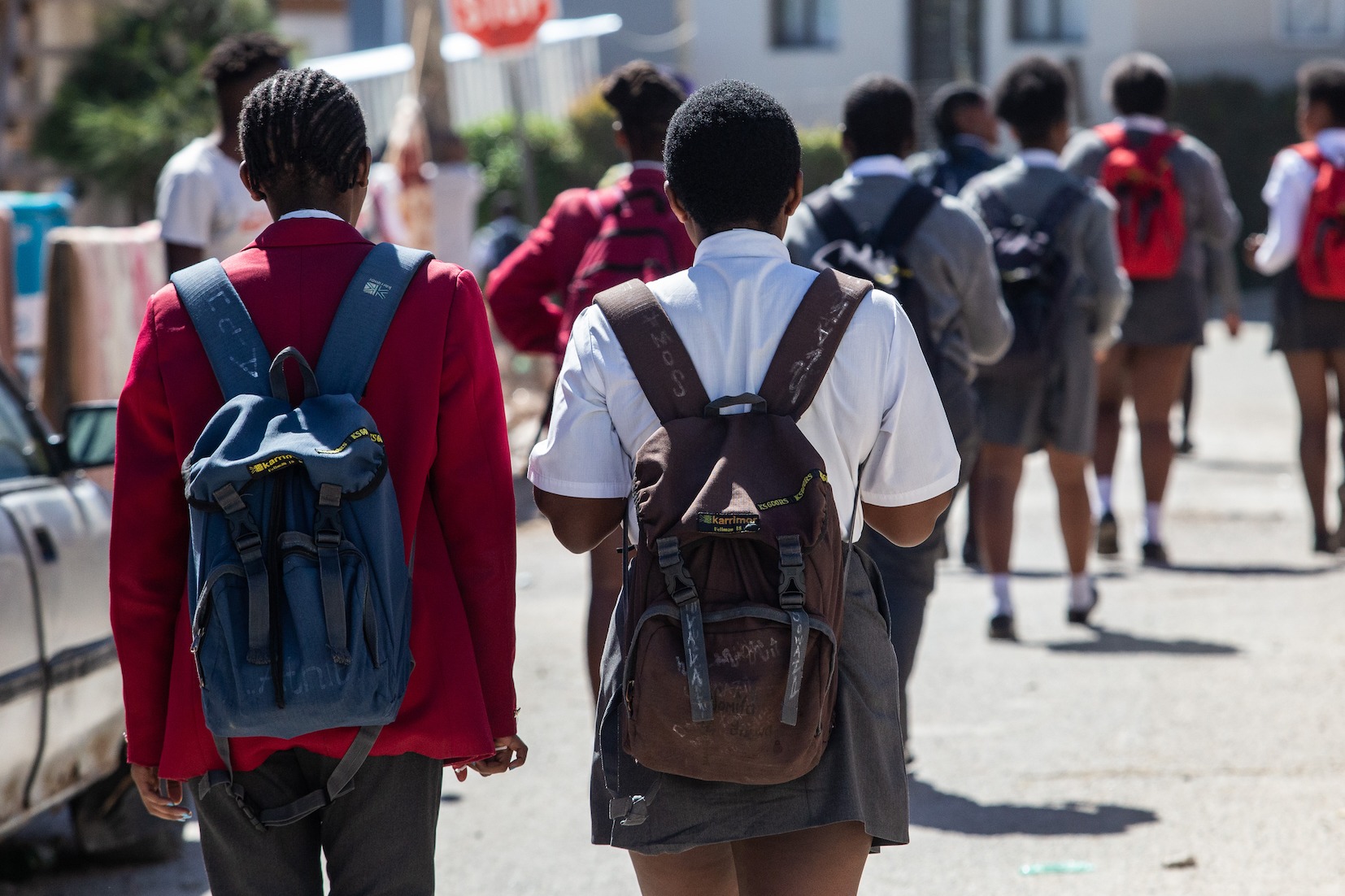
 Pupils walk home in Imizamo Yethu, Cape Town. The documentation status of migrant pupils has come under scrutiny after two Cape Town high schools requested that foreign children provide valid immigration or study permit documents. (Archive photo: Ashraf Hendricks / GroundUp)
The wave of xenophobic nationalism that has swept over South Africa in 2026 has resurfaced and inflected some longstanding issues in the education sector.
In Cape Town, immigrant parents of pupils in several schools were left dismayed in the last week of June after school authorities sent messages requesting valid immigration documentation.
On 24 June, a week before the expiry of the March and March deadline for undocumented migrants to leave the country, Excelsior High School in Belhar sent a letter home with pupils of immigrant parents, asking them to “Kindly provide the school with an official study permit for your child or proof of application for study permit immediately”, and warning that “our school will be audited by the Department of Home Affairs to prevent any complications with regards to adhering to the Immigration’s (sic) Act as stipulated in the Government Gazette of 2014”.
In the same week, Buren High School in Brooklyn sent out a WhatsApp message requesting “foreign learners to submit an updated copy of their child’s valid immigration documentation... by tomorrow”.
Buren’s deputy principal, Shamini Govender, told Viewfinder that the communication had been issued “because a valid document is a requirement. Especially in matric exams, we have to check it, otherwise the student can’t write.”
She added that the process was in no way punitive, and that in cases where pupils had no documents “we assist them, by working with the relevant authorities to get them what they need in order to write”.
Excelsior High School did not respond to questions submitted by Viewfinder, but a teacher, requesting anonymity, said that the letter had followed a meeting of a group of school principals in June, at which the March and March deadline had been discussed.
“These are schools in areas where there are a lot of migrants, so it was felt that some action needed to be taken, in case [anti-immigrant] groups came [to the schools] like they did in KwaZulu-Natal and Gauteng. That is why a lot of schools issued letters at the same time, all saying the same thing,” the teacher said.
The letters and the law
According to Zeenat Sujee, the head of the Education Rights Programme at SECTION27, communications from schools of this nature do not necessarily comply with the South African Schools Act.
“The Act very clearly states that a child must be allowed to attend school even if they don’t have documents. It also says that schools must not unfairly discriminate against learners in any way. Placing learners at risk of deportation is a failure to act in the best interests of the children.”
According to Sujee, the belief that matrics cannot write exams without identity documentation has a long history, and is not true.
“In 2019, the so-called Phakamisa judgment [Centre for Child Law v Minister of Basic Education] was handed down, which made it clear that a lack of identity documentation should not be a barrier to basic education. After this we were still seeing cases of learners being barred from registering for and writing their National Senior Certificate [matric] exams, but subsequent Department of Basic Education circulars have clarified that matrics are allowed to sit exams, whether they have documentation or not,” she said, adding that SECTION27 has received no cases of Grade 12 pupils being barred from writing exams in 2026.
/file/attachments/2998/Viewfinder-Xeno-educationinsetletter_498902.jpeg)
In a response to Viewfinder the Western Cape Education Department (WCED) said it was not aware of any Home Affairs audit, but that a request for identity documents “was made a while ago by the schools concerned for the administration of the National Senior Certificate. This is common practice – and the request is made to all learners.”
The WCED specified that if a candidate does not have an South African identity document, they should provide a birth certificate, and that those without these documents “should contact the WCED’s Examination Directorate or the nearest district office as soon as possible, as registration and certification details must ultimately be linked to the learner’s official identity records when writing the National Senior Certificate”.
Bullying, hate and trauma
Culture-based bullying is another longstanding issue in South Africa’s schooling system, but Viewfinder has now received a number of testimonials about bullying episodes inspired by the activities and ideas of the anti-immigration movement.
In January, after immigrant parents demonstrated outside Addington Primary School in Durban, demanding places for their children, supporters of the March and March movement staged a three-day protest outside the school that left several pupils and parents in need of counselling, according to Consolee Kanamugire of the Durban-based organisation Refugee Social Services.
/file/attachments/orphans/1000178406_804043.jpg "A parent and her daughter walks out of Addington Primary school in Durban, KwaZulu Natal. 22 January 2026 (Photo: Naledi Sikhakhane)")
“At a point during the protest the school called parents of existing immigrant learners to come and remove their children from the school for safety reasons, and when they came some were beaten,” she said, adding that although immigrant children are used to a degree of exclusion, as well as bullying from their peers, what happened in January was different.
“These children have been schooled by their parents not to speak unnecessarily, not to wear anything that identifies them as foreign, and other coping strategies, but when March and March came it was their first time seeing that hate from outsiders, and it has left several of them severely traumatised,” she said.
Immigrant pupils at Addington told Viewfinder they were taunted in July after the passing of the March and March deadline for undocumented migrants to leave the country.
“We were asked, ‘why are you still here?’” said one.
In Nyanga in Cape Town, a principal of a faith-based education centre, requesting anonymity, said two immigrant pupils are enrolled in the school, and both reported episodes of bullying in June.
“They are used to being ridiculed for their Shona, and their accents, but what did stick out in June was the fact that they were told they need to be out of the school by the time of the March and March deadline. The other students had obviously picked it up, whether from the news or their parents, and some of them were using it to be nasty,” he said.
A Vista High School pupil of mixed parentage, whose father is from central Africa, told Viewfinder he does not feel able to embrace his father’s culture, because it would open him up to ridicule.
“My mother is from the Eastern Cape. Recently I went back for ulwaluko [traditional circumcision], so I am a bhuti now, and at school I only hang out with other bhutis. If I spent time with foreigners people would ask me what am I doing? As much as I am interested to find out about my father’s culture, I will wait until I am finished school. For now, it’s too complicated,” he said.
Viewfinder asked the Department of Basic Education whether an increase in culture-based bullying had been reported by schools but received no response. In July, however, the department issued Circular No. S7 of 2026, which prohibits vigilantism and violence around schools, a step that civil society organisations have broadly welcomed. DM
This report has been produced by the Southern Africa Accountability Journalism Project (SA | AJP), an initiative of the Henry Nxumalo Foundation working with Viewfinder and with the financial assistance of the European Union. It can under no circumstances be regarded as reflecting the position of the EU.
/file/attachments/orphans/Xeno-Barometer3_683674.jpg)
Comments
Scroll down to load comments...