



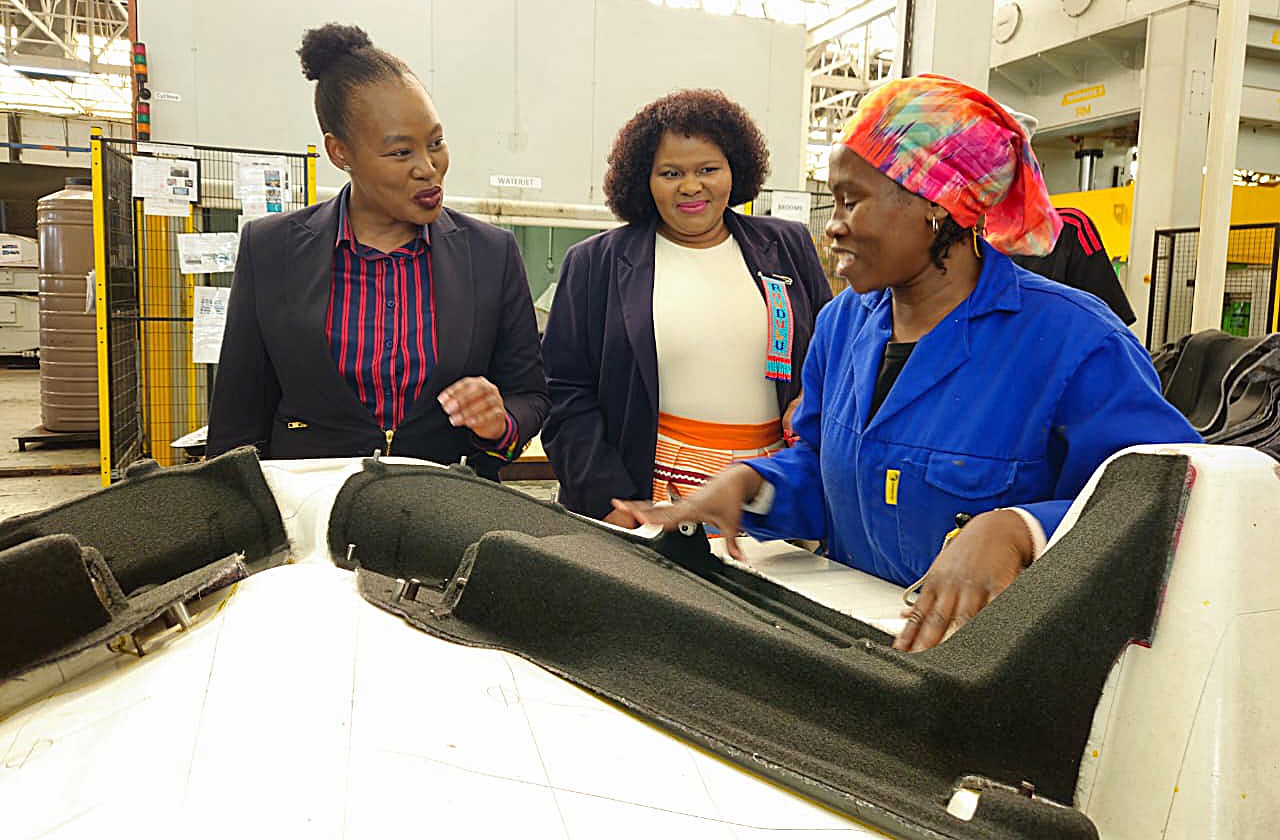
 Minister of Small Business Development Stella Ndabeni and Nelson Mandela Bay Mayor Babalwa Lobishe chat to Acoustex operator Nombulelo Moji on 22 September 2026. (Photo: Andisa Bonani)
Minister of Small Business Development Stella Ndabeni says the environment in which the automotive industry operates plays a critical role in the success of small and medium-sized enterprises (SEMs) facing mounting pressure caused by the country’s economic downturn.
Ndabeni said production in motor vehicles, parts and accessories and other transport equipment declined by 2.5% in 2025 compared with 2024.
Equally, the industry contributed about 5.2% to South Africa’s gross domestic product (GDP) in 2025, comprising 3.3% from manufacturing and 1.9% from automotive-related retail, she said.
“The evidence gives us an important message that automotive remains one of the country’s most significant industrial sectors, but its contribution cannot be taken for granted.”
This was why it was important that the space the businesses operated from remained conducive, said Ndabeni.
“This means electricity supply has to be sustained at all times,” she said, so that small businesses didn’t waste money on securing services that should be provided by local government, and instead could focus on production to preserve jobs.
/file/attachments/orphans/Andisa-Automotive1_693495.jpg "Acoustex commercial director Andre Swartbooi, mayor Babalwa Lobishe, Small Business Development minister Stella Ndabeni and accoustex director Weza Moss during an oversight at the business factory in Gqeberha, Eastern Cpae on Tuesday. 22 September 2026 (Photo: Andisa Bonani)")
Ndabeni was speaking on Tuesday at SME Acoustex, an automotive supplier in Neave Industrial Park, where she conducted an oversight visit ahead of a breakfast with industry roleplayers at the Boardwalk Hotel and Convention Centre.
Acoustex is a Tier 1 automotive company that produces the boot package components for the VW Polo, which are exported worldwide. It also produces seat covers for the Ford Ranger.
When the Automotive Masterplan was developed, Ndabeni said South Africa accounted for about 0.68% of global vehicle production.
Local content
“The Automotive Masterplan established an ambition of increasing local content from approximately 39% to 60%. The Masterplan explicitly recognises that achieving localisation requires the development of domestic component manufacturing throughout the automotive value chain. The localisation challenge is visible in the domestic market. Imported light vehicles accounted for 69.1% of total domestic light-vehicle sales in 2025, compared with 62.7% in 2024,” the minister said.
She said this did not mean that everything currently imported should be manufactured locally, but it raised an important question: what could realistically and competitively be manufactured in South Africa and which components and materials could be localised?
“We need industry to tell us what is required in terms of technology, machinery, tooling, certification, skills, working capital and long-term off-take. That is the level of specificity we need from this consultation.”
After the Covid-19 pandemic, Acoustex was among the city’s automotive SMEs that were affected when production levels significantly declined, threatening jobs, while it still had to deal with a huge electricity bill from the Nelson Mandela Bay metro.
The business owed the City R8-million, but after consultations, half the debt was written off in the City’s debt relief programme.
/file/attachments/orphans/Andisa-Automotive3_208698.jpg "Acoustex staff working on the VW line to produce the Polo boot package. Acoustex staff working on the VW line to produce the Polo boot package 22 September 2022 (Photo: Andisa Bonani)")
The programme has again been opened, from 1 September to 31 December, for qualifying account holders who, from 30 June 2026, have arrears of more than 30 days.
Customers who already have an active payment arrangement, or who previously benefited from the 2025 debt programme, may still apply for the 2026 relief. However, customers with an existing arrangement must continue to honour their current payment arrangement and pay their current account until their new application has been approved and the new terms and conditions have been confirmed by the Debtor Management Section.
Iran war effects
Acoustex commercial director Andre Swartbooi said one of the biggest challenges was the Iran-US war, which has increased the cost of raw material.
“We also have electricity issues that cause major problems. We’ve had electricity supply issues in the past, and we had to invest a substantial amount of money to put a generator in place. The big issue is that the business is very heat-driven, so when there’s no electricity, our parts harden and we have to reheat them, which drives up the electricity costs,” he said.
“If one of the press machines stops mid-cycle, that part becomes a reject, and we can’t use it, which is very expensive for us. Not only do we lose the output because of this, but also the raw material we use. All we ask from the local government is continuity; we’ve had a number of power dips in this area recently which cause problems. All we need is a sustained electricity supply.”
Mayor Babalwa Lobishe said among the strategies the city was implementing was to support businesses to ensure that high energy users did not disrupt supply to other industrial areas.
/file/attachments/orphans/Andisa-Automotive2_807242.jpg "A vehicle floor carpet used to line the interior floor pan. 22 September (Photo: Andisa Bonani)")
“Hence, we are saying the business chamber must be our ears on the ground to ensure that businesses that can’t break even can be assisted before they take drastic decisions on their operations, such as shutting down or discontinuing certain lines, which will lead to retrenchments.”
Lobishe said the City had conducted an analysis on the electricity supply dips that had affected two industrial areas, and found that the non-declaration of electricity usage had been the cause.
“Businesses ask for a lower voltage, but end up using more, which trips the system, but the City’s supply of electricity has been generally stable.”
Eastern Cape MEC for economic development Nonkqubela Peters said no economy could grow without proper infrastructure.
“While we have managed to attract investors, we also need to ensure to retain them so that we keep the jobs. Our communities’ livelihoods are connected to industrial activities.” DM
Comments
Scroll down to load comments...