



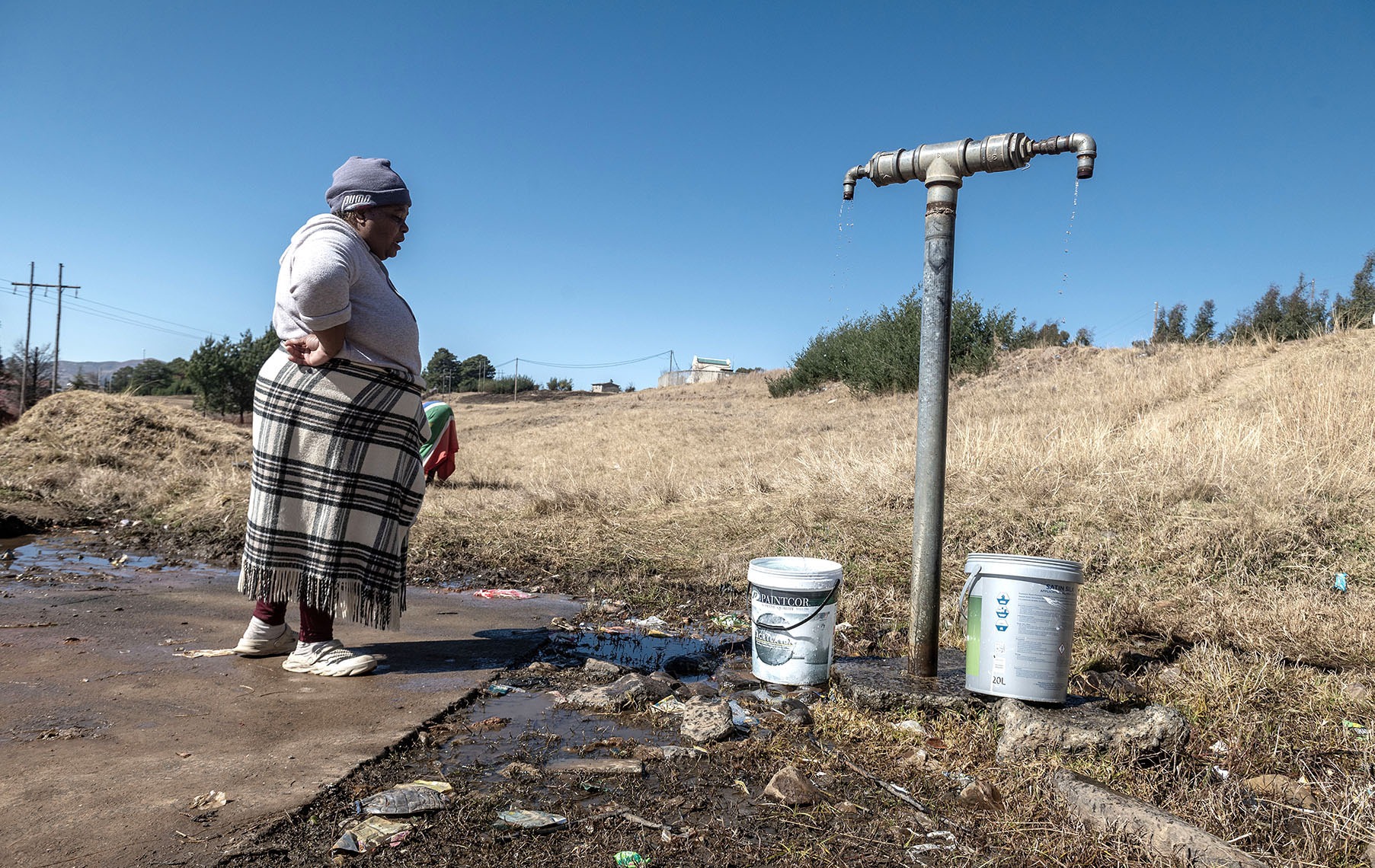
 Elizabeth Sane waits as a bucket of water fills from a communal tap. Water and electricity remain among the challenges affecting daily life in Phuthaditjhaba, Free State. Residents are forced to walk long distances to collect water from communal taps, which sometimes stop pumping when electricity is cut off due to deteriorating infrastructure. (Photo: Leon Sadiki)
Communities in the QwaQwa region of the Free State are facing “nightmare” water and electricity outages that residents say have plagued the area for more than two decades. Ageing infrastructure, alongside chronic mismanagement and maintenance problems in the Maluti-A-Phofung Local Municipality, is allegedly at the root of the crisis.
For families in the area, the disruptions have become an unwelcome norm, interfering with everyday efforts to learn, work and access services at government offices. QwaQwa, a former apartheid homeland, encompasses the capital, Phuthaditjhaba, and more than 90 surrounding villages, sprawled across the highlands around a section of the Drakensberg mountain range.
/file/attachments/orphans/Tamsin-QwaQwa-services13_926320.jpg "Water and electricity remain among the challenges affecting daily life in Phuthaditjaba, Free State. Residents are forced to walk long distances to collect water from communal taps, which sometimes stop pumping when electricity is cut off due to deteriorating infrastructure. (Photo: Leon Sadiki)")
When Daily Maverick spoke to Nthabiseng Tshotetsi, a pregnant mother staying just outside central Phuthaditjhaba, water had only recently been returned to her household after a month of dry taps. However, it remained undrinkable.
“We struggle a lot with water. Sometimes we don’t get water for two months. Now, they closed the water for about a month, so when they opened it just two days back, it was dirty. Imagine not having water for that long, and when they open it, they just give you dirty water. I don’t know what to do with that,” she said.
Until the water runs clean again, Tshotetsi said she would continue to make the 20-minute walk to the tap at a local church to collect water in two five-litre bottles. Due to her pregnancy, the exertion makes her feet swell, but she is hesitant to use her limited water supply to bathe them.
/file/attachments/orphans/Tamsin-QwaQwa-services6_394153.jpg "Phuthaditjaba resident Nthabiseng Tshotetsi is one of many complining about the water situation in the araa,.. Residents are forced to walk long distances to collect water from communal taps, which sometimes stop pumping when electricity is cut off due to deteriorating infrastructure. (Photo: Leon Sadiki)")
Tshotetsi said the electricity in her area sometimes goes out multiple times a day, making it particularly difficult to meet the needs of her five-year-old daughter in Grade R.
“This side, it would go in the morning. Imagine you have to prepare your child for school, and it’s cold. You don’t have warm water. Some people don’t have gas to use to prepare water... and kids have to eat their breakfast before going to school. How do you prepare that?” she said.
Schools and ECDs
The water and electricity outages affect not only households, but also schools and early childhood development centres. Tshotetsi sends her daughter to school with a bottle of water each day, because she doesn’t know if they will have enough water on site.
“I went to another school. I wanted to register her for next year. Then I asked for a toilet, and they told me [the] toilets are not working because they don’t have water. I don’t know how they’re managing with our kids,” she said.
/file/attachments/orphans/Tamsin-QwaQwa-services7_289106.jpg "Phuthaditjaba resident Nthabiseng Tshotetsi is one of many complining about the water situation in the araa,.. Residents are forced to walk long distances to collect water from communal taps, which sometimes stop pumping when electricity is cut off due to deteriorating infrastructure. (Photo: Leon Sadiki)")
On a visit to Lehlohonolo Educare Centre in Moeding, a remote village in QwaQwa, Daily Maverick was told by principal Matseleng Moloi that the early childhood development (ECD) programme had never had access to electricity, as there weren’t connections in the area.
She cares for about 40 children from the local community between six months and five years of age, and receives the ECD subsidy of R24 per child per day.
“[The lack of electricity] is a problem when it’s raining because inside the house it’s becoming darker... I buy gas. I also have a coal stove when it’s cold,” said Moloi.
/file/attachments/orphans/Tamsin-QwaQwa-services14_487613.jpg "Matseleng Moloi is the principal of Lehlohonolo Educare Centre in Phuthaditjaba, Free State. (Photo: Leon Sadiki)")
/file/attachments/orphans/Tamsin-QwaQwa-services15_273714.jpg "Matseleng Moloi is the principal of Lehlohonolo Educare Centre in Phuthaditjaba, Free State. (Photo: Leon Sadiki)")
According to the principal, she spends about R700 on gas each month, as well as about R500 to fill the JoJo tank she has on the property.
“Water is another struggle... Like now, we don’t have water, but we have a JoJo tank... I have to buy water or ask the parents to help me,” she said, explaining that she sometimes asks parents to send 20 litres of water to school with each child.
On visits to communal water points in Thaba Bosiu, Sedibeng and Monontsha, Daily Maverick observed how residents travelled long distances with buckets in wheelbarrows to collect supplies, sometimes waiting as long as 30 minutes to fill a container from the trickle coming from taps.
/file/attachments/orphans/Tamsin-QwaQwa-services2_959727.jpg "Elizabeth Sane carries a bucket of water. from a communal tap. Water and electricity remain among the challenges affecting daily life in Phuthaditjaba, Free State. Residents are forced to walk long distances to collect water from communal taps, which sometimes stop pumping when electricity is cut off due to deteriorating infrastructure. (Photo: Leon Sadiki)")
Homework in the dark
At the home of Jennett Moloi, a mother of two living in Mantsubise, an interview was conducted by candlelight. She said the area sometimes had up to 10 hours of electricity outages a day, including in the early morning and late at night.
Her two children, aged 12 and 17, were sitting by the coal-heated stove.
“Right now, they need to write homework. They are going to wait to see if the electricity will come,” she said. “I’m going to light the other candles so they can write their homework... I don’t even know when they sleep because I know they can’t sleep without [completing it].”
/file/attachments/orphans/Tamsin-QwaQwa-services18_203982.jpg "Jennett Moloi, a mother, has become accustomed to regular power outages and keeps candles at home in anticipation of being without electricity, a common occurrence in Phuthaditjaba, Free State, South Africa. Residents struggle with access to water and electricity, while small businesses are also affected as customers often stay home during power outages. (Photo: Leon Sadiki)")
It costs Moloi about R75 for a 25kg bag of wood, which lasts only a few days. She fills soft drink bottles with water and places them in the freezer to try to keep them cool when the power is cut, but for families with only fridges, keeping groceries fresh is a constant struggle, she said.
Her area had been without water for about two weeks, and the supply to the neighbouring community she had been visiting to fill her buckets had just been cut.
“We are struggling... In my house I have two buckets, and I have children. In the morning they have to use water to cook, wash dishes. We have nothing. I don’t know where I’m going to fetch water tomorrow, because I can’t go to the river. It’s not clean,” she said.
/file/attachments/orphans/Tamsin-QwaQwa-services17_223883.jpg "A family warms themselves around a fire outside their home in Phuthaditjaba, Free State, where residents struggle with access to water and electricity. (Photo: Leon Sadiki)")
Isaac Phiri, a resident of Phuthaditjhaba with a daughter in matric, said his area had frequent electricity outages, often with little or no warning. He has only one battery-powered lamp with a lifespan of six hours.
“Recently... we had electricity going off from the morning until the following day in the afternoon... My child studies... because she’s in matric, until 12am, 1am. Sometimes she sleeps earlier and wakes up in the early hours to study. If there is no electricity or lamp, she is not going to manage it,” he said.
Phiri’s area had been without water for about 10 days. While he has a JoJo tank, he says long stints without a water supply mean the tank becomes depleted, forcing him to pay R1,000 to private suppliers to have it refilled. As a pensioner relying on the R2,400 Older Persons Grant, it is a challenging expense.
/file/attachments/orphans/Tamsin-QwaQwa-services1_658222.jpg "Children help their parents collect water, while some residents walk long distances to roadside communal taps carrying stacks of clothes to wash in Phuthaditjaba, Free State, South Africa. (Photo: Leon Sadiki)")
Fighting for change
Maroba Sebonjane, a resident of Pahameng, noted that the water problems in his area and others had continued for more than two decades. He blamed a combination of ageing infrastructure and newer systems that were incomplete or poorly maintained.
Sebonjane said a lot of water went to waste due to leaks in pipes and taps that went unfixed.
The efforts he had made alongside other members of the community to address the issue with the municipal water entity, Maluti-A-Phofung Water, had been frustrating, he said.
/file/attachments/orphans/Tamsin-QwaQwa-services8_723369.jpg "Phuthaditjaba resident and community leader Maroba Sebonjani sent his children to stay elsewhere because of the unbearable conditions caused by water shortages and frequent electricity cuts. (Photo: Leon Sadiki)")
“Whatever we suggested... they would counter it... You come with a solution, they come up with a problem,” he said.
“There is no will to serve the people, not at all. But the will to squander that money – it’s overflowing. It’s abundant.”
If you do not own a wheelbarrow to take buckets to and from communal water points, “you’re as good as dead”, said Phuthaditjhaba resident Phiri.
“Imagine pushing a wheelbarrow with water. That’s our daily survival, a nightmare to live with. I’ve got my neighbour here... She’s using a walker. She has to put the 25-litre [barrel] on her back. Go to the JoJo there, get water, come back,” he said.
/file/attachments/orphans/Tamsin-QwaQwa-services9_968759.jpg "Phuthaditjaba resident and community leader Maroba Sebonjani, had to send his children due to the unbarale situation relating to shortage of water and cutting electricdty.. Residents are forced to walk long distances to collect water from communal taps, which sometimes stop pumping when electricity is cut off due to deteriorating infrastructure. (Photo: Leon Sadiki)")
Sebonjane showed Daily Maverick a letter he and other members of the community had sent to the Minister of the national Department of Water and Sanitation, dated 23 July 2026, requesting urgent intervention in the Maluti-A-Phofung Municipality to address “the ongoing water crisis of more than two decades”.
The letter stated: “The struggle to survive without water is a living nightmare, whilst water is being wasted daily from leaking water networks and infrastructure that the water department is failing to maintain. The standard of living in the affected areas has degraded to below normal human conditions.”
/file/attachments/orphans/Tamsin-QwaQwa-services10_106487.jpg "Water and electricity remain among the challenges affecting daily life in Phuthaditjaba, Free State. Residents are forced to walk long distances to collect water from communal taps, which sometimes stop pumping when electricity is cut off due to deteriorating infrastructure. (Photo: Leon Sadiki)")
A community in crisis
The longstanding water and electricity problems have reportedly eroded employment opportunities in the QwaQwa region, as businesses and factories have closed their doors or taken their operations elsewhere. Vacant industrial buildings stand, slowly to going to ruin, in the Phuthaditjhaba area.
“Business-wise, I’m feeling very heartbroken for the poor. These vendors or spaza shops... they’re running at a loss because of this on and off, on and off. Sometimes the duration [of the outages]... affects their products. Instead of making a profit, now you’re running [at] a loss because you get rid of the stuff you cannot sell to the people. It’s heartbreaking,” said Sebonjane.
“How are we going to develop business in the locations if there is no constant supply of electricity?”
/file/attachments/orphans/Tamsin-QwaQwa-services11_702193.jpg "Water and electricity remain among the challenges affecting daily life in Phuthaditjaba, Free State. Residents are forced to walk long distances to collect water from communal taps, which sometimes stop pumping when electricity is cut off due to deteriorating infrastructure. (Photo: Leon Sadiki)")
The situation also affects access to services at government offices in Phuthaditjhaba, such as the South African Social Security Agency and the Department of Home Affairs. People from local communities reported being turned away from these sites when the power was off, despite some having travelled long distances at their own cost to receive assistance.
“The municipality cannot work when there is no electricity,” said Phiri.
“Even the [Department of] Home Affairs, they knock off at 10am if there is no water or electricity, because they can’t work without electricity... It has a bearing on the cost, especially for people travelling from places far away from the [office]. Some of them queue from 4am... and then at 10am, the services cut. The whole line is still. They have to go back home. They come again tomorrow. Tomorrow again, there is no electricity.”
/file/attachments/orphans/Tamsin-QwaQwa-services4_353752.jpg "Children play outside with a residential skyline in the distance in Phuthaditjaba, Free State, South Africa, where residents struggle with access to water and electricity. Residents are forced to walk long distances to collect water from communal taps, which sometimes stop pumping when electricity is cut off amid deteriorating infrastructure. (Photo: Leon Sadiki)")
From the Maluti-A-Phofung Municipality
Maluti-A-Phofung Municipality spokesperson Thabo Kessah told Daily Maverick that the water shortages and water supply cuts in the QwaQwa region were the result of ageing infrastructure and vandalism. He did not respond directly to claims of poor maintenance and mismanagement on the part of the municipality.
“The municipality sought the assistance of the Department of Water and Sanitation, which in turn appointed a service provider to help with all these challenges,” he said.
Kessah said the municipality was aware that some residents were buying water from private suppliers to fill JoJo tanks, adding that “the intervention of DWS is gaining traction in minimising this reliance on JoJo tanks”.
The power outages too were also due to ageing infrastructure and vandalism, said Kessah, as well as the challenge of illegal connections that overloaded the electricity network.
The municipality’s strategy for addressing electricity and water outages in schools, ECD centres and government offices includes running continuous campaigns on saving electricity, especially during winter months, and encouraging legal connections and payments for services, said Kessah.
“The executive mayor has recently held discussions with the CEO of the Special Economic Zone and Free State Development Corporation on reviving industrial parks for economic activity. Discussions are ongoing and expected to yield results soon,” he said on the issue of declining economic and business opportunities in the region.
From the Department of Water and Sanitation
The Department of Water and Sanitation (DWS) confirmed to Daily Maverick that it had received the letter about the water crisis sent by Sebonjane and other community members.
The department noted that it was supporting the Maluti-A-Phofung Municipality through the Regional Bulk Infrastructure Grant, the Water Services Infrastructure Grant and the Maluti-A-Phofung Water and Sanitation Ministerial Intervention. It said that it had appointed the Vaal Central Water Board as the implementing agent for bulk water and sanitation infrastructure interventions in the region.
Actions under the bulk water programme included:
Upgrading the Sterkfontein Water Treatment Works from 10 to 20 megalitres per day, constructing bulk water pipelines and a 10-megalitre reservoir;
Pipeline projects including the water supply to Phuthaditjhaba and its central
business district, the Uniqwa reversal pipeline, and the supply to Tshiame and
Makgolokweng; andRefurbishment of the non-functional Wilge and Makwane Water Treatment Works to restore their treatment capacity and improve water supply in the areas they serve.
“Work already completed under the bulk infrastructure programme includes the refurbishment of the Nuwejaarspruit Pump Station and the Fika Patso Water Purification Plant, as well as the Uniqwa reversal pipeline,” the department said.
“The department is also working on assisting the municipality to improve their revenue income through water conservation and water demand projects.”
According to the DWS, it had identified communities in the Maluti-A-Phofung Municipality that remained unserved or did not receive a reliable water supply, with a broader borehole programme under way to address the backlogs through government funding and private sector partnerships. It said efforts were under way to refurbish 34 existing boreholes in priority areas. DM
This article was updated at 4.30pm on 22 September 2026 to include a response from the Department of Water and Sanitation.
Comments
Scroll down to load comments...