




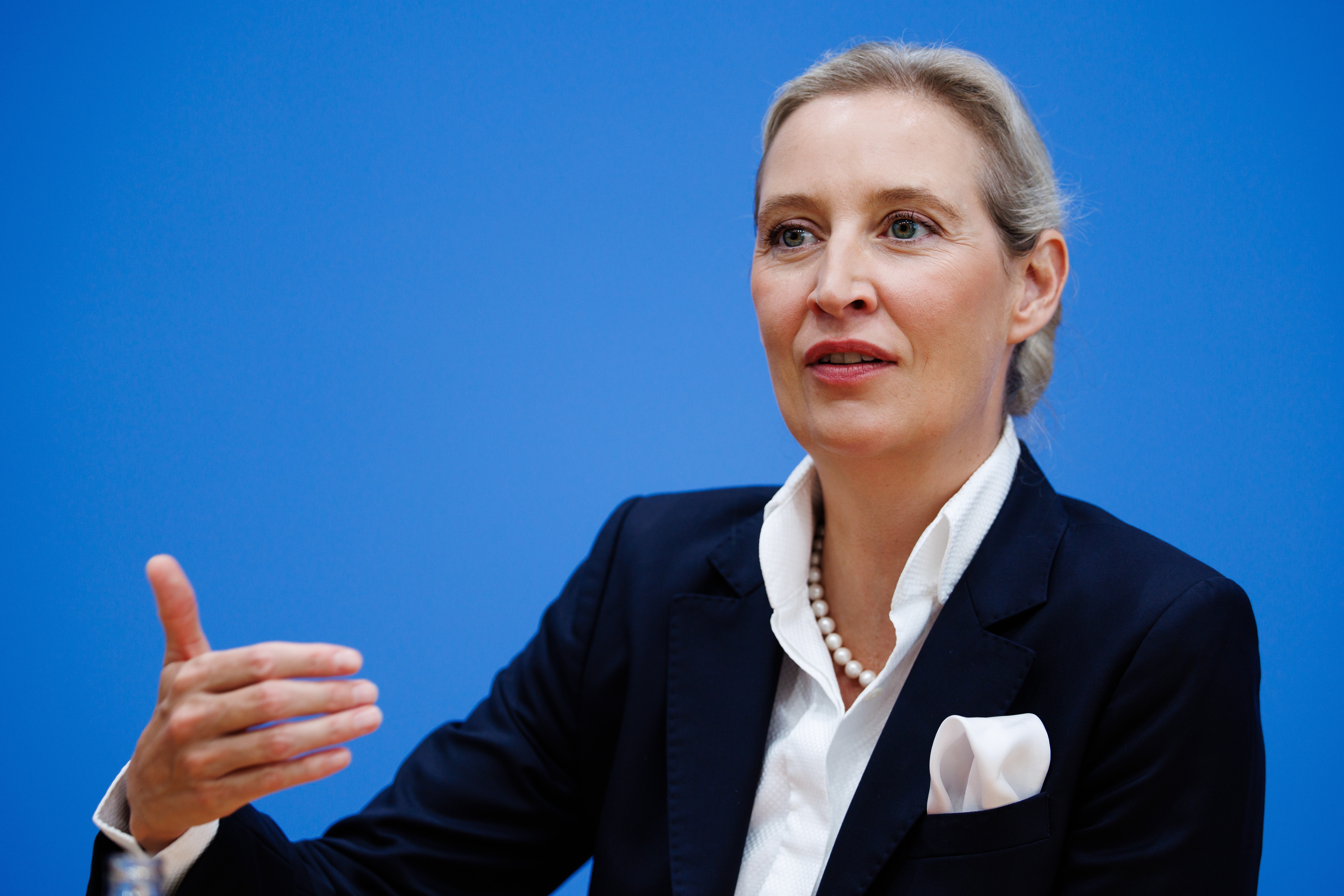
 Alternative for Germany (AfD) party and parliamentary group co-chairwoman Alice Weidel gestures during a press conference with representatives of the Alternative for Germany (AfD) party at the Federal Press Conference in Berlin, Germany, 21 September 2026. Elections for the House of Representatives in Berlin and the state parliament of Mecklenburg-Western Pomerania were held on 20 September 2026. EPA/CLEMENS BILAN
The win delivered the worst result for Chancellor Friedrich Merz's mainstream conservative party since 1949.
"The decline in the competitiveness of the German economy is largely due to Germany's decision to stop buying cheap Russian gas and instead purchase much more expensive gas from other countries, primarily the United States, at times paying several times more on the spot market," Kremlin spokesman Dmitry Peskov said.
Two people familiar with the plan said last week that Russian President Vladimir Putin's top economic envoy and leaders of Germany's far-right AfD had begun preparations to meet next year to discuss restarting gas supplies to Europe's biggest economy, even though the AfD is not in power nationally.
The AfD and a representative of the envoy, Kirill Dmitriev, declined to comment.
Germany has struggled to recover from the shock caused by the shutdown of the undersea Nord Stream pipelines from Russia, which were rendered inoperative by explosions in September 2022.
"Naturally, Germans, or at least some of them, are looking for an alternative to the current authorities in order to improve their situation. That is a natural process," Peskov said.
(Reporting by Anastasia Lyrchikova; Writing by Anastasia TeterevlevaEditing by Andrew Osborn and Kevin Liffey)
Comments
Scroll down to load comments...