




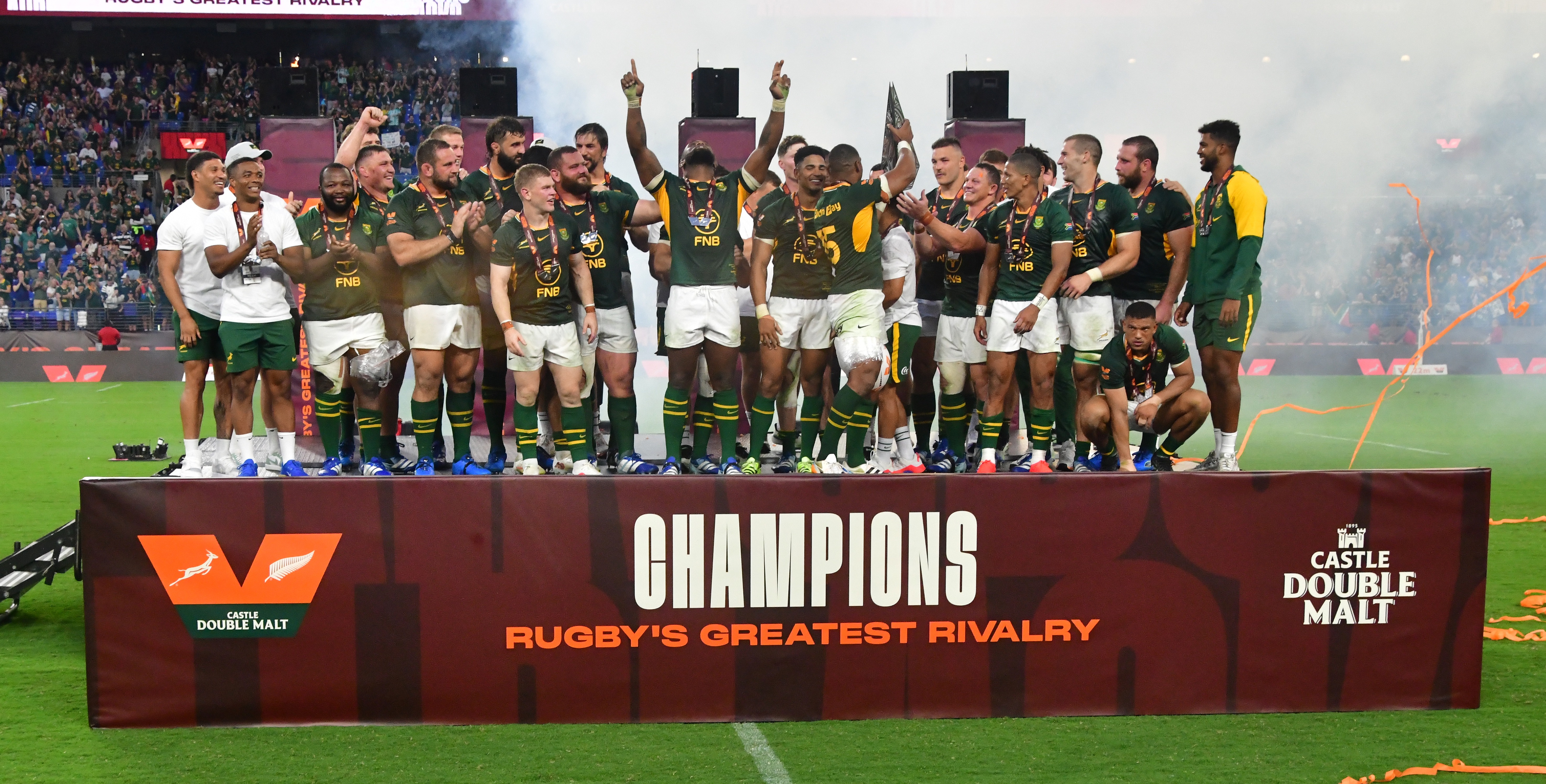
 The Springboks celebrate winning Rugby’s Greatest Rivalry over the All Blacks following a 43-28 fourth-Test win at M&T Bank Stadium in Baltimore on 12 September. (Photo: Alan Spiegler / Gallo Images)
South Africa last hosted a Rugby World Cup in 1995, while New Zealand’s most recent stint as host was in 2011. And neither is set to host the sport’s showpiece event in the foreseeable future.
In fact, there is a feeling in the boardrooms of South Africa and New Zealand Rugby that they may never host the global showpiece again.
That thinking, based on how the World Cup seems to shift to a new market (Japan, the US), or a slightly fringe rugby market such as Australia (where the sport is about fourth in the pecking order), and then back to the UK or France, led to a focusing of minds to rekindle full Test series and tours between the Boks and All Blacks.
Commercially, Rugby’s Greatest Rivalry (RGR) is set to become a World Cup replacement for South Africa and New Zealand and a four-yearly cash injection that they both desperately need.
After the Boks’ 3-1 series win in the 2026 edition hosted in South Africa in August and September, the series will be played in a similar time slot in New Zealand in 2030.
And it will continue on a home-and-away basis every four years after that. The 2034 tour in South Africa has been agreed in principle, although the contracts for that tour have not been signed.
/file/attachments/2997/TL_2613126_888590.jpg "Springbok captain Siya Kolisi celebrates scoring against New Zealand at DHL Stadium on 29 August, 2026 in Cape Town. (Photo: Ashley Vlotman/Gallo Images)")
NZ Rugby in financial stress
According to a new report, widely referenced in the New Zealand press last week, New Zealand Rugby’s (NZR) finances appear to be unravelling.
Against this backdrop, the South African Rugby Union’s (Saru’s) finances, while stable, despite a small financial loss in 2025, still require long-term protection.
Saru chief executive officer Rian Oberholzer made no bones about it when the RGR tour was discussed in a media forum earlier this year – South Africa is unlikely to ever host the World Cup again.
“I think we have moved away from the philosophy that everybody must get an equal chance to host a World Cup," Oberholzer told a media gathering at Saru’s offices in March.
“New Zealand and South Africa will not make the money out of a World Cup that World Rugby needs. I don’t think it’s a negative for us. It is more important for the best interest of rugby.”
New Zealand’s economy is relatively small, while South Africa has failed in recent bids for the 2011, 2015, 2019 and 2023 World Cups. Those bids required significant government guarantees reaching about R2-billion (at the last time of bidding).
Given South Africa’s stagnant economy, high unemployment and collapsing infrastructure, the appetite to spend lavishly on global sports events has waned.
“The Rugby World Cup is the only revenue stream for [governing body] World Rugby that must fund the whole ecosystem, and all the members get some funding out of a Rugby World Cup,” Oberholzer added.
/file/attachments/orphans/TL_2614355_617467.jpg "SA Airlink plane flying over DHL Stadium during the Castle Double Malt Rugby's Greatest Rivalry, 2nd Test match between South Africa and New Zealand at DHL Stadium on August 29, 2026 in Cape Town, South Africa. (Photo: Johan Orton / Gallo Images)")
“So, World Rugby must take the World Cup to where they can make the most money, and to go where they will be supported by local and national governments.
“I cannot see that the potential money generated out of South Africa will be the same as generated in Europe or maybe somewhere in the Middle East. World Rugby will drive World Cups to where they believe they can make the most money, and we all have to understand that.
“You cannot ask for a World Cup in your country, make less money, and then want the biggest slice of the cake when it comes to the annual grant that we get from World Rugby.”
If the sport’s biggest single payday is no longer available to you, you need something else that behaves like it. Enter the RGR.
For New Zealand, that something else isn’t working yet. New Zealand media reported on 17 September that a confidential internal NZR document, the Rugby System Programme, forecasts a NZ$27-million (about R250-million) net loss and cumulative losses of NZ$66-million from 2027 to 2031. It projects cash reserves falling to around NZ$72-million by then. They currently sit at NZ$144.7-million. The document calls NZR’s financial model “clearly unsustainable.”
/file/attachments/2998/chart4_only_all_blacks_659972.png)
/file/attachments/2998/chart1_who_is_making_money_694889.png)
Money games
NZR posted record income of NZ$304.2-million in 2025 and still lost NZ$7.5-million. Of its teams and competitions, only the All Blacks turn a profit – projected to be at plus NZ$38-million in 2026.
The Black Ferns (the women’s team), both sevens sides and every domestic competition run at a loss.
Broadcaster Sky’s new domestic deal from 2026 to 2030 is reportedly worth NZ$75-million to NZ$80-million, down from about NZ$111-million.
It’s a cut that reflects a shrinking market as much as a shrinking audience.
The National Rugby League (NRL) now draws more viewing hours in New Zealand than Super Rugby does. The report noted that NRL games drew 28 million New Zealand viewing hours against Super Rugby’s 19 million and the NPC’s 14 million.
That’s the context for why the RGR and the “money game” in Baltimore mattered so much to NZR specifically.
/file/attachments/2998/chart3_nzr_reserves_617451.png)
The Herald’s Gregor Paul reported that “a late ticket surge and the release of extra seats sold with dynamic pricing is believed to have led to New Zealand Rugby making close to NZ$9-million in Baltimore – a record payday,” calling it the most lucrative match the All Blacks have played.
Daily Maverick previously reported that the Baltimore Test alone earned Saru roughly R90-million more than a home fixture would have, on top of a projected R170-million to R200-million in ticket sales from the full eight-match series against the All Blacks.
Oberholzer has said outright that this is commercial strategy, not nostalgia. “Taking the Springboks to new audiences and territories is a key objective... We wouldn't be doing it if it wasn't substantial.”
/file/attachments/orphans/Rugby-Successforward4_222864.jpg "Siya Kolisi of South Africa and teammates lift the Rugby’s Greatest Rivalry Championship Trophy after the victory against New Zealand at M&T Bank Stadium on September 12, 2026 in Baltimore, Maryland. South Africa defeated New Zealand 43-28. (Photo: Caean Couto / Getty Images)")
NZR has also structured its new Sky deal to exclude offshore Tests from the bundled rights entirely, selling them separately match by match, which the union says gives it “the flexibility to generate significant additional income”.
Saru’s numbers look steadier, but the union is working through a version of the same problem. Daily Maverick has reported that Saru’s group revenue rose 29% to roughly R2.02-billion in 2025, with sponsorship, at R739-million, overtaking broadcast income (R678-million) for the first time in the professional era.
The union is debt-free and received an unqualified audit. It still posted a pre-tax loss of R40-million, about R33-million after tax, and group liabilities exceeded assets by R84-million.
/file/attachments/2998/chart5_sponsorship_vs_broadcast_908043.png)
Unlike New Zealand, South Africa is now in a stronger financial position due to its shareholding in the United Rugby Championship, which started in July 2025.
A full shareholding means Saru will make more money as long as the URC tournament remains profitable.
The URC pays out a percentage of its profits to 16 clubs, not 12, due to Saru’s roughly 15% share. There are now six shareholders – Saru, the Irish, Italian, Scottish and Welsh Rugby unions, along with CVC Capital Partners, which holds just over 26%.
Saru’s highest accumulated cost over the past eight years has been paying to participate in URC (and the Pro14 competition before that). The cost of securing South Africa’s place in Northern Hemisphere rugby was about R300-million per year.
According to its 2024 financial report, Saru paid R392-million annually for top club teams to compete in URC and European Professional Club Rugby (EPCR).
Without this contribution, the Bulls, Cheetahs (who play in EPCR), Lions, Sharks and Stormers would have no international competition.
In real terms, though, Saru was paying about R60-million annually to participate after the income from broadcast sales of URC and EPCR, and the R54-million travel budget from URC, were deducted.
But it’s the flagship brands – the Springboks and the All Blacks – where the most commercial value lies and why the RGR was born.
/file/attachments/orphans/TL_2398117_497233.jpg "Rian Oberholzer (CEO of SA Rugby) during the SA Rugby and EP Rugby press conference at Southern Sun The Marine on May 12, 2025 in Gqeberha, South Africa. (Photo: Richard Huggard/Gallo Images)")
Why the RGR must work
A home World Cup is, for a rugby union, the single biggest financial event available to it. Years of advance ticket and hospitality revenue, a guaranteed audience, a bump in sponsorship and participation that outlasts the tournament itself are all positive spin-offs.
Oberholzer’s point in March wasn’t a complaint; it was that South Africa and New Zealand have lost access to that entire category of income, permanently.
World Rugby will keep sending the tournament to whichever market pays it the most. In the men’s game, Australia will host the World Cup in 2027 and the US in 2031. Neither Saru nor NZR is bidding for the 2035 World Cup. Neither can generate the revenue that World Rugby needs from a host.
That leaves both unions needing something that behaves like a World Cup without being one, which is recurring, sellable to broadcasters and neutral markets, and large enough to matter against a real budget shortfall.
The RGR is that something. NZR has restructured its own broadcast rights specifically to protect this kind of revenue, carving offshore Tests out of its Sky deal so it can keep selling them separately rather than bundling them away.
For NZR, that revenue is a partial offset against a structural deficit its own internal document calls unsustainable.
For Saru, it’s replacing an equity sale, such as the one that fell apart with the US-based Ackerley Sports Group in December 2024.
Saru has no substantial reserve and is still funding a R500-million high-performance and Springbok programme out of operating revenue.
Against this financial backdrop, if the biggest prize in the sport, the World Cup, isn’t coming back, the next-biggest one must be built, and built to repeat. DM
Comments
Scroll down to load comments...