




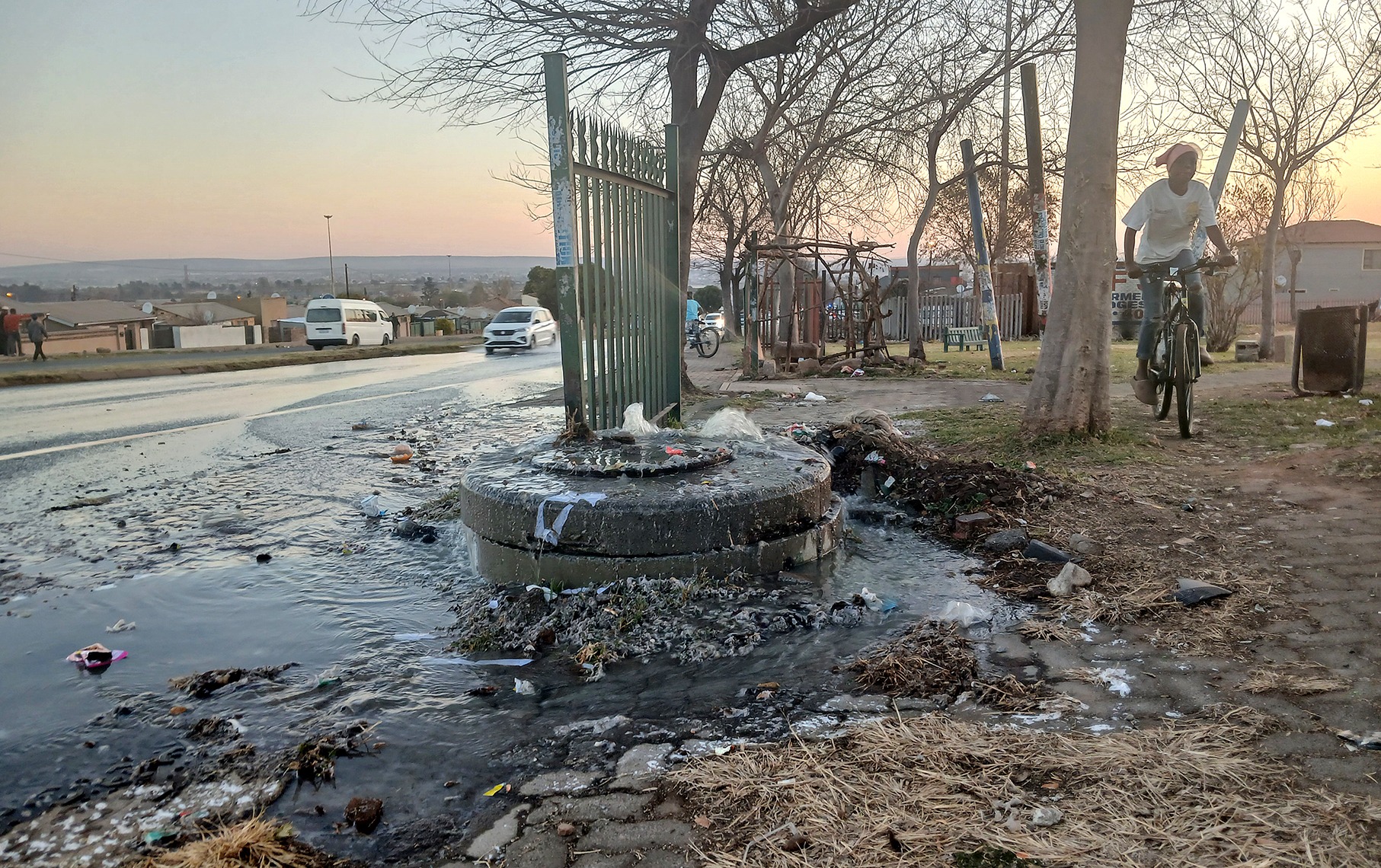
 A manhole leaks sewage in Soweto. (Photo: Bheki Simelane)
Everything you flush down a toilet or pour down a drain is supposed to be properly treated. What comes out of the process should be clear, close to odourless and safe enough to discharge into a river without making people sick or stripping oxygen from the water.
Untreated sewage entering waterways and the sea can lead to diseases such as cholera, make drinking water more difficult to treat, and harm river ecosystems.
But in almost every metro in South Africa, wastewater treatment has deteriorated between 2021 and 2024, according to the 2025 Green Drop report.
This is measured through the Green Drop score, which is the Department of Water and Sanitation’s assessment of how well wastewater treatment works are functioning.
Ekurhuleni got the highest score of any metro in 2024, at 82%, down from 86% in 2021, and was the only one rated “good”. Six of its 17 wastewater treatment plants achieved Green Drop status, meaning they are performing excellently. But, as GroundUp has reported, sewage spills are common.
Cape Town, at 75%, dropped from the “good” to “average” category and recorded its lowest score so far. None of its plants is in a critical state.
Johannesburg’s score has dropped in every audit cycle, scoring an excellent 91% in 2011, then a “good” 86% in 2013, “average” 73% in 2021, and “very poor” 49% in 2024. The city has experienced serious failures at its two biggest wastewater treatment works and is exceeding the design capacity at another.
/file/attachments/2998/guchart1_669789.jpeg)
Mangaung is the only metro that has seen an improvement in scores between 2021 and 2024, but the score is still low at 43%. Not enough preventive maintenance is being conducted, and its treatment capacity is limited. GroundUp reported earlier this month that none of the 13 treatment works are functioning properly, that screw pumps are missing, and that effluent flows into Maselspoort Dam, a drinking water source.
Nelson Mandela Bay dropped from 58% in 2021 to 36% in 2024, with two of seven treatment works disqualified. Vandalism is a contributor, as well as procurement issues.
Tshwane scored 34% in 2024, down from 60% in 2021. In 2013, Tshwane scored 82%, but now most of its treatment systems are performing poorly, and many are in a critical state.
Ethekwini has seen the biggest drop. Its treatment works were “excellent” in 2011 and 2013, “average” in 2021, and dropped to a “very poor” 31% in 2024. The April 2022 floods had a significant impact on its sewerage works.
Buffalo City is the only metro with a critical score of 26%, dropping from 59% in 2021. Twelve out of 15 treatment systems scored below 31%. The municipality has blamed vandalism. But it also failed to commission a new sludge plant in 2021. DM
This story first appeared in GroundUp.
Comments
Scroll down to load comments...