




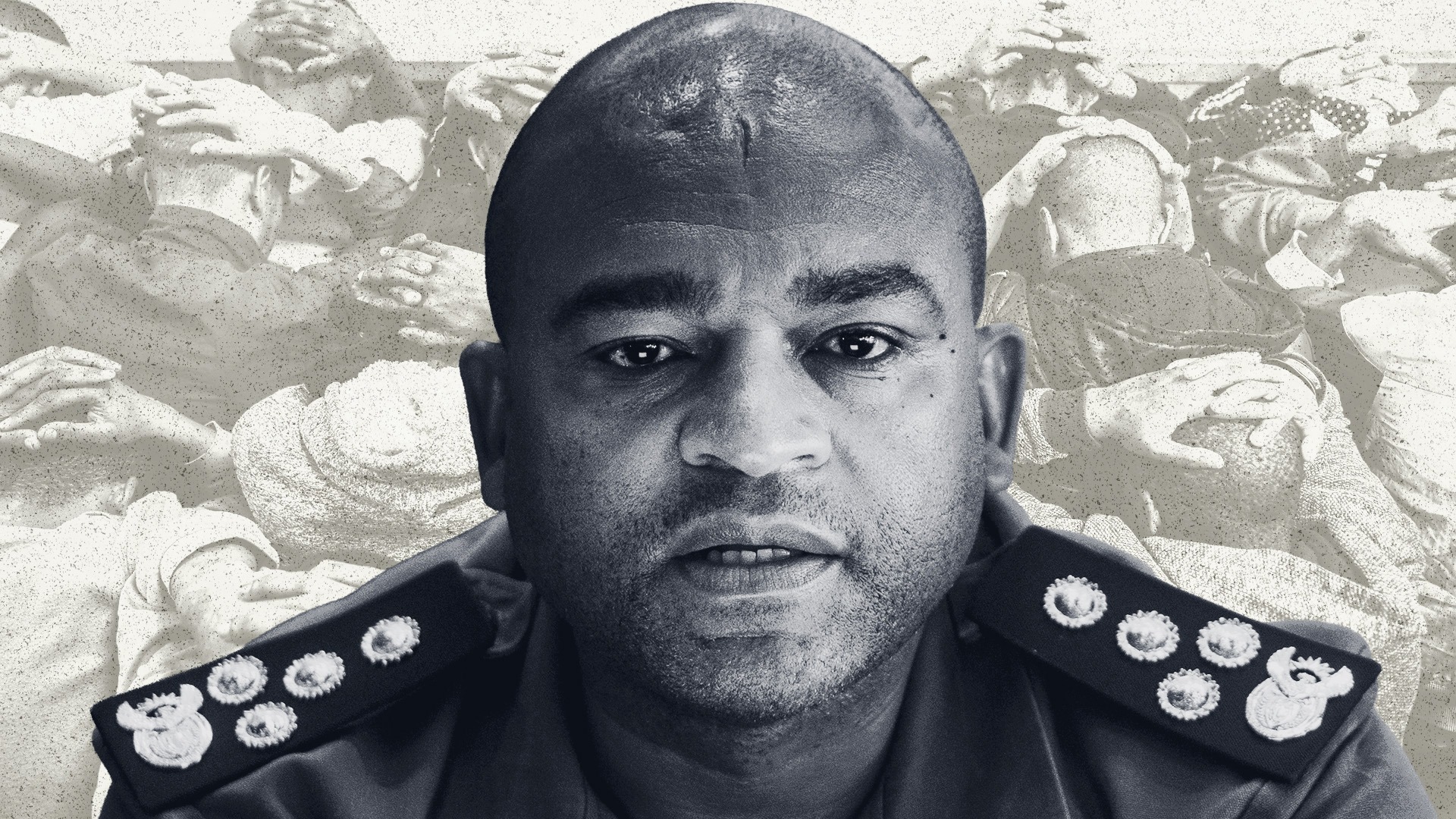
 Illustrative image: National Correctional Services Commissioner Makgothi Thobakgale (Photo: Brenton Geach / Gallo Images) | Prisoners during a raid at Pollsmoor Prison. (Photo: Jaco Marais / Gallo Images / Die Burger)
South Africa’s prisons have effectively transformed into operational bases for organised crime, allowing incarcerated gang leaders to seamlessly direct street-level operations, according to National Correctional Services Commissioner Makgothi Thobakgale.
He was testifying on Thursday, September 17, before the Madlanga Commission of Inquiry, which is investigating whether a cartel has infiltrated South Africa’s criminal justice system – from law enforcement and prosecuting powers to prisons.
His detailed submissions laid bare a grim reality inside facilities across the country, exposing a system where state control has buckled under the weight of pervasive corruption, smuggling and gang rule.
/file/attachments/orphans/thobakgale-madlanga-caryn3_767770.jpg "Awaiting-trial prisoners in an overcrowded cell at the Westville Prison, Durban. (Photo: Gallo Images / Sunday Times / Jackie Clausen)")
He testified that Correctional Services officials are involved in contraband smuggling and giving inmates cellphone access, pointing out that overcrowding remains a problem, gang infiltration persists, and street and prison gangs collude to sustain the illicit drug trade.
‘Isis affiliated detainees’
One of the more alarming aspects of Thobakgale’s lengthy testimony related to the Islamic State (Isis), which he described as “a violent extremist group […] operating across central, eastern and southern Africa”.
He said that on 5 May this year, the Hawks had asked that a group of detainees, allegedly affiliated with Isis, be separated from general prison inmates.
#sapsHAWKS Gauteng: ISIS affiliated suspect arrested for murder and kidnapping amongst other charges. Ryan Mitchell Grobler (33) has appeared before the Johannesburg Magistrate’s Court on Thursday, 11/09 following his arrest on the same day facing charges of murder, kidnapping,… pic.twitter.com/VSFmW1Wrts
— SA Police Service 🇿🇦 (@SAPoliceService) September 12, 2025
“The detainees were found in possession of a cellphone, providing clear evidence that they had maintained unauthorised communication with individuals outside the correctional centre,” Thobakgale testified.
“This communication created the potential for the group to continue coordinating activities and issuing instructions from within the correctional centre.”
Nearly 40,000 cellphones seized
Thobakgale explained that “although prohibited, large numbers of cellular phones are confiscated [from prisoners] annually. They are used by incarcerated offenders to direct criminal operations, coordinate drug distribution, orchestrate the intimidation or assassination of witnesses and officials, and facilitate fraud against members of the public.”
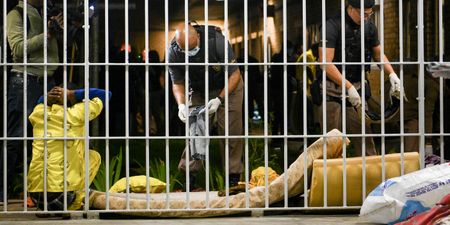
Thobakgale said prison officials were no longer allowed to bring their cellphones into correctional facilities after some were found to have allowed prisoners to use their devices.
Confiscations of cellphones in prisons surged from 30,215 in the 2023–2024 financial year to 39,242 in 2025–2026. Thobakgale attributed this to intensified facility searches and a steadily expanding inmate population.
Overcrowding alert
The problems in South Africa’s correctional facilities are compounded by ongoing overcrowding – between April and June this year, the number of prisoners increased by 3%.
Thobakgale said it cost around R480 a day to maintain an inmate and that the 3% increase equated to a R700-million expense hike, prompting his department to send an alert to Cabinet ministers.
SA’s prisons by numbers
Correctional Services boss Makgothi Thobakgale has told the Madlanga Commission of Inquiry that in South Africa:
There are 243 prisons, of which 239 are active correctional facilities. (A total of 228 of the 243 prisons are older “fortress-style designs that rely on manual, labour-intense security systems. Just 15 prisons are “new-generation” that have had integrated security systems from design stage. Budget constraints aside, there are moves to improve the older prisons.)
There are 107,067 beds in those facilities.
The prison population comprises 169,118 inmates.
The Department of Correctional Services has 39,000 officials, which coincidentally, is roughly the number of cellphones seized in correctional facilities in the 2025-2026 financial year.
Collusion and ‘criminal continuum’
He made it clear that gangsterism – in and outside of correctional facilities – remained a major problem.
“Gangs have infiltrated and continue to infiltrate correctional centres,” said Thobakgale. “Some offenders, particularly those affiliated to organised gangs, continue to pursue criminal objectives while in remand detention or serving sentence. This is the central security risk that the department manages on a daily basis.”
/file/attachments/orphans/thobakgale-madlanga-caryn8_772252.jpg "Prisoners during a search at Goodwood prison in Cape Town in 2024. (Photo: Jaco Marais / Gallo Images)")
Many offenders entering correctional centres were already affiliated with street gangs, such as the Americans, Hard Livings, Clever Kids and Naughty Boys, which were involved in drug trafficking, extortion and violent crimes.
When they entered correctional centres, they forged relationships with prison-based gangs.
Thobakgale explained that this created “a continuum of criminal command and communication between offenders inside correctional centres and gang leadership operating externally”.
This was one of the ways correctional facilities were “used to sustain gangs”.
The Correctional Services Department had a “gang combating strategy” in place, which was continually reviewed to respond to evolving threats and changing crime profiles at different prisons.
‘Hammermen’ and the other Big Five
Turning his focus to the Numbers gangs, Thobakgale outlined their distinct functions: the 26s were geared towards making money, the 27s enforced gang codes and meted out violence, and the 28s were involved in a range of crimes including smuggling.
He explained that the gangs dated back to the 1800s and have remained a constant threat, both inside and outside of prisons.
He pointed out the role of “hammermen” – contract killers associated with gangs, especially in the Western Cape, South Africa's gang violence capital. He said the hammermen were sometimes tasked with murdering witnesses in criminal cases.
Apart from the 26s, 27s and 28s, other groups were active in SA’s correctional facilities, including the Big Five, a gang that did not mix with the others and “that cooperates directly with officials in exchange for privileges”.
Thobakgale emphasised that this Big Five was separate from a cartel of the same name, which the Madlanga Commission is investigating for allegedly infiltrating South Africa’s criminal justice system.
Thobakgale explained that the Big Five prison gang was “involved primarily in food-related activities and smuggling”. Its members “typically work in offices, kitchens, and gardens, where they may also act as informers for officials”.
He said Big Five prison gang members aimed to turn officials into smugglers or to convert them into aiding its objectives.
‘Sharing a cigarette’ – infiltration method
Thobakgale detailed how gangsters gained power over prison officials.
“The process typically begins with minor requests and favours – for example, sharing a cigarette – and escalates to personal conversations designed to establish familiarity and identify an official’s vulnerabilities, most commonly financial hardship,” Thobakgale testified.
“Once familiarity is established, the official is drawn into ‘looking the other way’ in respect of parcels, visits or searches, in exchange for payment, and is progressively groomed into a role that facilitates smuggling.”
Thobakgale said that when Correctional Services officials rejected bribes, they or their families could become the target of intimidation and extortion.
‘The Lord’ gang boss and Thoshan Panday
He highlighted cases of procedural misconduct by Correctional Services officials, including one linked to 28s gang boss George Thomas – known as Geweld (“Violence”) and The Lord – whom Thobakgale described as South Africa’s “number one gang leader.”
In 2024, Thomas was transferred from a KwaZulu-Natal prison to Helderstroom in the Western Cape, the province where he had operated as head of the 28s gang.
/file/attachments/orphans/thobakgale-madlanga-caryn5_303259.jpg "George 'Geweld' Thomas, the alleged leader of the 28s gang. (Photo: #Protect-SA-at-all-cost! / X)")
About a decade earlier, Thomas had been sentenced to seven terms of life imprisonment plus 175 years for various crimes, including a string of murders, carried out in the Western Cape.
While he was detained and during his trial, several state witnesses were killed, and there were widespread fears that his 2024 prison transfer would ignite escalating gang violence.
Thobakgale said that Thomas’s prison transfer “was found to be inconsistent” with standard operating procedure and disciplinary action was taken against the officials involved.
/file/attachments/orphans/thobakgale-madlanga-caryn7_737888.jpg "Thoshan Panday's family is heavily implicated in corruption in the 2010 Soccer World Cup. (File photo: The Witness / Wikipedia)")
Another case Thobakgale referred to involved corruption-accused uMhlanga businessman Thoshan Panday, once associated with a son of former president Jacob Zuma.
In 2024, the Mail & Guardian reported that whistleblowers had claimed that when he was incarcerated at the Westville Correctional Centre while awaiting trial, Panday and a convicted murderer had “unlawfully spent extended periods in private hospitals”.
Thobakgale referred to this report and said an investigation had since found that Panday had a relationship with the “regional commissioner” (presumably of correctional services) who “visited him at both the correctional centre and the hospital several times”.
Thobakgale said that “the regional commissioner,” whom he did not name, “sought to influence Panday’s continued hospitalisation and unrestricted family visits”. DM
What next?
More witnesses are expected to testify before the Madlanga Commission, which aims to wrap up its hearings by early October, after which it will complete its report and present it to President Cyril Ramaphosa. DM
Comments
Scroll down to load comments...