




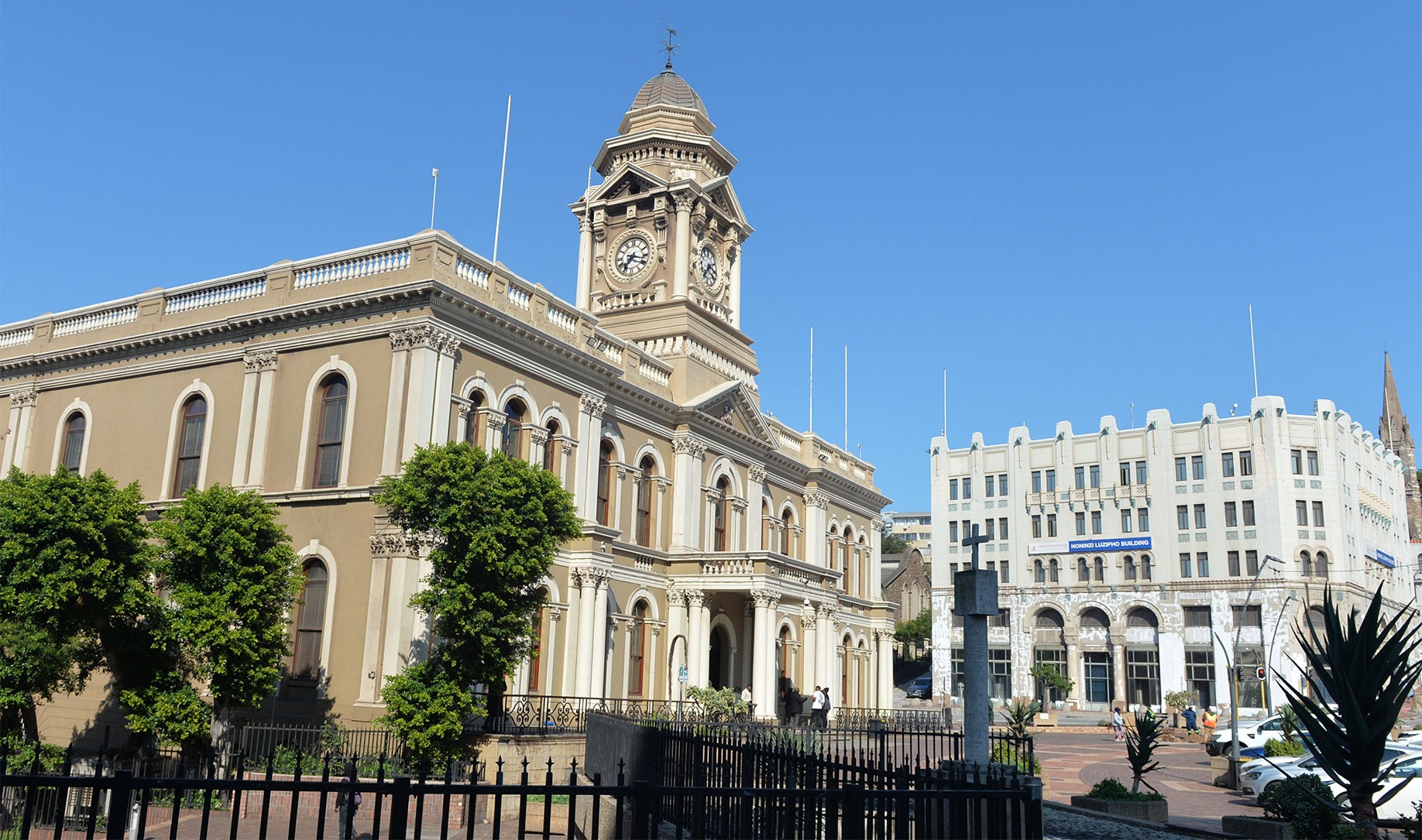
 The Gqeberha City Hall, the headquarters and administrative hub of the Nelson Mandela Bay Metropolitan Municipality. (Photo: Deon Ferreira)
The Nelson Mandela Bay municipality wants to keep charging residents R4.50 for every unit of electricity they buy, even though a court has ordered it to revert to the previous system, under which the first 300 units of electricity each month were cheaper.
Many households ended up paying more when that system was scrapped.
The DA took the municipality to court, and on 4 August 2026 the Gqeberha high court ordered the metro to restore the old tariff and credit residents for amounts they had overpaid. The municipality agreed to the urgent order.
Now, however, the municipality wants to return to the flat rate. Acting city manager Lonwabo Ngoqo said on Thursday that the municipality would argue its position when the case returned to the high court later in 2026.
Ngoqo said returning to the Inclining Block Tariff (IBT), under which the first units of electricity were charged at a lower rate, could leave a hole in the municipality’s budget because it was based on the R4.50 flat rate.
He was speaking on the sidelines of a postponed Budget and Treasury Committee meeting on Thursday, which could not go ahead because most committee members were absent.
/file/attachments/orphans/Andisa-Tariff_754866.jpg "Lonwabo Ngoqo is announced as the acting Chief Operations Officer of the Nelson Mandela Bay Metro on April 01, 2025 in Gqeberha, South Africa. Pillay is the fourth official to serve in the position since Dr Noxolo Nqwazi was suspended in October 2023 due to alleged financial misconduct. (Photo: Gallo Images / Die Burger / Lulama Zenzile)")
“How the revised tariff will affect the overall budget of the municipality is actually a very serious matter that could cause a deficit. The current budget is based on the flat rate, so the revised tariff will definitely have a negative effect on it, as we would have to make adjustments. The adjustments will determine whether our budget remains funded; we will look into other avenues we can explore in terms of doing that.”
After the court order, the municipality welcomed the return to the IBT, presenting it as evidence that it had listened to residents. Mayor Babalwa Lobishe said: “When residents expressed concern, we listened. When the court provided clarity, we accepted our constitutional responsibility to implement its order.”
But that position has now been reversed. According to Ngoqo, the municipality is preparing to argue Part B of the DA’s court application challenging the electricity tariff — the very tariff it had agreed to reverse — because its budget was built around the higher rate.
Nersa ‘approves challenge’
Municipal spokesperson Sithembiso Soyaya said Nersa had considered the metro’s application on 7 September and approved the changes needed to return affected domestic electricity customers to the IBT.
“The approved amendments apply to the affected domestic tariff categories that were moved from the Inclining Block Tariff structure to flat rate pricing during the 2026/27 financial year. Importantly, Nersa has confirmed that the amendment is limited to these affected domestic categories.
“The domestic time of use, commercial, industrial, wheeling, small-scale embedded generation and all other unaffected tariff categories remain unchanged from the tariffs previously approved by Nersa on 11 May 2026.”
Soyaya said Nersa had approved the return to the IBT, but had rejected the municipality’s proposed monthly basic charge for domestic prepaid customers of R91.54 a month. This would have been a fixed monthly fee on top of what customers paid for the electricity they used.
“The approval specifically excludes that proposed charge,” he said.
The municipality had proposed the charge as a way of making up some of the revenue it expected to lose when the cheaper IBT was restored.
Flat rate ‘still on the cards’
Ngoqo said the municipality still had an opportunity to retain the flat rate if it succeeded in the next stage of the court case.
“Remember this matter was granted an urgent relief by the court in Part A, which means we have to commence with the rebate process because there’s a court order that we need to implement. We have no option in this,” Ngoqo said.
He said the municipality would make its case in Part B of the application, where it would argue why the R4.50 flat rate should be retained.
“The actual merits of the case will be argued and discussed in Part B of the matter. When this happens, we will argue why the city cannot revert to the Inclining Block Tariff and advance our position as the municipality. We don’t have a court date yet, but we hope we will go back before the courts go to recess in December.”
He said the municipality’s revenue projections were based on the R4.50 flat rate and that officials would have to assess the financial impact of reinstating the IBT.
“We will look at the budget and see which alternatives we can explore to remain afloat or for the budget to be in a surplus and not a deficit. We are going to council on 22 September for a decision on the tariff and court issue.”
Inconsistencies
The rebate process has been marred by inconsistencies as some residents were still charged based on the flat rate from 1 September, while others had still not received their reimbursement electricity tokens.
DA councillor Brendon Pegram submitted formal questions to Ngoqo, passing on complaints he had received from residents in his ward.
/file/attachments/orphans/Andisa-Tariff_461317.jpg "Nelson Mandela Bay Municipality DA ward 7 councillor Brendon Pegram write to the acting chief financial officer to seek clarity regarding the process of reimbursing residents after they were overcharged for electricity (Photo: Supplied / Brendon Pegram)")
DA councillor Brendon Pegram said residents were still having problems with rebates and different electricity rates.
“I have been inundated with calls, messages and complaints regarding the electricity tariff rebates, the different electricity rates being charged, and the free electricity tokens that qualifying customers are meant to receive. I fully understand the frustration and confusion being experienced by residents. The situation is unfortunately not straightforward, as different customers appear to be receiving different outcomes when purchasing electricity,” Pegram wrote on 1 September.
‘Billing corrections’
Ngoqo said the municipality was still analysing its billing and electricity database from 1 July onwards to identify and correct cases where customers had been disadvantaged.
He encouraged residents experiencing problems with their electricity accounts to report them so that they could be resolved.
Ngoqo also said that if the municipality succeeded in its court challenge to retain the R4.50 flat tariff, it would seek to recover money credited or rebated to customers under the court-ordered return to the IBT.
In other words, the credits and additional electricity units being given to affected customers could now potentially be reversed if the municipality wins its case.
“That is easy, as we move forward we will balance our books, so if a customer for example, purchases electricity for R200 we will deduct R20 to balance the deficit. What is important is that when we do the adjustment budget in February next year, we will be able to go through all the processes so we are able to balance our books.”
He indicated that the municipality was working towards improving the revenue collection, currently sitting at 75% to 80%. DM
Comments
Scroll down to load comments...