



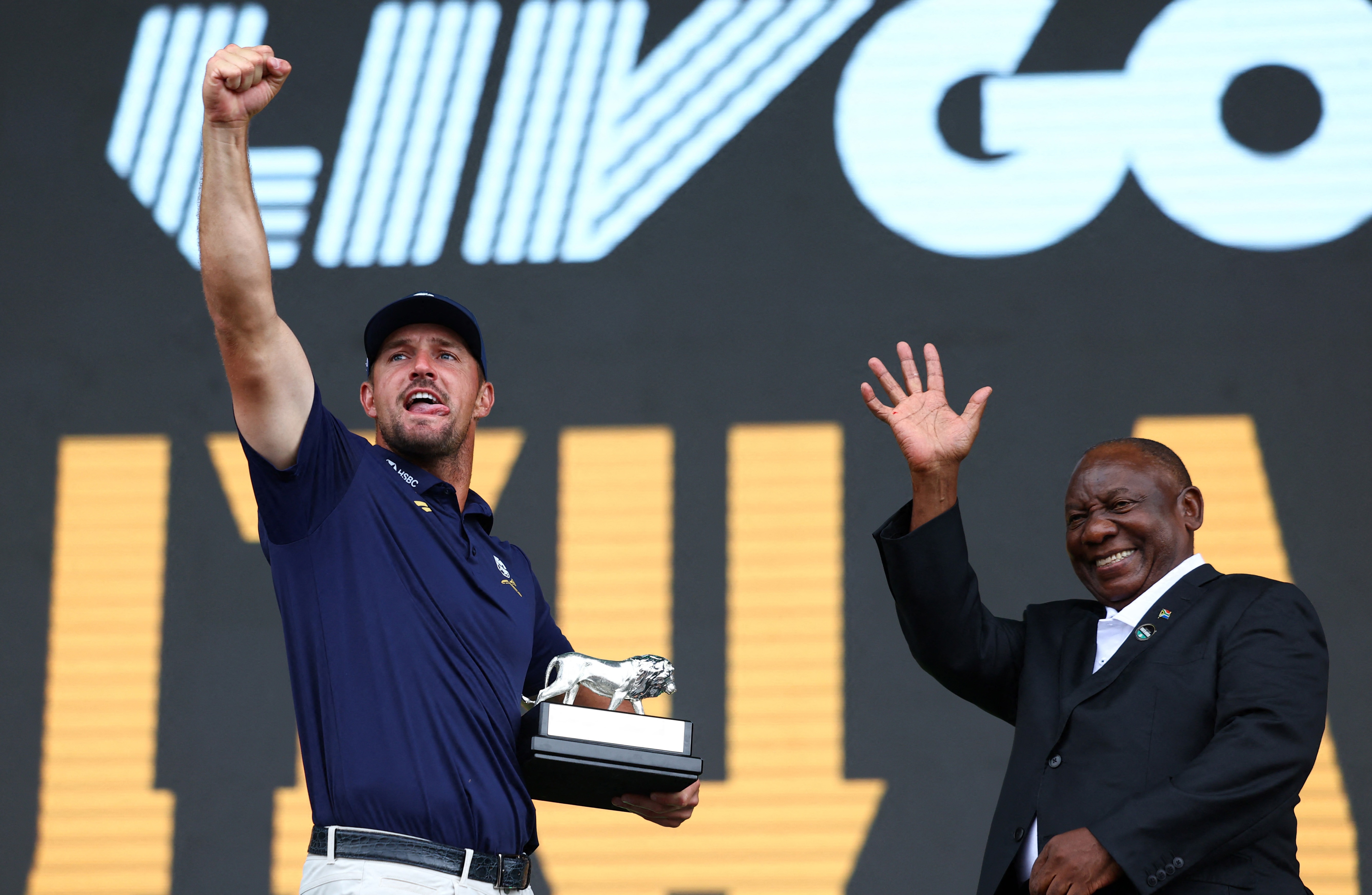
 Bryson DeChambeau celebrates with South African President Cyril Ramaphosa after winning LIV Golf South Africa in March 2026. (Photo: Reuters / Siphiwe Sibeko)
LIV Golf, the Saudi-backed league that, whether you like it or not, changed the landscape of professional golf, looks set to wither away in a sea of debt.
LIV filed for Chapter 11 bankruptcy in a US court on 8 September, effectively killing the league, although current CEO Scott O’Neil continues to fight to keep it alive.
The jargon of the moment is that LIV 1.0 is gone, but LIV 2.0 is coming. How, and more importantly why, are the obvious questions when it comes to LIV’s existence.
Its own numbers, which are in the court papers, show a league without a TV audience and therefore no real market.
LIV couldn’t make it work with the unlimited resources of Saudi Arabia’s Public Investment Fund (PIF) and close to $6-billion in backing over its five-year lifespan. There is never going to be that much gratis money flowing its way again, and without money, what attraction does it offer to serious professional golfers?
/file/attachments/orphans/Golf-LIVexperiment11_757305.jpg "Bryson DeChambeau wins the tournament during day 4 of LIV Golf South Africa at The Club at Steyn City on March 22, 2026 in Midrand, South Africa. (Photo: Sydney Seshibedi/Gallo Images)")
Besides being the creation of the golf-obsessed Yasir Al-Rumayyan, the PIF governor who chairs LIV, there was very little foundation to the league. It had money and a gun-for-hire frontman in Greg Norman as its first CEO, but little else.
Promises were made and players bought for obscene amounts to sign up to the league’s promise of “golf, but louder”. It’s all ended with a simpering whimper.
Al-Rumayyan called the league “my baby” during its original recruitment drive and personally assured players the league would be funded until 2032. Well, here we are.
/file/dailymaverick/wp-content/uploads/2023/06/GettyImages-1492708293-1.jpg "Head of the Saudi Arabia Public Investment Fund, Yasir Al-Rumayyan, has been invited to a US Senate hearing to shed light on the merger with the PGA Tour. (Photo: James Gill - Danehouse/Getty Images)")
Bankruptcy
The bankruptcy filing itself is a dry, soulless document – shorn of the hype LIV promised, but never delivered.
LIV has essentially taken a $49.6-million loan from PIF to keep the lights on. But it has liabilities of between $500-million and $1-billion against assets of between $100-million and $500-million.
According to court papers, it had only $15-million in the bank in September.
The filing shows broadcast rights at only 5% of LIV’s revenue, roughly $10-million to $11-million against $208-million total income.
By contrast, 67% of the PGA Tour’s revenue is from broadcast income.
/file/attachments/2997/Screenshot2026-09-17at174441_494561.png)
O’Neil said last month there was a new backer in principle, which the court papers confirm.
Private equity firm BC Partners has been brought in to help restructure the league under what O’Neil calls a “player-first ownership model”.
Buried in the pages LIV’s lawyers filed with the New Jersey court is the actual mechanism that will decide this. Before 13 October 2026 – 35 days after the filing – 50% of players, representing two-thirds of claim value, must sign on to the BC Partners deal or it can collapse.
LIV says it hopes to emerge from bankruptcy in early 2027. What happens next depends mostly on whether LIV can hold on to its two biggest names – Jon Rahm and Bryson DeChambeau.
Ironically, they are listed as its two largest creditors, according to court papers. If it can’t keep them, LIV is probably over.
If it can, LIV could survive in some smaller, differently owned and considerably less glamorous form. The odds aren’t good.
/file/attachments/orphans/Golf-LIVexperiment2_162986.jpg "Scott O'Neil, CEO of LIV Golf speaks to the media during a press conference ahead of LIV Golf Hong Kong at Hong Kong Golf Club on March 03, 2026 in Hong Kong, China. (Photo: Kate McShane/Getty Images)")
The talker and the filing
I interviewed Scott O’Neil on 9 February 2026, weeks ahead of LIV Golf’s South Africa event at Steyn City. He is, in fairness, good company and a fluent salesman.
Asked directly about [mainly] British press reports that LIV was “on life support” after a string of player departures, he laughed it off: “The capture of my demise has been much overstated,” said O’Neil.
“I have so much confidence in our chairman, his commitment, our long-term process, programme and planning. The funding that we have in place and the commitment to go forward.”
Seven months later, LIV laid off most of its staff and filed for bankruptcy.
Asked how many years LIV had to become profitable on its own, without the PIF’s backing, he couldn’t or wouldn’t give me a number.
“I hate to put a timeframe on it. We have one,” he said, before adding: “With the safety net of the sovereign fund, obviously [we have time].” That safety net is exactly what the bankruptcy filing suggests ran out.
O’Neil had, in fact, already given a number. Six days earlier, he told the Financial Times that LIV would not break even for five to 10 years.
LIV's own chief restructuring officer, David Orlofsky, repeated a version of that line in the bankruptcy filing itself, saying that with “appropriate funding and a level playing field with its competitors”, the league’s existing model would have reached profitability “within five to seven years”.
/file/attachments/orphans/Golf-LIVexperiment12_386459.jpg "Bryson DeChambeau chips on to the 18th green from the bunker during day 4 of LIV Golf South Africa at The Club at Steyn City on March 22, 2026 in Midrand, South Africa. (Photo: Sydney Seshibedi / Gallo Images)")
The most revealing exchange with O’Neil, in hindsight, was about players. I asked whether he had any contractual mechanism to stop a mass exodus if stars took up the PGA Tour’s standing offer to return. He said, no. He framed it as a strength, not a risk.
“We’ve been advocating since day one for free agency,” O’Neil said. “I wish [the players who leave] well. I hope they do well. In terms of what we are, we’re quite different.”
The bankruptcy filing lists 24 separate parties LIV owes more than $1-million each, and its own marquee players sit at the very top of that list – Rahm at close to $8-million, DeChambeau at $5.7-million, Dustin Johnson at $5.4-million. Brooks Koepka, who left LIV 10 months ago, is still owed roughly $1.68-million.
It’s not a great way for LIV 2.0 to start – owing marquee players money, while relying on their loyalty to ensure the tour can continue in some form.
Rahm was noncommittal before the start of the Irish Open earlier this month. Asked directly whether he saw a future with LIV or a path back to the PGA Tour, he wouldn’t say either way. “There’s just a lot of things in place, right? There’s a lot of things that could happen, and it’s one of those things where time’s gonna tell,” Rahm told the BBC. “I still have a contract with LIV 1.0 that I’m more than willing to fulfil. So, like I said, time will tell.”
That he referenced only the first incarnation of LIV and not the touted “2.0” version, was telling.
According to a report in the Telegraph, Rahm is reportedly still owed upwards of $100-million of the roughly $300-million signing fee attached to his original 2024 deal. Across all players, LIV’s total liability is reported at around $45-million in unpaid compensation, on top of hundreds of millions more in future contract guarantees it may simply never pay out.
Tyrrell Hatton appears on the creditor list at $3.3-million.
/file/attachments/orphans/TL_2539604_931277.jpg "Jon Rahm during day 4 of LIV Golf South Africa at The Club at Steyn City on March 22, 2026 in Midrand, South Africa. (Photo: Sydney Seshibedi/Gallo Images)")
SA fallout?
While the precarious position LIV finds itself in has already claimed many victims, such as the hundreds of staff who were laid off and unpaid vendors, players and caddies who will also lose their livelihoods.
Many may scoff that players made their choice and there was always a risk that this would be the outcome, it extends beyond a few already very rich players.
On 4 March 2026, at a Department of Sport, Arts and Culture press conference in Pretoria, Minister Gayton McKenzie told reporters that LIV Golf’s 2026 debut at Steyn City was “nearly sold out”. He also stated that discussions were “already under way” to renew the tournament “for several more years”, and that future editions could grow to accommodate up to 95,000 spectators.
“It’s the biggest event on the LIV calendar, eclipsing even Australia,” said McKenzie.
Six months later, LIV Golf filed for bankruptcy protection.
/file/attachments/orphans/Golf-LIVexperiment9_156016.jpg "Gayton McKenzie (Minister) of Sport during day 4 of LIV Golf South Africa at The Club at Steyn City on March 22, 2026 in Midrand, South Africa. (Photo: Sydney Seshibedi / Gallo Images)")
McKenzie also put a number on what the event was worth to South Africa, saying that it was projected to bring in “close to one billion rand in economic activity through tourism, hospitality, local spending, taxation and international exposure”.
The 2026 LIV Golf SA at Steyn City was by any metric a success, drawing more than 80,000 fans and delivering a fine event.
The economic impact figures mentioned by McKenzie have not been independently verified, but the event obviously stimulated the tourism, event and hospitality industries.
The problem is that there is no clarity on what the 2027 tournament will look like, who will play and when it will happen, if at all, until the current financial woes are addressed.
Daily Maverick has spoken to several people who attended the 2026 event and bought “early bird” tickets for 2027, but now want their money back because of the uncertainty around the league.
But LIV’s website states: “Pre-purchased tickets for 2027 events remain valid and are therefore not eligible for refunds at this time.”
/file/attachments/2997/liv-timeline-graphic_431726.png)
More money for everyone
While LIV Golf has always been positioned as the bad guy, the reality is that all professional men’s golfers benefited.
For nearly five years, it became a money arms race, and the PGA Tour had to respond to the existential threat LIV posed – especially in the first few years.
PGA Tour prize money rose from $427-million in 2022 to $560-million in 2025, driven at least partly by LIV’s existence.
The PGA Tour’s $700-million-a-year media rights deal completed in 2022 also played a part in increasing prize funds for players. But competitive pressure applied by LIV helped.
World No 1 Scottie Scheffler’s 2022 haul of $14-million was eclipsed by a profitable 2025, when he won nearly $25-million in prize money – a 74% rise.
The number of players earning more than $1-million went up from 126 to roughly 165 between 2022 and 2025.
The PGA reframed its Signature Events to combat LIV’s guaranteed money, and it saw purses leap from an $8-million average to $20-million, a 150% escalation.
You don’t need a PhD in sports economics to see what happened. LIV forced the PGA Tour to pay its players more.
Every player on the PGA Tour, from the superstars to the journeymen grinding for status, is richer today because LIV exists. That’s the irony at the heart of this whole saga. The disruptor made the establishment stronger.
/file/attachments/2991/pga_prize_money_comparison_2022_2025_812302.png "Players on the PGA Tour have seen a 31% growth in prize money since LIV’s arrival. Source: PGA Tour. (Graphic: DM)")
The bottom line is that LIV Golf, however poorly conceived and however unlikely to succeed based solely on the whim of the PIF, changed golf’s landscape forever.
In time, it might just become a footnote, the way cricket’s Packer Series in the late 1970s is almost forgotten. Like Packer, which briefly tarnished cricket’s image, LIV bloodied professional golf’s nose.
But like Packer, LIV started a revolution out of which players, caddies and agents have benefited.
LIV is on life support, and chances are it will die. But its existence will reverberate through the sport for decades to come. DM
Comments
Scroll down to load comments...