




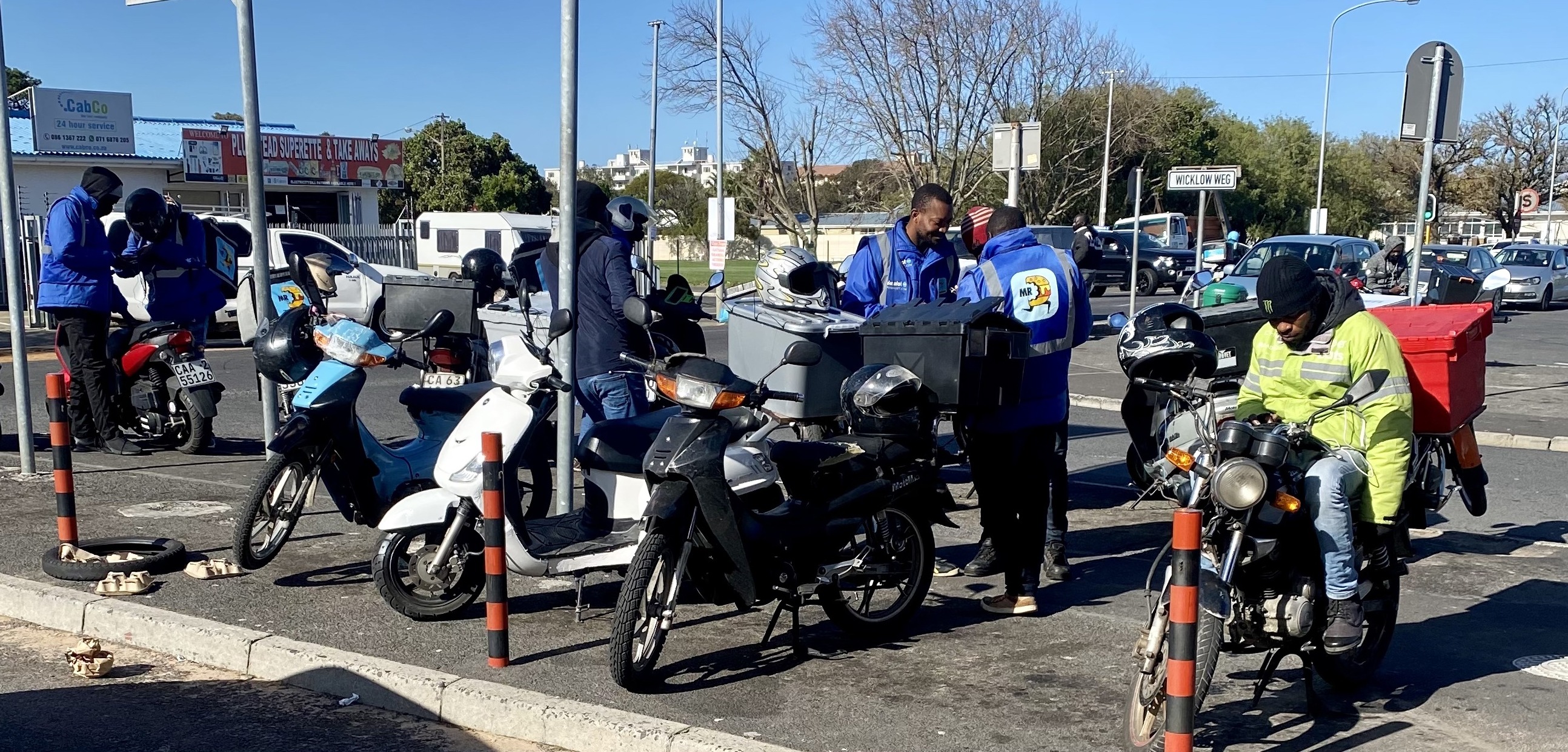
 Delivery riders need better streets and facilities. (Photo: Bianca Coleman)
It is lunchtime in Cape Town’s city centre. Summer is at its peak, and it is sweltering outside. You are popping out of the office for a bite to eat. On your way, a cluster of haphazardly parked motorcycles block the pavement, and you need to step into the road and dodge the oncoming traffic to reach your destination. There is no way through for parents pushing prams and wheelchair users.
On the same pavement, exhausted delivery riders are sitting for a moment’s rest after who-knows-how-many near misses with who-knows-how-many SUVs. These workers, kitted in branded company jackets, are on the asphalt in desperate need of some shade. Something is not right here.
Our streets and shopping precincts were designed long before the delivery motorcycle boom. Consequently, the riders who transport our online shopping do not have designated spaces to stop for pick-up, rest, eating, vehicle servicing or going to the toilet, representing a public health concern. Without any alternatives, riders park illegally on the pavement, often resulting in repeated fines of R500 a pop.
In some cases, vehicles are impounded and may cost thousands of rand to release. For an industry that has built its reputation on smooth operations, this is an inefficiency. For delivery riders, it can be harrowing. For pedestrians, certain areas have become difficult to navigate safely.
In a recent Daily Maverick article on this subject, Councillor Mikhail Manuel, chairperson of the City of Cape Town’s Urban Mobility Portfolio Committee, says Capetonians would be happy to chip in an extra R2 for riders to have dignified waiting areas. But it is not the responsibility of the consumer to provide a company’s workers with dignified working conditions.
Companies have a duty to ensure that the workers flying the flag of their brands all around our city have places to stop, rest and use the toilet. It is also their responsibility to ensure that their business does not impede the pedestrian experience. The City equally shares these responsibilities and its role is to regulate and enforce them.
Manuel’s article suggests that the companies should approach landlords to negotiate rented spaces for delivery-rider hubs. While this may work in some cases, the problem may require a land-use solution that is more scalable. There are thousands of car parking bays in the City of Cape Town. We already have reserved bays for a variety of users and uses including loading, minibus taxis, residential permits and disabled access.
Considering current demand, the time has come to designate and protect bays for delivery riders. Considering the amount of public road space that is designated for private cars, there is a broader question of how we allocate this space given the increase in commuters on two wheels and non-car alternatives.
In the meantime, local organisations, in partnership with online delivery platforms that are realising the urgency of the situation, have been showing that relatively small-scale interventions can be successfully implemented.
/file/attachments/2997/EOSR8862_433487.jpg)
Safe Mobility Hub Programme
The Safe Mobility Hub Programme, an industry-wide project managed by Young Urbanists NPC in partnership with Takealot, Mr D, Woolworths, the City of Cape Town and other stakeholders, converts on-street car parking bays to parking for delivery riders, protected by bollards and kerb separators. The Safe Mobility Hub is implemented at different tiers, starting with simple motorcycle parking bays and progressing to amenities such as modular seating, shade, Wi-Fi and toilets.
In bustling Bree Street, home to one of three Safe Mobility Hub sites in the city centre, delivery riders now enjoy 14 designated rider bays and comfortable seating for breaks while the pavement is clear for pedestrians to walk freely and safely. Here, riders can stop in designated areas without the stress of potential fines or impoundment.
For example, if a delivery fleet operator with 100 motorcycles avoids 10 impoundments a year because of the Safe Mobility Hub intervention, that could save nearly R30,000 a year in impoundment charges. The breakdown of this is that the City charges R2,446 for towing vehicles away. An associated administration fee of R161.80 per vehicle and an initial storage fee of R206.30. This all adds up to R2,814.10 for an impoundment.
As well as meeting the needs of last-mile delivery riders, the Safe Mobility Hub also benefits last-mile commuters and pedestrians. All two-wheelers are free to park at the Safe Mobility Hub, leaving the pedestrian space uncluttered. The seating area is also open to everyone, improving the overall quality of the street.
CitiPods, a partner of the Safe Mobility Hub programme, is a local organisation addressing the challenges facing rider dignity. CitiPods provides modular structures with sheltered seating areas, toilet facilities, phone charging and internet connectivity. Each CitiPod is designed to be sympathetic to its surroundings while responding to the specific needs of each site.
The structure helps maintain an orderly shopping precinct, keeping delivery riders off the ground and out of the car lanes, while a dedicated pod manager ensures smooth daily operations. CitiPods uses a funding model that shares implementation costs among a range of stakeholders, reducing the financial burden on any individual party. With support from Uber Eats, the launch of the first CitiPod at Constantia Village on 14 August marked a genuine milestone in advancing rider dignity. Another CitiPod will soon be installed at the V&A Waterfront.
Local South, together with Langa Bicycle Hub, the University of Cape Town’s Centre for Transport Studies and other partners, recently piloted the Micro-Mobility Hub project in Rondebosch, Observatory and the city centre. These sites provided varying combinations of designated parking bays, seating, shade, water, toilet facilities, Wi-Fi and device charging points.
Although delivery riders were initially sceptical of these interventions, they quickly became well-used and appreciated. In the final report for the Micro-Mobility Hub pilot published in April, Local South included testimonies from users of the facilities.
“I’m so happy for the project,” says Eric, a delivery rider from Burundi who used the hub outside the Long Street McDonald’s. “You made our lives easier.” Despite the project’s success in keeping two-wheelers off the pavement, local government authorities recently reverted the site back to the previous car parking bay arrangement.
/file/attachments/2997/Image02_346731.jpeg)
Future regulation of last-mile sector
Manuel is right in saying that companies with last-mile operations could solve these issues and provide dignity to delivery riders in a matter of months. Even without regulatory requirements, companies have already demonstrated significant interest and support for those stepping in. These pilot initiatives provide early signs of success that the City can use to inform future regulation.
As an interim solution, companies in the last-mile sector should support initiatives such as those proposed by Young Urbanists, CitiPods and Local South. In the long-term, future land-use applications for restaurants and retailers that intend to use last-mile delivery operations must incorporate dedicated space for last-mile delivery riders.
In addition, the City must allocate more kerb space for essential facilities such as public seating, toilets and parking for two-wheelers. This does not involve the privatisation of public space. By adding public amenities that delivery riders require, such as seating, toilets, shade, charging facilities and internet connectivity, the quality of public space is improved not just for last-mile delivery riders, but for everyone. DM
Dylan Kesler is an urban researcher at Young Urbanists specialising in public transport and last-mile mobility. Jenny Dove is a sustainability professional and entrepreneur, and co-founder of CitiPods.
Comments
Scroll down to load comments...