




 The war between Basic Education Minister Siviwe Gwarube and Director-General Mathanzima Mweli has spilt over into textbook procurement. (Illustrative image: Siviwe Gwarube (Photo: Luba Lesolle / Gallo Images) | Mathanzima Mweli. (Photo: Frennie Shivambu / Gallo Images) | Textbooks. (Image generated with Google Gemini Flash Image 2.5)
For five months, the Department of Basic Education has been embroiled in an increasingly confusing and bitter dispute over its new Foundation Phase textbook catalogue.
The row was ostensibly catalysed by the publication of a media report casting doubt on the outcome of the catalogue process and relaying the disbelief of publishing insiders at the result.
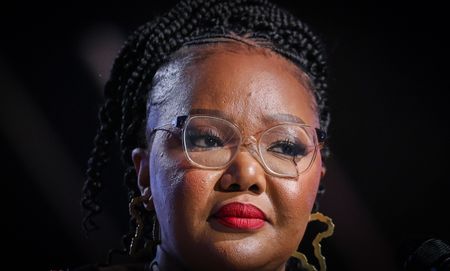
At least five separate investigations into the textbook catalogue ordered at the behest of Basic Education Minister Siviwe Gwarube have followed.
Daily Maverick has now obtained the two full forensic reports produced by independent investigators Rakoma & Associates, the Auditor-General of SA’s (Agsa’s) dedicated review of the Foundation Phase catalogue contained in the Agsa’s management report for the Department of Basic Education’s (DBE’s) 2025/26 audit, and the external legal opinion obtained from Chris Erasmus SC and advocate Hanny Kelaotswe.
These reports reveal administrative aspects of the catalogue process for which the DBE can rightly be criticised and should address: in particular, its failure to formalise important parts of an unusual procurement system and to disclose aspects of its pricing methodology upfront.
But these reports categorically do not show the corrupt, manipulated or fundamentally compromised catalogue invoked by big publishing houses and seemingly being used to justify the political decision to keep the catalogue suspended.
Not the forensic investigators, not the Auditor-General and not the external lawyers who have closely studied this matter have concluded that the catalogue outcome was unfair, illegal or manipulated. Not one of these reports has recommended that the catalogue outcome should be scrapped.
/file/attachments/2997/IMG_3582_685903.jpg "Screenshot")
Just as importantly, the forensic report focused on Lighthouse Publishers, the tiny newcomer whose extraordinary success ostensibly triggered this saga, entirely exonerates Lighthouse of any wrongdoing.
This has not been made public in any way – despite the fact that Lighthouse’s directors and staff have spent almost half a year under a cloud of suspicion and have paid a high reputational price.
The people behind Lighthouse are victims of a political battle in which they played no part. But the much larger group negatively affected by this are the pupils of grades R to 3 in South African government schools who are now likely to spend another year being taught with materials from a catalogue that has not been overhauled for 14 years.
And the age of the catalogue shows: the books for these early grades that are supposed to spark a lifelong love of reading are tired, uninspiring and littered with Eurocentric names and concepts that probably make little sense to the average South African 6-year-old.
/file/dailymaverick/wp-content/uploads/2022/02/MC-LRC-Books-Main-pic.jpg "Learners study under difficult conditions after teachers divided a classroom in two to accommodate other learners at Balasi Junior Secondary School in Qumbu, Eastern Cape. The school was damaged by storms. A lack of textbooks and stationery are making learning at more than 1,000 schools in the province very difficult. (Photo: Felix Dlangamandla / Daily Maverick)")
What the investigations actually found
Rakoma & Associates conducted two investigations: one specifically into allegations concerning Lighthouse and another small publisher, and a much broader forensic and procurement-compliance review of the entire catalogue.
The findings of the first investigation could hardly be clearer: Rakoma found no evidence that Lighthouse had been improperly favoured or that it had in any way violated the terms of reference. It concluded that the publisher’s books underwent the same anonymous screening and quality-assurance processes as everyone else’s.
The one concern it did identify related to future delivery capacity, as Lighthouse is a new company and would have to demonstrate that it can print and distribute material at scale.
/file/attachments/2997/Screenshot2026-09-14at215009_681940.png)
But Rakoma explicitly treated that as a future operational risk, not evidence of misconduct or an irregularity in Lighthouse’s inclusion. Its recommendation was to retain Lighthouse on the catalogue.
The broader Rakoma report was tougher on the DBE, identifying governance weaknesses, inadequate record-keeping, and a pricing and allocation methodology that should have been more clearly communicated upfront.
/file/attachments/2997/IMG_3581_299669.jpg "Screenshot")
It recommends that the National Treasury should give its stamp of approval before provincial procurement from the catalogue begins, specifically to prevent irregular expenditure.
But Rakoma’s ultimate recommendation is that the DBE should “reject the option of setting aside the catalogue; instead, preserve the approved 6,385 titles under a regularised, Treasury-ratified framework to protect classroom delivery for the 2027 school year”.
Importantly, Rakoma also did not conclude that the underlying evaluation was corrupted by the governance failures it identified. On the contrary, its report found that the catalogue process was “substantively fair, equitable, transparent, competitive, and cost-effective”.
This was the same finding as the external legal opinion and the Auditor-General.
The textbook review findings contained in the Agsa’s management review of the DBE stated: “The process followed was consistently applied to all submissions, thereby achieving fairness”.
The Agsa recommended formal incorporation of the catalogue process into the supply chain management as procurement by “other means”, more detailed formalisation of procedures, roles and the pricing review system, and stronger conflict-of-interest controls, among other measures.
The Agsa did not recommend that the DBE cancel or suspend the catalogue; rerun the evaluation process; remove Lighthouse from the catalogue; prevent provinces from procuring from the catalogue; or even obtain Treasury condonation before moving forward with it.
A great deal of public confusion over the textbook issue could be relieved by simply publishing the relevant reports.
Gwarube has said that external legal counsel is now required to ratify the findings of the independent forensic investigators, given that they are not lawyers. This is sensible on the face of it, but hard to square with the reality that there now appear to have been at least five separate investigations into this catalogue.
The first was a Treasury probe, which was reportedly “inconclusive”; the second was an opinion from DBE’s internal audit, which reportedly found unspecified “issues”; and the third, fourth and fifth investigations are those referred to here from external parties.
What now seems to be clear is that none of these investigations – which have presumably cost fairly significant amounts of public money and government resources – has produced meaningful evidence of wrongdoing or corruption in the textbook catalogue process.
So why is this much-needed catalogue still in suspension?
The political battle underlying the textbook row
The most likely explanation is purely political, and at its heart involves just two personalities: Gwarube and her department’s director-general, Mathanzima Mweli.
It is an open secret that Gwarube and Mweli are at war with each other, with Gwarube accusing Mweli of undermining her leadership and leaking information to the ANC, while Mweli’s complaint appears to be that Gwarube is meddling in the administrative processes of the department, which should be his domain.
Disciplinary action against a department’s director-general can only be undertaken with the approval of the President, and Cyril Ramaphosa is known to be reluctant to move against DGs due to the destabilising impact this can have on departments.
/file/attachments/orphans/Vince-Suliman-Carrim-SIU10_704749.jpg "South African President Cyril Ramaphosa inspects the Brazilian presidential guard of honor during a welcome ceremony at the Planalto Palace in Brasilia, Brazil, 09 March 2026. President Ramaphosa is on a two-day state visit to Brazil. (Photo: EPA / ANDRE BORGES)")
The President’s attitude to the inevitable conflicts that have arisen since the formation of the Government of National Unity between DA ministers and departmental top officials, many of whom are ANC-aligned despite officially mandated political neutrality, has been hands-off.
In other words, Ramaphosa is unlikely to act against Mweli, even on Gwarube’s request, unless there is clear-cut evidence of serious wrongdoing on Mweli’s part –and when the textbook catalogue row first erupted, Gwarube may have believed she had her best chance to rid herself of a troublesome DG.
That is because the textbook catalogue process has been Mweli’s baby, so allegations of corruption or maladministration around it may have seemed like a political gift. Add to this Gwarube’s pre-existing suspicion of her DG’s actions and motives, and it is not hard to understand why the minister has been hellbent on pursuing this matter.
But whatever Mweli’s other failings, we are now at a point where the textbook catalogue issue looks like a clear dead-end in providing justification for a move against the DG.
The decision to keep the catalogue frozen also seems increasingly questionable in a situation where none of the external reviews obtained thus far has found the catalogue outcome corrupt, manipulated or unfair, and the principal forensic investigation explicitly recommended preserving it.
If it can do so, the DBE should surely fix the governance defects, obtain the Treasury sign-off Rakoma recommends and get these fresher books into classrooms as soon as possible. If it does not, South Africa’s youngest pupils will pay the price of becoming collateral damage in a fight that, by now, appears to have very little to do with textbooks. DM
Comments
Scroll down to load comments...