




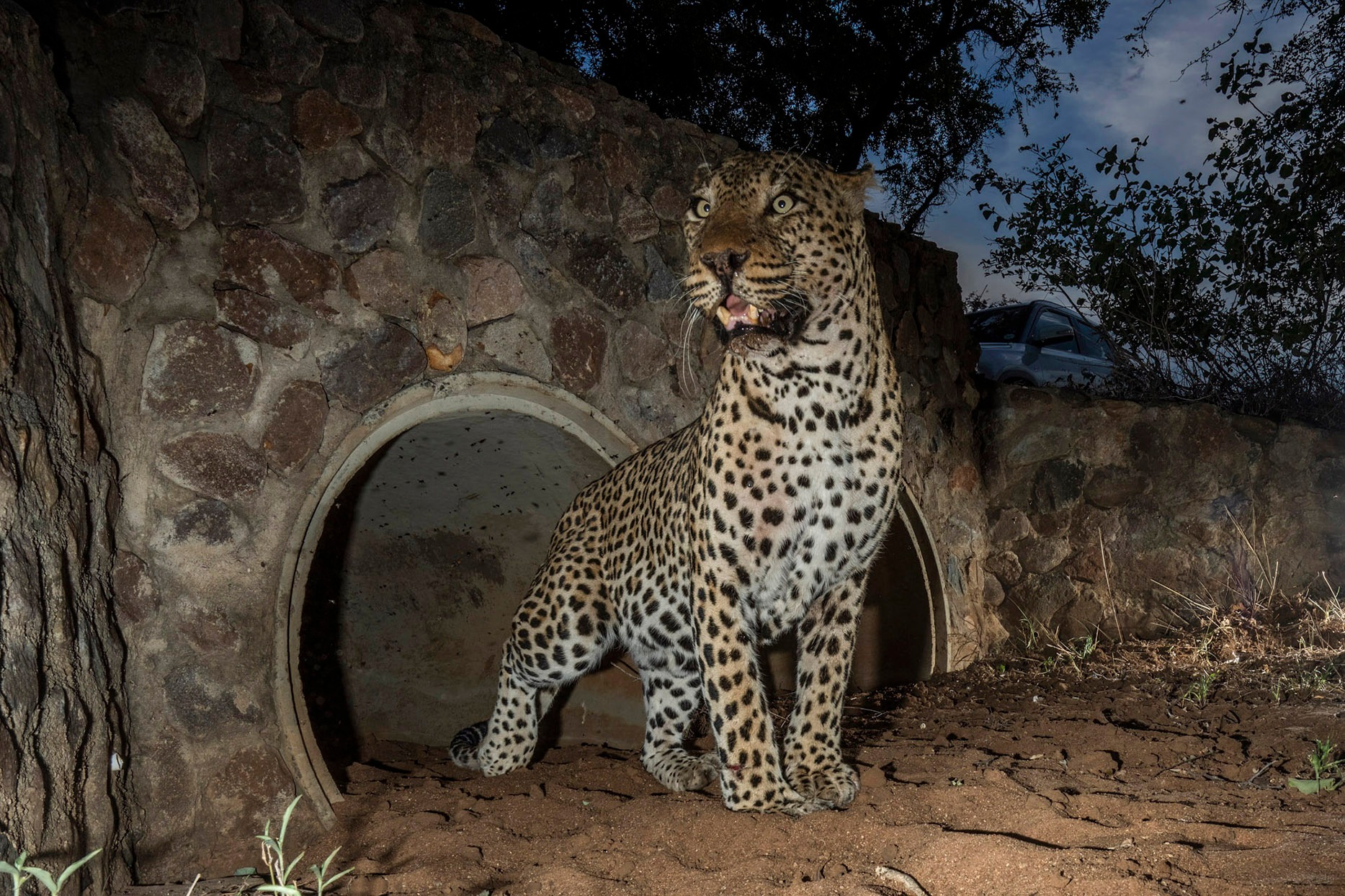
 ‘Mafu’ emerges from a culvert at Hoedspruit Wildlife Estate on 17 December 2024. (Photo: Daniel Newton)
Somewhere along the R40 through Hoedspruit, South Africa’s safari capital in Limpopo province, a leopard reaches the road and has a choice.
It can cross the asphalt, where cars move through the increasingly urban landscape outside Kruger National Park. Or, it can disappear into a concrete opening beneath it.
The opening was never intended for a leopard, because it is there to move water underneath the road.
These big cats are using it anyway.
So are other animals, according to researchers studying wildlife movement along the busy artery tracing the park’s western boundary.
What road engineers call “culverts” have consequently become the subject of a conservation investigation to reduce wildlife road deaths. The Road Ecology Project, run by the Ingwe Research Programme, is trying to establish how animals negotiate a road laid across their movement corridors, why they use some of the tunnels beneath it and pass others by, and what might persuade more wildlife to go under, rather than over, it.
The answer, according to Africa Geographic’s new Spots on the Line documentary, could eventually involve engineering larger passages and directing animals towards them.
The documentary reveals why that is important – between May 2024 and August 2026, nine known leopards were killed on the region’s roads in collisions with cars – seven of these incidents were recorded on the R40. Several leopards were hit along a single 15km stretch.
Marine Servonnat, Ingwe executive director, would make the underground passages bigger if she could redesign the highway now.
“If we had the funding and authority, we would replace the current culverts so they are all at minimum 90cm in diameter,” she says. “It’s still not a simple fix: it’s a significant, site-specific engineering project and, on an artery like the R40, where the alternative route adds 30km on roads in poor condition, any solution has to work around keeping the road open.”
The secret traffic beneath the road
Before anyone starts rebuilding, however, Ingwe’s researchers and collaborators say they need to understand what is already happening beneath the traffic.
Christoffel de Lange, a research assistant with Transfrontier Africa NPC, a research partner in the project, says the study began with several basic knowledge gaps. Were animals already using these passages? If so, how often? And what made them more likely to use one?
The dry-season data delivered a clear answer to the first question. “There’s a number of species already using the culverts,” De Lange says, “from porcupines through to leopards, genets and warthogs.”
Some are using them remarkably often. “Porcupines use the culverts, if I remember correctly, more than 40 times per week.”
Leopards were also recorded commuting through the passages multiple times a week.
/file/attachments/orphans/ME-Tiara-LeopardRoadSolutions2_794543.jpg "A leopard on Hoedspruit Wildlife Estate, Limpopo, 29 October 2020. (Photo: Owen Gröbler)")
For De Lange, those rates suggest that existing culverts could become a valuable tool for reducing wildlife road deaths.
“We also managed to identify a couple of factors that influence culvert usage, things such as culvert openness and distance to gates,” De Lange says. Of course, researchers have also found that not every species chooses to go underground. Some simply stroll past.
Then the rains come and the picture seems to change again. The wet-season data are still being analysed, but culvert use seems much lower during the wet season, says De Lange.
These details may seem obvious, but they are important to understand how and when wildlife is ever going to treat any existing drain seriously as infrastructure. An opening beneath a highway may look like a safe crossing to a person, but the animal gets the deciding vote.
“We have an assumption that this is due to water within the culverts. It is one of the factors that we are still going to test,” he says.
What makes a good tunnel for a leopard?
This project is thus starting to gather something like a fauna “wishlist” for the road: how large a passage should be, where it should sit, what should surround it and how it should be maintained.
For Servonnat, the work also extends beyond fixing places where animals are already known to be at risk.
“We are collecting a range of variables that will allow us to understand what characteristics make a location particularly deadly,” says Servonnat.
If those patterns can be identified, researchers may eventually anticipate where dangerous wildlife crossing points are likely to occur instead of waiting for roadkill to reveal them.
“Once year two of data collection is completed,” she says of this relatively new project, “we will have a much better understanding of where exactly the solutions should be implemented.”
/file/attachments/orphans/ME-Tiara-LeopardRoadSolutions7_127709.jpg "An unknown leopard spotted in the Hoedspruit, Limpopo area, 6 June 2025. (Photo: Bruce Topham)")
When a dog’s nose goes where cameras can’t
Finding a leopard’s route through the landscape presents another problem: leopards, naturally, are not particularly interested in cooperating with researchers.
A camera trap watches a small piece of ground – unless the animal passes through that patch, the camera sees nothing.
Aliénor Brassine, a natural scientist and fauna specialist working on the project, is testing whether a dog’s nose can help fill some of those blank spaces.
The conservation detection dogs are being trained on leopard scent, initially using known target odours such as verified leopard scat. Training becomes progressively more challenging, and the dogs are deliberately exposed to scents from other animals. They are not rewarded for merely finding the smell of another carnivore.
“The dog needs to learn that leopard is the target,” Brassine says. “The dogs have been consistently reliable at identifying leopard scat during training.”
/file/attachments/orphans/ME-Tiara-LeopardRoadSolutions1_377306.jpg "Alienor Brassine trains a conservation dog in the Greater Kruger region, April 2026. (Photo: Africa Geographic)")
The more ambitious prospect – detecting transient scent such as urine or traces left by an animal moving through an area – is harder to validate.
Brassine is cautious about claiming more than the dogs can currently demonstrate. The work remains in a training and pilot phase, and she says she wants more opportunities to test the dogs on independently confirmed leopard scent deposited naturally in the landscape.
“The advantage is that dogs and cameras are effectively sampling different things,” says Brassine.
If a dog “repeatedly indicates leopard scent at a particular fence opening, trail or culvert”, researchers could place cameras there and investigate further.
“A dog’s indication tells us that it has detected the target odour,” says Brassine. “Determining whether a particular location represents a regular road-crossing point requires additional evidence.”
The dog’s nose finds the clues; cameras can then be moved in to watch. Together, the two methods may help researchers identify where leopards are moving through the landscape.
/file/attachments/orphans/ME-Tiara-LeopardRoadSolutions_158099.jpg "Alienor Brassine holds leopard scat for training conservation dogs. (Photo: Africa Geographic)")
Sixty cameras and a long Sanral road
For now, however, the availability of equipment and safety protocols are imposing some initial limits.
De Lange says the study “had about 60 cameras at our disposal”, restricting both the number of underground passages that can be monitored and the size of the study area. More equipment would allow researchers to monitor a longer stretch of highway, perhaps extend the work to other roads and build a larger dataset from which stronger conclusions can be drawn.
Servonnat says a local team from the South African National Roads Agency Limited (Sanral) helped researchers locate the passages in the study area and supported the installation of “Predators Crossing” signs. When the team discovered that official road-sign guidelines included animals such as kudu, warthog and elephant but no predator, Sanral helped develop a leopard sign.
They have “been very supportive. With them, we located all the culverts in the study area,” says Servonnat.
“They support the proposal that culverts should be used to allow for safe crossing, and that we must look at channelling game towards the culverts by means of fencing or other barriers, without compromising road safety,” she says.
Mukovhe Gangashe, route manager for Hoedspruit Routine Route Maintenance, says he helped facilitate access to Sanral senior provincial officials and permission to use the road reserve.
He notes that the collaborative project “can still achieve more by extending its scope of work to monitor the movement of predators along the road, which would provide an effective way of preventing further accidents”.
But gathering more data runs into the practical constraints of managing a densely populated road outside the national park and neighbouring network of private and provincial reserves.
Gangashe says road-safety rules governing where monitoring devices can be installed are a “major challenge” and can restrict researchers’ ability to collect additional data, even as the project seeks a clearer picture of predator movement along the R40.
/file/attachments/orphans/ME-Tiara-LeopardRoadSolutions6_874665.jpg "Unknown female on R40, 6 October 2024. (Photo: Supplied)")
Hoedspruit starts watching the route
The idea may already be travelling: researchers cite growing awareness as one of the project’s biggest interventions.
Preliminary findings have been presented at conferences around South Africa, says De Lange. And discussion of the work has spread elsewhere in Limpopo to the Waterberg, where culverts are also being considered as safer wildlife crossings.
Locally, people living around Hoedspruit have become a source of information. Servonnat says residents have reported roadkill and wildlife crossings, shared examples of solutions used elsewhere and voiced concerns about the loss of wildlife and road safety.
“We have given them a voice and made them feel part of the project,” she says. “It’s not only an Ingwe project; it’s a Hoedspruit project that includes all its people and businesses.”
Servonnat believes familiarity with individual animals can also encourage coexistence. Naming a leopard, she says, can help residents follow its life.
/file/attachments/orphans/ME-Tiara-LeopardRoadSolutions5_887933.jpg "Tlanga, a leopard born in Hoedspruit Wildlife Estate, Limpopo, as pictured in 2023. Tlanga is now thought to roam nearby Kapama Private Game Reserve. (Photo: Owen Gröbler)")
Sometimes, the answer is a shovel – and a town ‘as one big team’
Since data are still being analysed and dogs being tested, the research is not yet at the point of prescribing final interventions. The researchers still want to publish their findings and use the evidence to make “practical scientific recommendations” about the design, placement and maintenance of the passages, says Servonnat.
Some of that will require money and engineering. Servonnat’s larger tunnels would be significant infrastructure projects. Monitoring a longer stretch of highway would require more cameras, staff, fuel and time.
But the animals moving beneath the road have already established something useful. They will use infrastructure that was never designed for them.
And one of the interventions is considerably more ordinary.
Some of the tunnels simply need to be kept open.
“Next, we’ll get on with cleaning the culverts that are blocked to ensure better wildlife passage,” says Servonnat. “And we’ll do it with the residents of Hoedspruit as one big team.”
De Lange says the majority of culverts along the study route are blocked. The immediate remedy can be remarkably simple: “Keep the culverts clean, maintain the culverts.”
A blocked culvert, as he puts it, “is useless to an animal”. DM
For the full investigation, watch Africa Geographic’s Spots on the Line documentary.


Comments
Scroll down to load comments...