




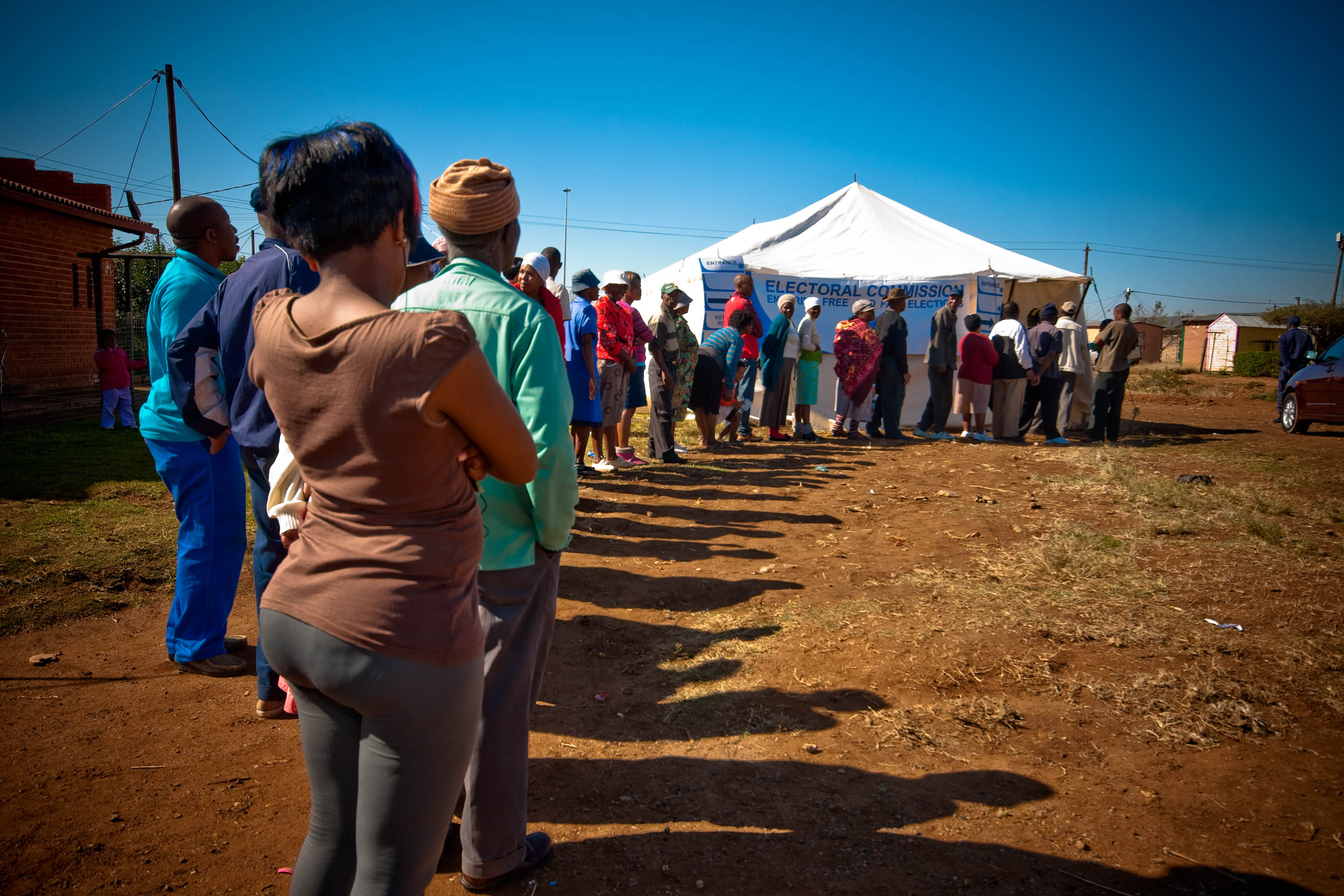
 South African residents wait in a long queue at a voting station in Sebokeng, Johannesburg, South Africa, on 18 May 2011 to cast their votes in the municipal elections. (Photo by Gallo Images/Frank Trimbos)
In her doctoral study, Dr Modise examined voter turnout in South Africa between 1999 and 2019. Her work shows that declining participation cannot be explained by attitudes alone. It is shaped by the interaction between citizens’ beliefs and the institutions through which democracy is practised.
This is an important intervention. For too long, public debate has treated voting as a simple moral instruction: citizens must turn up. That remains true. Voting matters. But democratic participation also depends on whether citizens believe their vote can influence political outcomes, whether institutions encourage real accountability, and whether electoral systems make people feel represented rather than merely processed.
Dr Modise’s research highlights one of the central tensions in South Africa’s democratic journey. Proportional representation is generally expected to support broader participation and multiparty competition. Yet, in South Africa, prolonged one-party dominance before 2024 contributed to perceptions that political outcomes were difficult to change. When concerns about service delivery, unemployment, poverty and inequality persist, voters may begin to question whether casting a ballot produces meaningful consequence.
That is not indifference. It is democratic disillusionment.
The distinction matters. If low turnout is dismissed as laziness, the response will be shallow: more reminders, more slogans, more appeals to civic duty. But if declining turnout reflects weakened voter efficacy, then the response must be deeper. Institutions, political actors and society must rebuild the link between participation and visible accountability.
This is where university-based research becomes essential public infrastructure. Dr Modise’s work does not simply describe a political trend; it gives South Africa a clearer language for understanding it. It broadens the discussion from who votes to why voting feels meaningful, or meaningless, in the first place.
Therefore, the purpose is to use rigorous political research to shed light on a challenge at the heart of South Africa’s democracy. By showing how electoral institutions and voter attitudes influence one another, the research offers policymakers, civic educators, political parties and citizens a stronger framework for restoring democratic participation.
For NWU, this is the kind of scholarship that strengthens the university’s public role. It demonstrates research that is not confined to lecture halls or academic journals, but speaks directly to national life. It helps society interpret its own warning signs. It asks better questions, and better questions are often where renewal begins.
Democracy does not only depend on the act of voting. It depends on citizens believing that participation matters. If South Africans are staying away from the polls, the answer is not to scold them back into line. The answer is to understand the conditions that made withdrawal seem rational, and then to rebuild trust with seriousness.
The key takeaway is that informed citizenship, institutional accountability and democratic renewal do not happen by accident. DM
/file/attachments/2997/DrNM_453353.png)