




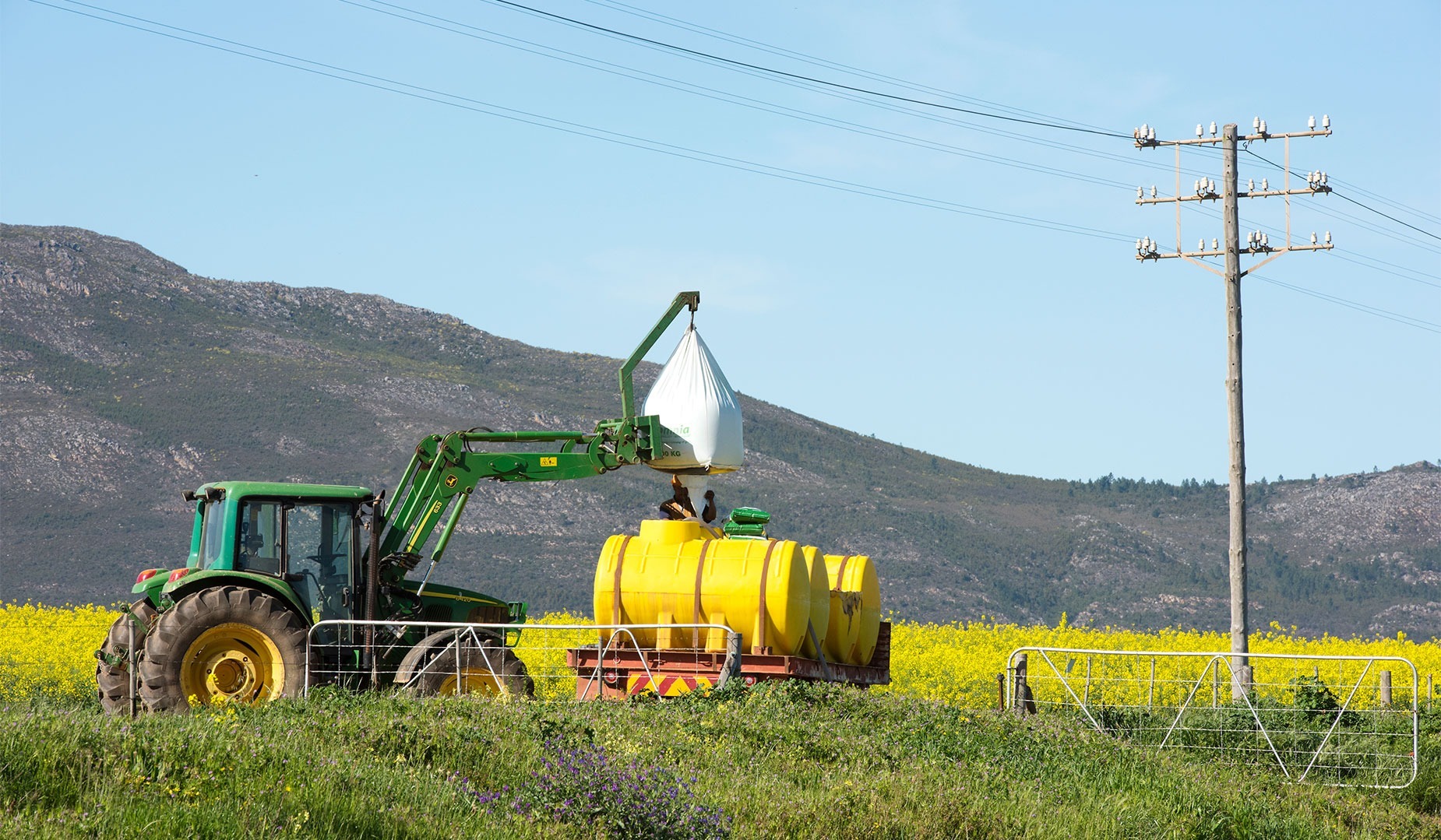
 The use of agricultural chemicals and fertilisers is necessary with high-production crops, but there is an environmental cost in many instances. (Photo: Gallo Images / Michael D Kock)
 This is the fifth in a six-part series. Read Part One, Part Two, Part Three and Part Four.
Plant ecologist Eugene Moll describes the Western Cape as a land capable of forgetting itself. Plough renosterveld for long enough, he says, and its seed bank expires. The wildflowers, bulbs and grasses no longer return by themselves.
/file/attachments/orphans/Seapesticide2CropdusterimageiStock-_293937.jpg "A crop duster sprays chemicals onto farming fields. (Photo: iStock)")
Farm chemicals are a less-visible part of that story, but their effects can travel. Sprays can wash into streams, seep into groundwater or drift through the air. At high levels they can threaten the insects and other small creatures that keep rivers alive.
Repeated use may also disturb the microscopic fungi and bacteria that recycle nutrients in soil. The damage is easy to miss because the water may still look clear and the crop may still look green.
Western Cape studies have found dozens of farm chemicals and their breakdown products in agricultural rivers. Most were at low levels, but several crossed the limits scientists use to warn of danger to aquatic life.
/file/dailymaverick/wp-content/uploads/2024/01/pest-6.jpg "Tony-pesticideOrange pest 6")
That doesn’t make farmers villains. Wheat and grape growers face dry summers, stubborn weeds, fungal disease and crop-eating insects. A bad outbreak can erase a season’s income.
Weedkillers, fungus treatments and insect killers protect the harvest. The challenge is to keep that protection while stopping as much as possible from escaping beyond the crop.
The first of three studies I consulted followed the trail into water. Lou Curchod of the Swiss Tropical and Public Health Institute and colleagues monitored three Western Cape farming areas during the severe 2017-18 drought.
They collected spray records from 38 farms and placed samplers in the Krom, Berg and Hex rivers, gathering traces over two weeks.
/file/attachments/orphans/IMG-20260728-WA0020_848680.jpg "The Hex River, which flows through the Kleinburg Kriegler Farms in De Doorn, in the Cape Winelands, Western Cape broke its banks in May 2026, flooding several vineyards in the area. (Photo: Kleinburg Kriegler Farms)")
The records show that wheat and grapes face different enemies. Around Piketberg, wheat farmers relied mainly on weedkillers (2,4-D, bromoxynil and MCPA). Grape growers used more treatments against mildew and other fungal diseases (penconazole, mancozeb and spiroxamine).
Wine-grape farms were among the heavier users in the survey. These products don’t directly boost growth. They remove the weeds, diseases or insects that compete with the crop.
The river acted like a diary of the farming year. The team found 53 different chemicals and breakdown products. Most stayed below the researchers’ warning lines.
However, four insect killers (imidacloprid, thiacloprid, chlorpyrifos and acetamiprid) and one weedkiller (terbuthylazine) crossed those danger lines at least once.
That doesn’t mean the water was poisonous for people, and unfortunately the study didn’t monitor dead fish or insects. But crossing them is a warning that these creatures may be at risk. The researchers concluded that “a wide variety of pesticide compounds is present in streams draining agricultural watersheds”.
The timing of certain chemicals in the rivers closely followed the staging of their use on farms. What went onto the land did not always stay there.
/file/dailymaverick/wp-content/uploads/2022/02/GettyImages-1128827145.jpg "BM-Ed-Agriculture option 1")
A later study asked where these chemicals were coming from and found a more tangled story. Emma Davies at Stellenbosch University and colleagues returned to the Grabouw, Piketberg and Hex River areas in 2022 and 2023.
They found two insect killers (imidacloprid and chlorpyrifos), a weedkiller (terbuthylazine) and a fungus-fighting treatment (spiroxamine) had again crossed protective limits. The first of these insect killers was the most persistent concern across all three areas.
But not every trace could be blamed on rain washing a freshly sprayed field. Some chemicals appeared at times when farmers were not expected to be using them. Worryingly, they may have seeped into groundwater and then slowly fed back into rivers.
In Piketberg, traces of medicines pointed to wastewater treatment plants as another possible route. Even the Jonkershoek nature reserve control site contained traces of weedkillers, perhaps from controlling invasive plants, maintaining trails or movement through the air.
In the researchers’ words, “drivers of pesticide contamination were area dependent”. Put simply, each river has its own story. Their warning that “lessons learned in one catchment may not apply generally” means solutions can be aimed at the real local problem. One area may need better farm buffers and spray timing. Another may need cleaner wastewater treatment or closer attention to groundwater.
The third study looked beneath the boots rather than downstream. At Langgewens Research Farm, Flackson Tshuma from Stellenbosch University and colleagues compared different ways of growing wheat.
/file/attachments/orphans/WW3wheat2_320404.jpg "Wide angle view of a Combine harvester offloading wheat grain in a wagon on a farm in the Swartland in the Western Cape Province, South Africa. (Photo: Gallo Images / Dewald Kirsten)")
The usual programme included several weedkillers, two fungus treatments and an insect killer. A lighter programme retained two weedkillers (glyphosate and pyroxasulfone), removed synthetic insect and fungus treatments and added a beneficial fungus plus kelp-based plant tonics, often called biostimulants.
The lighter approach didn’t suddenly produce a bloom of new microscopic soil life. Soil is slow and a few seasons may not be enough for a hidden community to rebuild.
/file/attachments/orphans/BWRenosterveld2_436883.jpg "The stubble land of harvested wheat fields near the banks of the Misverstand Dam on the Berg River, near Porterville, Western Cape, South Africa bake under the harsh African sun, waiting for rain. (Photo: Gallo Images / Mike Copeland)")
But here came the welcome surprise: the reduced programme “did not reduce the wheat yield and quality and soil biological parameters in any way”. Gentler ploughing also improved the activity of several natural substances in the soil that help recycle carbon, nitrogen and phosphorus.
Together, the research papers offer a small repair manual rather than a miracle cure.
Keep honest spray records;
Choose the least-harmful treatment that works;
Watch the weather;
Leave planted buffers beside water;
Disturb the soil less and test biological controls carefully;
Improve wastewater plants where needed; and
Above all, keep testing the rivers and soil so that progress can be seen.
Moll’s “pedoderm”, the thin living skin on which the Cape’s abundance depends, is not beyond help. The Stellenbosch wheat trial suggests that farmers may be able to use fewer chemicals without giving up the harvest. The river studies show where action is most urgent and how we can check if it is working.
A landscape can forget itself, but careful farming and patient science can help it remember more.
Tomorrow: Some thoughts about the future of wheat and wine farming


Comments
Scroll down to load comments...