





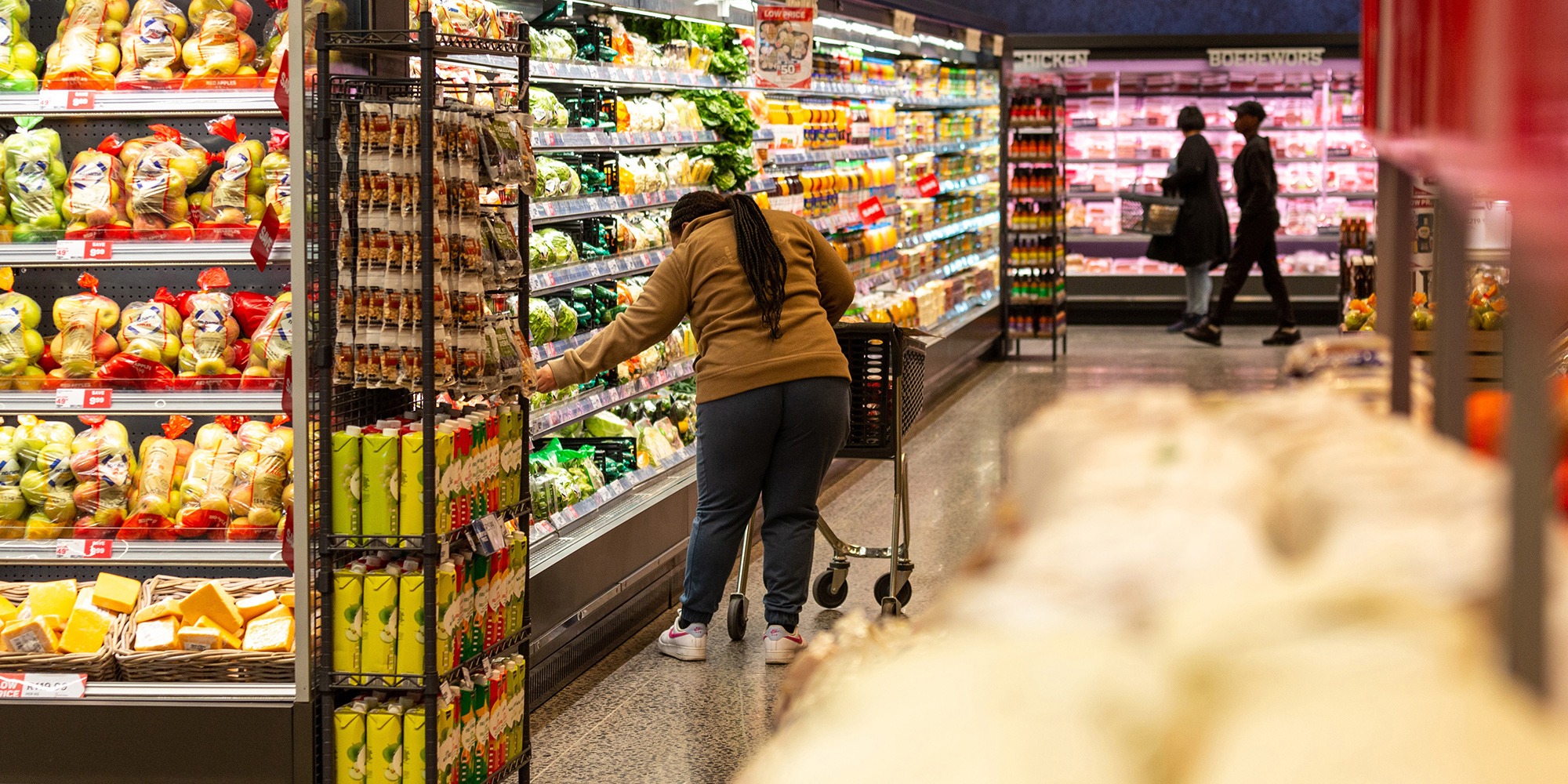
 Some supermarkets will use slower-tempo music to encourage shoppers to take their time and be tempted by more products than they need. (Photo: Dwayne Senior / Bloomberg via Getty Images / File photo)
While consumers cannot be controlled, they can be influenced.
Influencing consumer behaviour, such as how long they spend in a store, their browsing time and how much they buy, is a science, Roland Goldberg, an expert in consumer behaviour and associate professor at North-West University, tells Daily Maverick. Strategies range from the store layout and lighting to pricing, he says.
A daily pilgrimage for essentials
Although consumers are not always aware of the messages present in stores, these cues are not always hidden, Goldberg says. It is not by accident that people are “greeted” by flowers at the very front of a store. These flowers are strategically placed to lure the consumer into the store, he explains.
Goldberg adds that a consumer visiting a store for a daily item, such as bread, milk or eggs, will have to venture to the back of the store.
“I call it the ‘bread and milk pilgrimage’ to actually venture through the store to get to those items, because if those items were placed in front of the store, the consumer would come, grab that item, go to the till area and then leave without being exposed to the rest of the store,” Goldberg says.
He explains that research shows that retailers place daily essentials at the back to force consumers to pass by other products that they typically do not intend to buy. After being exposed to a greater array of products, there is a high chance that people will buy additional products.
Goldberg provides an example. Unhealthy foodstuffs such as energy drinks and sweets are usually placed towards the middle of the store, and consumers shopping for milk or eggs may pass the sweets or energy drink aisles and suddenly feel the need for an energy drink or sweets.
/file/attachments/orphans/Iman-retailers_674508.jpg "Supermarket brands use tactics to influence customers'purchases.
<br>(Photo: iStock)")
Appealing to the senses
Goldberg speculates that supermarkets often use lighting to influence the consumer. He has found that occasionally pinkish or reddish fluorescent light is shone onto the meat in the butchery section. He speculates that is to make the meat look more appealing and/or pink or red in colour.
“The psychological heartbeat of the store comes down to the music,” says Goldberg.
Slow tempo music slows people down, he says. Retailers specifically choose music with a tempo that is either slower or faster depending on the product to subconsciously match consumers’ walking pace to the specific beat the store is playing.
Goldberg has noticed that supermarkets rarely play high-energy or fast-paced music like rock n roll, disco or club tracks during peak hours.
“You would just grab your milk and then sprint through the aisles and leave because of that beat. Instead, they will play slower, more familiar and relaxed tracks like jazz. That slows your physical pace down, it keeps you wandering and kind of distorts your sense of time, so that you end up spending a few more rands in the store,” Goldberg says.
Buy two, get one free
Promotions also influence customers to buy products. A loss leader is where a high-demand item, such as a two-litre milk, loaf of bread and instant coffee, is sold below cost or sold at a loss specifically to stimulate foot traffic into the store and drive other profitable sales, Goldberg explains. An example of a loss leader is typically a “buy two get one free”, he adds.
Consumers don’t mentally monitor and track the prices of all items in a store, they track everyday items and high-demand items such as milk, bread or instant coffee. According to Goldberg, by aggressively discounting these known-value items, the supermarket relies on the behavioural reality that consumers rarely visit a supermarket to buy just one item.
Although the supermarket would make a loss on the known-value item, the strategy is to make a profit from the additional goods that the consumer will buy during the same trip, such as sweets, cleaning supplies, toiletries or meat. The extra purchases subsidise the initial loss of the known-value item, making the overall trip highly profitable for the store.
Loyalty programmes and social media
Loyalty programmes are what Goldberg calls a “digital handshake”. In exchange for a consumer’s data, such as the products they purchase, the consumer receives points and discounts. Data is used to regulate stock, to see how much stock should be bought and to customise personal advertising messages to the consumer, he says.
Goldberg adds that social media advertisements are strategically placed. When buying products online from a supermarket, supermarkets can track what is put in a consumer’s basket and what is frequently purchased. The products previously bought or put in a basket may be advertised on social media platforms outside of the supermarket website or app, he explains.
Targeting children
/file/attachments/orphans/Iman-retailers2_727329.jpg "Promotional signage at a QualiSave supermarket, a new brand operated by Pick n Pay Stores Ltd., during the launch of the grocery store in Cape Town, South Africa, on Monday, Aug. 15, 2022. Pick n Pay in May said it was revamping stores, targeting 3 billion rand ($181 million) of savings and seeking to be clearer in how it approached different target markets. (Photo: Dwayne Senior / Bloomberg via Getty Images)")
“Eye-level is buy level,” Goldberg says.
This is a common saying in marketing reflecting that the ideal placement of products on a shelf is at an adult’s eye level, he explains.
This tactic is used on children as well. Goldberg cites the example of the placement of cereal boxes on lower shelves to meet young children’s eye level. Studies have found that the presence of, for example, cartoon characters on cereal boxes can create an emotional connection between children and the product, he says. If it is as if the characters are making eye contact with the children
Mariaan Wicks, a registered dietitian and subject head and senior lecturer in dietetics at North-West University, says the display of characters on products is a form of child-directed marketing. Wicks conducted a study on child-directed pre-packaged food and beverages to examine the extent and types of marketing techniques used on the packaging of child-directed foods sold in South African supermarkets and online retailers, and to assess the nutritional quality of these foods.
The study identified child-directed foods as food with packaging containing two or more of the following aspects:
Pictures or cartoon images appealing to children;
Specific or unusual shapes, colours, sizes or other iconography as well as the foregrounding or emphasis of any of these factors;
Language, direct words or allusions referring to children, such as “fun”, “play” or “school”;
Puzzles, games and premium offers such as competitions, toys and giveaways targeted at children;
Cross-promotions or tie-ins with films, children’s television programmes, celebrities, games, merchandise, websites and sports teams; and
Nutrient, health or health-related claims, such as “ideal for little brain development”or “ideal for small hands to use”, which target the parent or caregiver.
Child-directed marketing is harmful because it can influence the foods bought by the household, and at a young age children can become “hooked” on products for life and continue to purchase them as adults, says Wicks.
The study found that 66% of the 516 foods included in the study were classified as less healthy. Less healthy foods are mainly highly processed foods that are high in saturated fat, salt and sugar content and have a substantial amount of evidence linking their frequent consumption to increased total energy intake and higher body mass index.
Her study found that the majority of items marketed at children were confectionery items such as chocolates, ice cream or sweets. She says this is concerning because these foods contribute towards weight gain and developing non-communicable diseases such as diabetes, hypertension or high blood pressure.
Wicks believes there is potential for using child-directed marketing to encourage children to eat healthier foods.
“Healthy food packaging is often boring, whereas unhealthy food packaging and marketing is exciting and colourful and gets your attention. Just think of cereal boxes, the sugar-sweetened cereal boxes are colourful with nice characters on it, and whereas your whole wheat, minimally processed food and cereal boxes – they're boring,” Wicks says.
She says displaying front-of-package warning labels on unhealthy foods, as Latin America has done, would promote healthier eating among children. In Latin America, products with front-of-package warning labels cannot be marketed to children, which does away with marketing power, Wicks says. She believes that without elements such as colourful packaging or games, children’s requests for specific products would decrease.
Shopping tips and tricks
Goldberg has three golden rules when shopping to avoid being influenced by supermarket tactics.
“You have to treat your handwritten shopping list like a legally binding contract,” he says.
Firstly, if an item is not on one’s grocery list, it should not go into the trolley or basket. Secondly, consumers must not go grocery shopping when hungry.
If one walks into a decompression zone or the entrance of a supermarket and smells, for example, a cinnamon roll from a bakery or rotisserie chicken from the deli, the smell will induce hunger and may influence a shopper to buy more than they had planned.
Thirdly, when shopping for a few essentials, do not take a trolley. Goldberg suggests using a hand basket or using neither a trolley nor a basket at all if only shopping for two to three items. An empty trolley may subconsciously trick the brain into wanting to fill it, but when carrying a hand basket, the moment that hand basket gets very heavy, one may be highly motivated to head straight to the till and buy only the items intended. DM
Comments
Scroll down to load comments...