




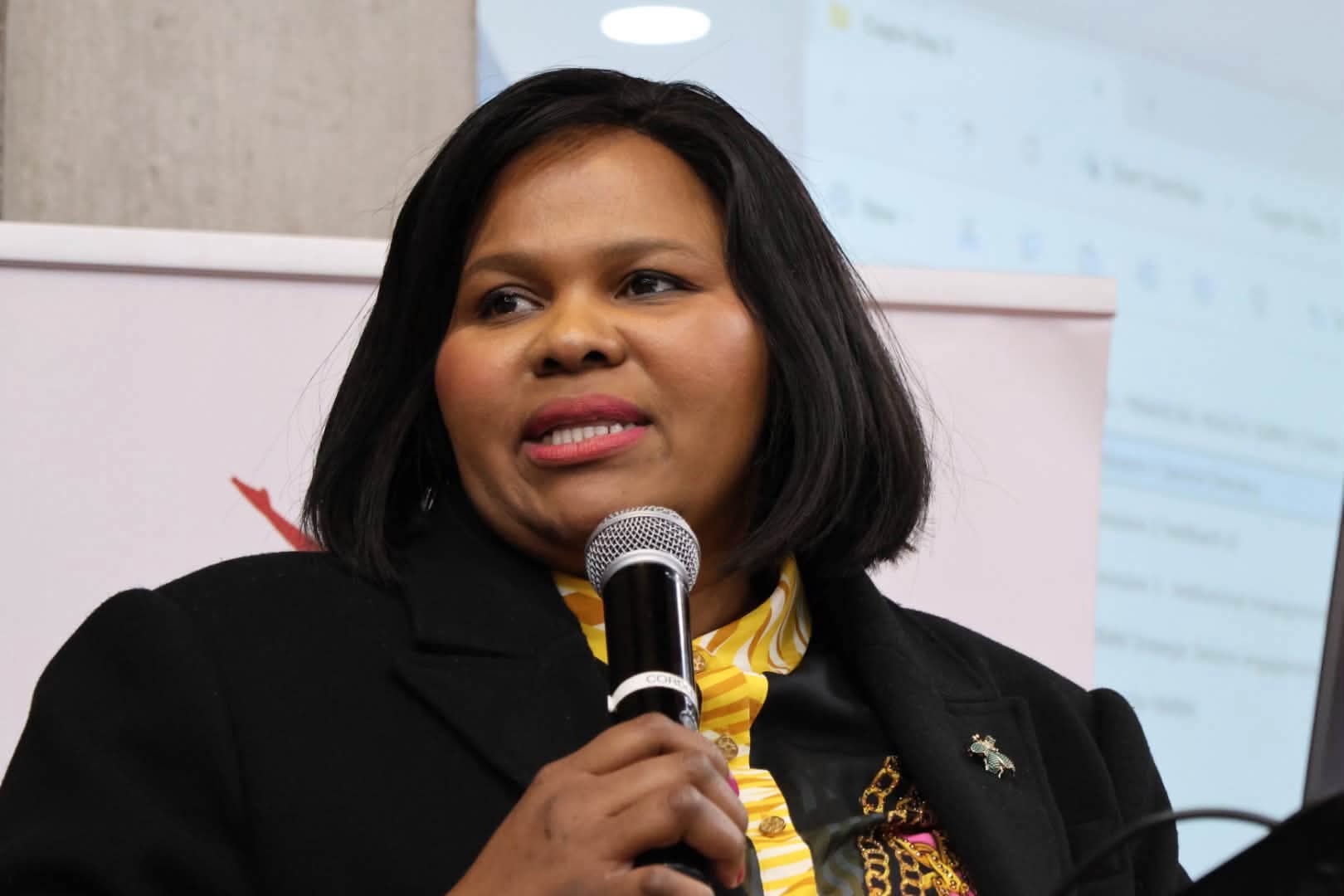
 Nelson Mandela Bay’s mayor, Babalwa Lobishe. (Photo: Nelson Mandela Bay municipality)
In parts of Nelson Mandela Bay, residents have to step over rocks placed in the street to avoid raw sewage spilling into their yards — a hazard that community leaders say has gone unresolved for years.
Suburbs across the metro sometimes go without water for days or weeks at a stretch after repeated infrastructure failures, while a pylon collapse in March left large parts of the city in the dark for close to three weeks.
Against this backdrop, Nelson Mandela Bay Mayor Babalwa Lobishe delivered her State of the Metro Address in a Despatch hall on Thursday, 10 September, painting a picture of an administration making progress.
Opposition parties in the metro were, unsurprisingly, quick to reject that assessment. So did several of Lobishe’s own coalition partners, including the EFF, which boycotted the address – delivered at a gala dinner that Lobishe said cost R235,000 in ratepayers’ money.
Nelson Mandela Bay has seen three government changes since the start of the term of office in 2021, which has resulted in instability and ultimately the deterioration of service delivery – worsened by the revolving door of city managers for nearly three years.
The problems extend beyond water and electricity, with broken streetlights, dilapidated roads and a housing development backlog compounded by the metro’s inability to spend allocated grant funds.
/file/attachments/orphans/DSC_9563-copy_582935.jpg "Gqeberha,Eastern Cape, Aloes..Street lights not working,William Moffat Express Way.
<br>.25/06/2026 (Photo: Deon Ferreira)")
The municipality is also struggling to address its ballooning unauthorised, irregular, fruitless and wasteful expenditure (UIFWE) bill dating back more than a decade, which has become a contentious matter with the National Treasury.
In her address, Lobishe highlighted what she described as the positive strides achieved by the ANC-led coalition during its term in office.
She also acknowledged significant challenges, including ageing infrastructure, vandalism, financial pressures, institutional capacity challenges and economic uncertainty.
‘Principled decision’
The event was boycotted by opposition parties, including the DA – which protested outside the venue – ACDP, Good, UDM and PA, which called it a waste of taxpayers’ money.
Coalition partners the EFF, PAC, Northern Alliance and African Independent Congress also stayed away.
EFF Eastern Cape chairperson Zilindile Vena said the party had taken a “principled decision” not to attend because residents were still battling unemployment, poverty and serious service-delivery challenges, including water outages and leaks, sanitation and drain spillages, deteriorating roads and persistent electricity problems.
/file/attachments/2997/WhatsAppImage2026-09-13at144921_860661.jpeg)
“We cannot celebrate what our people are still being forced to endure,” said Vena, adding that the EFF’s participation in the coalition did not amount to a “blank cheque” for the administration’s every decision.
Vena said that while the EFF remained committed to the coalition and to the two portfolios it leads – Electricity and Energy, and Budget and Treasury – “Coalition government requires cooperation, but cooperation does not mean silence.”
He said the party accepted responsibility for its performance: “Where we fall short, we must account to residents. Where we have delivered, that work must equally be acknowledged. However, the failures of the municipality cannot be collectively attributed to the EFF simply because we are part of the governing coalition.”
He said the State of the Metro Address should be an honest assessment of the entire municipality, including its infrastructure, finances and administrative capacity.
“The EFF will not participate in an event that risks presenting a municipality in crisis as a municipality at ease.”
ACDP councillor Lance Grootboom said the State of the Metro Address should be an exercise in accountability, not extravagance.
/file/attachments/orphans/Lance1_106659.jpg "ACDP councillor Lance Grootboom (Photo: Nelson Mandela Bay) 29 June 2026")
“The final total cost of this event is not yet clear from the documents available to us. That is precisely why the ACDP believes the municipality must immediately disclose the full cost to ratepayers, including catering, décor, entertainment, sound, production and every other associated expense.
“At a time when residents are struggling with potholes, broken streetlights, sewage spills, electricity interruptions, water problems, ageing infrastructure and communities waiting far too long for basic municipal services, this kind of expenditure sends completely the wrong message.”
Freedom Front Plus councillor Bill Harington said Lobishe’s address painted a picture of progress, but residents and taxpayers were experiencing a different reality.
/file/attachments/orphans/BillHarington_775109.jpg "Freedom Front Plus Bill Harington councillor lamented the municipality's ongoing infrastructure decay. (Photo: Deon Ferreira)")
“The metro’s revenue collection rate for July 2026 was only 78.3%. At the same time, R105-million is being budgeted for a new Enterprise Resource Planning system, while the municipality continues to struggle with water and electricity losses, poor grant allocation and spending performance, and financial management challenges.”
Abantu Integrity Movement councillor Khusta Jack called the event self-aggrandisement and rejected the invitation because of the expenditure involved.
“The questionable dinner was to be attended by over 700 invited guests. This meaningless expenditure adds to the alarming history of the runaway UIFWE in a metro that already ranks worst in the country. We cannot fathom how this reckless spending will alleviate the burdens of our socially and economically hard-pressed residents.”
The DA’s diagnosis
The event was preceded on Wednesday by a DA press briefing at which mayoral candidate Retief Odendaal delivered what he called the “real” State of the Metro Address.
Odendaal highlighted the municipality’s failures under the coalition government and said that, if voted into power at the upcoming local government elections, the DA could begin turning it around within two months.
/file/attachments/2997/WhatsAppImage2026-09-13at145507_958536.jpeg)
On water-related matters, Odendaal said that while the dams supplying the metro were full, taps were dry in communities, even as residents face punitive tariffs.
“The municipality’s own mid-year report shows that non-revenue water losses reached 60.39% during the first five months of 2025/26. Let me put that into perspective: more than six out of every 10 litres entering the system are not generating revenue for the municipality.
“This is an infrastructure crisis, it is a management crisis, and it’s a financial crisis.”
Odendaal said the electricity department was effectively bankrupt, arguing that this had severely affected its ability to function.
This was evidenced by the estimated 22,000 faulty streetlights in the city. “The streets are dark and, as a result, our communities are living in fear.”
Odendaal said the metro was heading for yet another qualified audit opinion.
Not a ‘total boycott’
Lobishe said there was not a “total boycott” of the event, as the Freedom Front Plus and Defenders of the People had attended, along with the ANC. “We are not in a business of feelings. We are here to service the people,” she said.
“Our personal feelings come last, and we’ve done what we were supposed to do – connecting with our people. And I’m very sure that tonight we’ve connected well with the people.”
Lobishe acknowledged ongoing challenges with water and sanitation, but said the metro had made progress, noting that:
About 98% of households in the metro had access to water, while 95.7% had access to improved sanitation facilities.
A total of 2,089 households had been connected to water and sanitation services.
285 standpipes had been installed in informal settlements.
The metro had repaired 1,186 leaks in indigent households and reduced bucket toilets by 1,100 (though approximately 4,692 remained in use).
She said the metro had successfully implemented approximately R1.3-billion in drought mitigation projects to avert the threat of the metro running out of water.
But, as Daily Maverick has reported, the metro has a backlog of about 4,000 water leaks and receives an average of 150 complaints a day. A shortage of plumbers means leaks take seven to 10 days to address, against an ideal turnaround of three days, while less than 40km of the metro’s 4,700km water-pipe network have been replaced.
/file/attachments/orphans/Photo7_887797.jpeg "Gift of the Givers deployed water trucks to Tiryville after residents endured nearly two months of intermittent water supply. (Photo: Supplied/Gift of the Givers)")
Sewage problems also abound. Residents in the townships and the northern areas of Gqeberha are forced to step on carefully placed rocks to avoid walking through raw sewage running down the streets and into their yards.
Electricity woes
Theft of electricity, vandalism of infrastructure and maintenance failures contributed to electricity losses of close to R1-billion by November of the 2025/26 financial year.
The municipality’s maintenance failures were exposed last year when several pylons collapsed, causing widespread electricity outages lasting more than two weeks. Following the latest collapse in March, the municipality was forced to allocate R35-million to replace its ageing electrical infrastructure.
According to Lobishe, during the period under review:
Roughly 94% of households in the metro had access to electricity.
A total of 472 households were newly connected to the grid.
26 power transformers were refurbished.
297 new streetlights were installed.
3,708 streetlights were retrofitted.
She said the metro had also maintained and refurbished key high-voltage transmission lines to improve network reliability and resilience.
Financial sustainability
The metro is at odds with the National Treasury over its handling of R23-billion in UIFWE. The Treasury has warned that the metro’s proposed blanket write-off is unlawful because the Municipal Public Accounts Committee did not investigate the expenditure item by item or establish whether the money could be recovered.
Lobishe acknowledged that the rate of revenue collection had declined since the Covid-19 pandemic, but said several interventions had begun to improve the situation. The monthly collection rate had risen from 76.6% in June to 78.3% in July, she said.
Delays in permanently appointing executive directors across several directorates have severely hampered decision-making, as acting directors must be rotated after three months.
Three executive director posts – Water and Sanitation, Electricity and Energy, and Solid Waste Management Services – have been advertised.
Lobishe attributed the metro’s high vacancy rate largely to “natural attrition”. She acknowledged that the large number of acting senior managers was putting pressure on the institution. DM
Comments
Scroll down to load comments...