



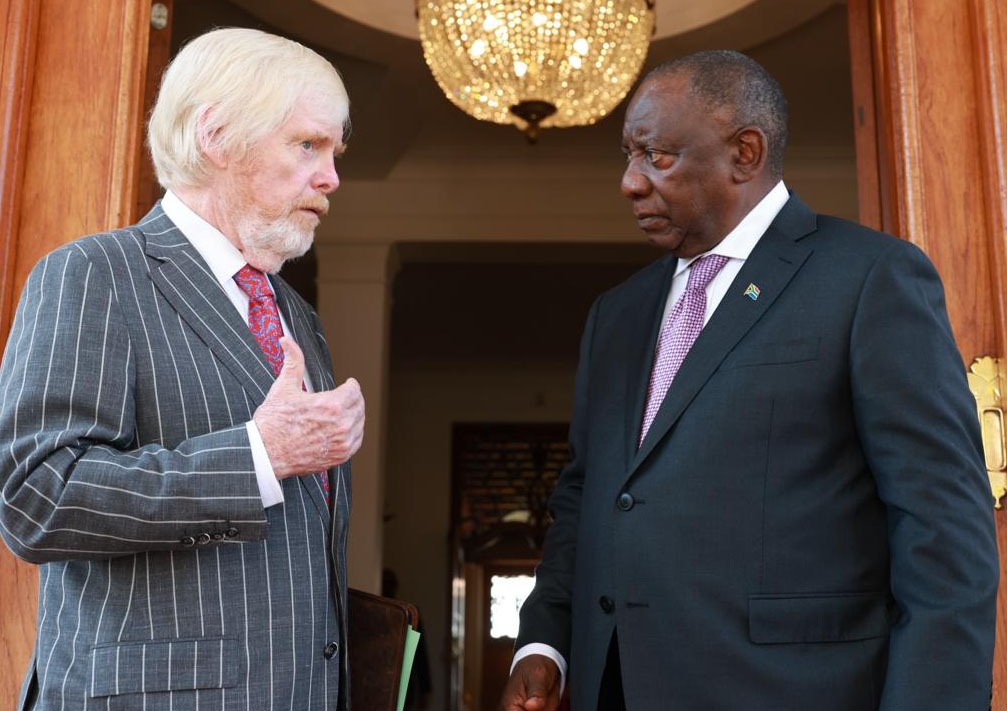
 President Cyril Ramaphosa meets with the US ambassador to South Africa, Leo Brent Bozell III, at Mahlamba Ndlopfu, his official residence in Tshwane. (Photo: Elmond Jiyane / GCIS)
President Cyril Ramaphosa is pondering his reply to a message from US President Donald Trump, which could be decisive for the future of South Africa’s fraught relations with the United States.
US ambassador to South Africa Leo Brent Bozell III delivered Trump’s message to Ramaphosa in Pretoria on 26 August.
While details of Trump’s message remain sparse, a diplomatic source told Daily Maverick it centres on his “five asks”.
The “five asks” – as Bozell has called them – are roughly that Pretoria must:
Prioritise the protection of farmers from violence;
Condemn the “Kill the Boer” chant as hate speech;
Scrap the expropriation without compensation law;
End the requirement that US investors must surrender ownership of 30% of their businesses to black South Africans under broad-based black economic empowerment (BBBEE) laws; and
Demonstrate that South Africa is really non-aligned globally, as it claims to be, by distancing itself from US enemies such as Iran.
Daily Maverick understands that Pretoria believes that much progress has been made in addressing the demands, and that in his reply to Trump, Ramaphosa will point this out.
Ramaphosa’s spokesperson, Vincent Magwenya, confirmed that the President would reply to Trump.
“I can’t give a timeline. But it will be timely,” he said.
Dialogue under way
/file/attachments/orphans/CRpondershisreplytoTrump5_968512.jpg "Roelf Meyer at the first National Dialogue meeting at Union Buildings on July 11, 2025 in Pretoria, South Africa. The initiative aims to foster unity in South Africa, find collective solutions to the country’s multifaceted challenges and restore the country to the path of transformation, development and progress. (Photo: Gallo Images / Beeld / Deaan Vivier)")
In an interview with Daily Maverick before leaving for Washington, South Africa’s new ambassador to the US, Roelf Meyer, said Trump’s executive order banning US aid to SA and offering asylum to Afrikaner farmers would remain in place until Pretoria adequately addresses Washington’s five demands. Signed on 7 February 2025, just weeks into Trump’s presidency, the order alleges Afrikaner farmers are victims of genocide.
He said he would prioritise addressing the five demands to see if mutually acceptable terms could be reached, noting, “We will have to … see how we can manoeuvre on this.”
In March, Bozell publicly complained that the US was growing impatient as it had put the five asks to the South African government more than a year earlier and had not received an answer.
Meyer insisted the South African government was ready to negotiate the five demands – a dialogue that now appears to be under way following his arrival in Washington.
The Agoa question
It is understood that the African Growth and Opportunity Act (Agoa) was not specifically mentioned by Trump in his message to Ramaphosa.
Yet one important question which might nevertheless depend on Ramaphosa’s response is whether South Africa will remain eligible for preferential access for many of its exports to the US under Agoa.
Last week, Trump signed into law legislation to extend Agoa until December 2028. It expired last year, after which Congress retrospectively revived it and extended it until December this year.
/file/dailymaverick/wp-content/uploads/2025/06/GettyImages-2216308500.jpg "Tori-Trump-tariffs")
However, it is not certain that South Africa will retain these benefits, as the eligibility of all countries in Agoa is currently undergoing a routine review. South African diplomats have been working hard to retain SA’s inclusion and have received positive feedback from the State Department and the US trade representative, which formally makes these decisions.
But they don’t know if they have succeeded as it all eventually depends on the whim of Trump – like most other US decisions.
The preferential access of Agoa has been considerably eroded by Trump’s 25% tariff on autos and 50% tariffs on steel and aluminium – plus a recent 12.5% tariff for allegedly failing to curb imports of goods supposedly produced by forced labour.
However, Agoa still offers some relative advantages to SA exporters.
Eckart Naumann, independent economist and associate of the Trade Law Centre, has pointed out that several products which SA exports to the US were exempted from the new 12.5% tariff. These included macadamia nuts, oranges, limes, tea, spices, seeds, cane sugar, orange and lime juice, syrups, chemicals, critical minerals, platinum-group and precious metals, isotopes, civil aircraft and parts and components, and pharmaceuticals. DM
Comments
Scroll down to load comments...