




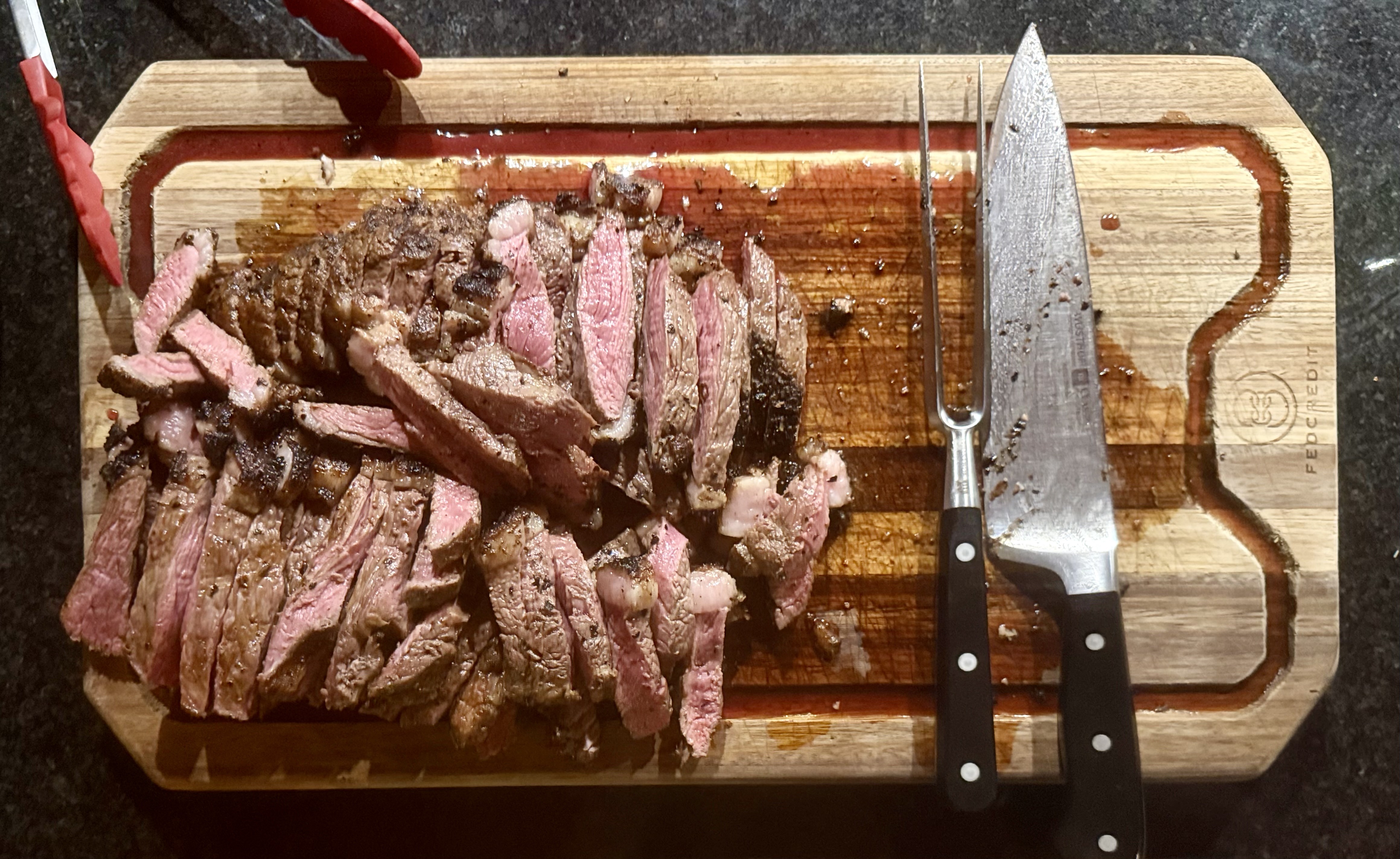
 Tony Jackman’s picanha, cooked (twice) and ready to serve. (Photo: Tony Jackman)
A picanha is a single triangular hunk of beef, cut from the tail end of the cow, and it has a thick cap of fat. That cap is a part of the cut; it must not be trimmed away.
There are many (including myself) who regard the picanha as the pinnacle of what a steak can be. This is because it is from the rump, and therefore particularly flavourful, and comprises a single muscle. And because of that fatty edge, which renders down first, creating so much flavour inside.
A traditional “rump steak”, by contrast, can contain up to five muscles, which is why your rump steak might not be consistently tender. Some parts tend to be tougher.
Most rump steaks comprise three or four of these muscles.
And one of those is the picanha – unless you’re buying your pican-something-or-other steak from Checkers nowadays, where it may be a “ribcanha”, which defeats the entire object of the single-muscle picanha with its fabulous cap of fat.
An AI search proves very helpful: “A ribcanha is a specific premium cut of beef popularised by South African supermarket chains like Checkers. Its name is a portmanteau of ‘ribeye’ and ‘picanha’. The cut is essentially a ribeye roast prepared and trimmed to mimic the style of a traditional Brazilian picanha – featuring a distinct shape and a thick, continuous fat cap on the outer edge.
A picanha is a sizeable chunk of meat – more Rocky than Frank-N-Furter (I’ve just been to the fabulous Rocky Horror Show at the Theatre on the Bay in Camps Bay, so it’s front of mind) – and will feed a small crowd. You’ll get five to seven or so steaks out of a picanha, so bear this in mind when you’re shocked by its price. It’s not the equivalent of a single ribeye or rump steak. You’re paying for five to seven steaks.
And it MUST have that fat cap. Non-negotiable.
Recently, I bought a picanha, took it home, and planned how I was going to cook it. Then I unwrapped it and was horrified to see that the fat cap had been trimmed away, leaving only a thin veil of connective tissue known as silverskin.
Sacrilege.
/file/attachments/2997/picanha-rubbed_756768.jpg)
To cook a picanha, you score the fat and put it fat-side down over hot coals or in a super-hot skillet. It cooks like this for eight minutes, after which you turn it over to grill for three more minutes. (Yes, I set a timer.)
Then it comes off the braai/grill and onto a board to be cut into individual steaks, which are braaied on both sides to the preference of the person who’s about to eat it.
Last weekend, we did ours medium rare.
First, I scored the fat. Then I made a rub of a variety of dry spices, rubbed it all over, and left it in the fridge for a few hours.
It must come out of the fridge at least an hour before you’re going to cook it.
Tony’s dry-rubbed picanha on the braai
/file/attachments/2997/picanha-8minutes_240299.jpg)
(Serves 5 to 7, depending on its size)
Ingredients
1 whole picanha with its fat cap – no compromises
1 heaped tsp dried oregano
1 tsp cumin powder
1 tsp pimentón or other paprika
1 tsp garlic powder
½ tsp mustard powder
1 tsp salt
1 tsp black pepper
Additional salt for the second cook
Method
/file/attachments/2997/picanha-sliced_590085.jpg)
Using a sharp knife, score the fat cap fairly deeply but without puncturing the red meat. Do this in long strips, so to speak, because later you’ll slice through at the same points to create individual steaks.
Mix the dry rub ingredients together. Rub it into all parts of the picanha. Put it in the refrigerator, but remove it from the fridge an hour or more before it is to be cooked.
Prepare hot coals and a clean grid. Have a clean board and sharp chef’s knife to hand near the braai.
Set a timer on your phone – to 8 minutes.
Braai it fat side down for 8 minutes, then turn it and braai the other side for 3 minutes.
Take it off, onto the board, and slice it into individual steaks.
Braai those steaks on both slides, not for very long. You can salt the two sides while they’re cooking if you like.
How long they will need to cook at this point depends on how thick you sliced them and your guests’ preferences.
Ours were cut quite thin, so were on for barely minutes.
Bear in mind, when judging how long to cook them for this second time around, that they’re already cooked at both ends, so it will be quicker than it would be if cooking steaks from scratch.
And less is usually best when cooking a steak.
Let the steaks rest for 5 minutes or more before serving. DM
/file/attachments/2994/retrokaroo1_233595.jpg "To buy a copy of Tony Jackman’s Retro Karoo Food (Penguin Random House) signed by the author in gold, send an email to him at tony@dailymaverick.co.za. Or buy it through the Daily Maverick shop.")
To buy a copy of Tony Jackman’s Retro Karoo Food (Penguin Random House) signed by the author in gold, send an email to him at tony@dailymaverick.co.za
Or buy it through the Daily Maverick shop.
Tony Jackman is twice winner of the Galliova Food Writer of the Year award.
Follow Tony Jackman on Instagram @tony_jackman_cooks.
Comments
Scroll down to load comments...