




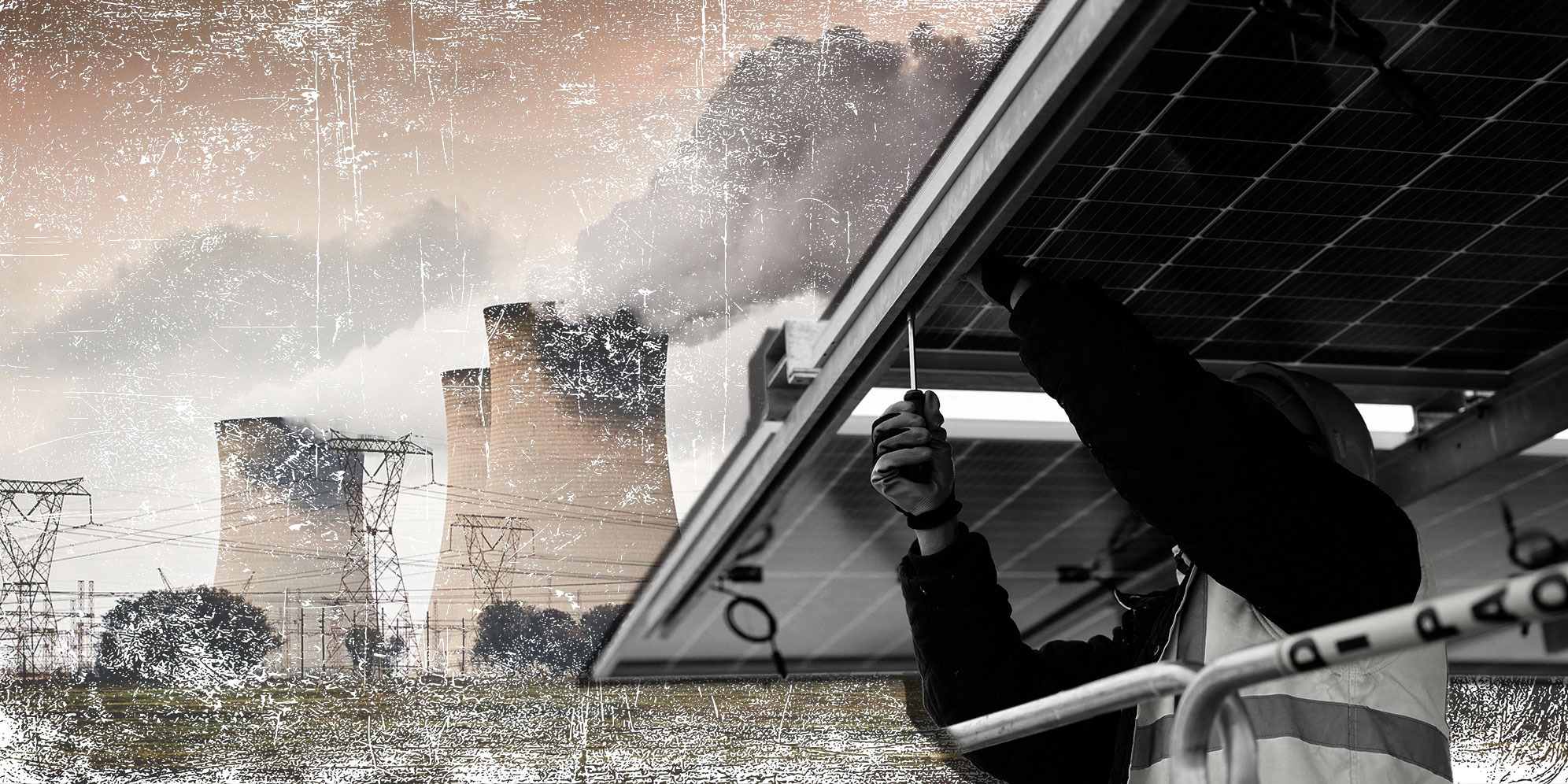
 Illustrative image: A worker installs a 540W solar panel. (Claudia Greco / Reuters) | The Arnot coal-fired power station, operated by Eskom, in Mpumalanga. (Photo: Waldo Swiegers / Bloomberg via Getty Images) | (By Daniella Lee Ming Yesca)
South Africa’s rooftop solar and battery storage owners have a deadline hanging over them: 30 September 2026, the date by which Eskom Distribution says residential low-voltage solar PV and battery energy storage (BES) systems connected behind the meter must be registered with the utility. It is the second such deadline this year, and it will not be the last word in a dispute that has run for months between Eskom and homeowners, installers and civil society groups, about who has the legal right to regulate what happens on the customer's side of the meter.
South Africa’s residential solar and battery storage market has grown rapidly on the back of years of load shedding and steeply rising electricity tariffs, and Eskom Distribution itself now concedes that most of the installed base remains unregistered. Whether this installed base is treated as a compliance risk to be policed, or as a resource to be accommodated, has implications well beyond the individual homeowner facing a letter of demand to register.
Eskom’s registration and compliance campaign has caused real alarm among hundreds of thousands of South African households that have installed solar PV and battery systems, largely in response to years of load shedding and steeply rising electricity tariffs. Homeowners have faced conflicting, changing and incorrect information about what is required of them, including threats of fines and disconnection for failing to register their systems, and efforts to force customers to convert to the new Eskom Homeflex tariff, sign a new supply contract with Eskom and increase their supply deposits to the utility.
The Organisation Undoing Tax Abuse (Outa) has engaged Eskom Distribution repeatedly on the matter and has now set out its position and legal reasoning in a detailed submission to the utility. These engagements have produced real movement – but have also exposed where Eskom is now digging in.
Eskom softens its stance
Following engagement with Outa and other stakeholders, Eskom Distribution has conceded three significant points:
Eskom has extended its original registration deadline of 31 March 2026 to 30 September 2026;
Eskom no longer requires sign-off of a residential solar PV/BES installation by a professional registered with the Engineering Council of South Africa (Ecsa). Eskom now accepts a certificate of compliance (CoC) issued by a duly qualified installation electrician or electrical contractor registered with the Department of Employment and Labour; and
Eskom has withdrawn its earlier threats to fine and/or cut electricity supply to residential customers who fail to register their installations.
These are meaningful concessions, and they follow sustained pressure from Outa and other stakeholders rather than a voluntary change of heart by the utility. But a further threat remains.
The threat that survived: ‘unsafe’ installations
Eskom has indicated that, deadline or no deadline, it will still cut off supply to a residential customer where it deems the customer’s solar PV/BES installation to be “unsafe”.
It is Outa’s view that Eskom would have no lawful right to disconnect a residential customer who holds a valid CoC – lawful proof of technical and safety compliance for the electrical installation – simply because Eskom deems that installation to be unsafe. Before it could lawfully act, Eskom would first need to prove that the CoC itself was invalid or was unlawfully issued. A generalised assertion of “unsafe” is not, in Outa’s assessment, a legally sufficient basis for cutting off a compliant customer’s electricity supply.
This is not a minor technical point. A CoC is a legal instrument, issued under the Electrical Installation Regulations (EIR) of the Occupational Health & Safety Act (OHS Act) by a duly qualified installation electrician or electrical contractor registered with the Department of Employment and Labour.
Why Outa says Eskom’s underlying case does not hold up
Eskom Distribution has routinely justified its registration and compliance regime by pointing to the Electricity Regulation Act (ERA), the National Energy Regulator of South Africa’s (Nersa) regulatory authority, the South African Grid Code, Eskom’s own internal technical specifications, network safety, quality-of-supply risk and the system operator’s need for data on installed rooftop solar capacity. Outa has examined each of these justifications in detail and rejects all of them.
No point of connection, no Nersa jurisdiction: A low-voltage residential solar PV/BES system connected to a customer’s distribution board, on the customer’s premises, well behind the meter, has no “point of connection” as defined in the Grid Code of South Africa – this being the physical node at which a customer’s network connects to the distributor’s network, i.e. at the outgoing terminals of the meter. Without a point of connection, a solar PV/BES installation of less than 100kW falls outside the scope of the ERA and Nersa’s regulatory authority. Schedule 2 of the ERA does not require such a system to be registered with Nersa or with the distributor. Any reliance on the ERA or Nersa to require registration, or to justify fines or disconnection for failing to register, is, in Outa’s view, misplaced.
SANS 10142-1 – not Eskom’s own specifications – is the mandatory standard: The applicable legislation for low-voltage electrical installations behind the meter is the OHS Act and its EIR, regulated by the chief inspector of the Department of Employment and Labour, not by Nersa. The EIR requires compliance with SANS 10142-1, the only mandatory national technical and safety standard for such installations, which in turn references relevant South African and international standards for PV panels, inverters and battery systems. The convenor of the SANS 10142-1 working group at the South African Bureau of Standards has confirmed there is no technical or safety “gap” in the standard that would require Eskom’s own NRS specifications to fill. Those NRS specifications are voluntary utility documents, drawn up by Eskom and municipal distributors for their own purposes without a public participation process – they are not national standards, and SANS 10142-1 does not reference them. A valid CoC, issued under the EIR, is the only lawful proof of technical and safety compliance for such an installation.
The network safety argument is a red herring: Eskom has cited the risk of back-feed into its network when its personnel work on de-energised lines as a justification for registration. But a solar PV/BES inverter that complies with SANS 10142-1 and the South African and international standards referenced therein, and is backed by a valid CoC, cannot back-feed the network on loss of mains supply. In any event, standard utility operating procedure for working on de-energised networks – isolate, lockout, measure, earth – protects personnel regardless of whether a downstream inverter has failed or is non-compliant. Eskom’s own accident statistics show negligible incidents caused by back-feed from unregistered residential solar systems, against a far larger toll of accidents in front of the meter caused by informal and illegally connected networks and connections where there are no installed solar PV/BES systems. Outa’s assessment is blunt: Eskom is “barking up the wrong tree”.
Quality-of-supply concerns apply just as much to equipment nobody is asked to register: Eskom also cites quality-of-supply risks – overvoltage, undervoltage, dips, sags, flicker and harmonics – set out in the Grid Code as a reason for its registration and compliance requirements. A compliant, CoC-certified solar PV/BES system and inverter already addresses these. Other household and commercial equipment, such as variable-speed drives, electronic soft starters, induction motors and power factor correction capacitors, can cause exactly the same disturbances, yet Eskom does not require these to be separately registered over and above SANS 10142-1 compliance. Where a solar installation genuinely does cause a quality-of-supply problem, Outa argues this can be dealt with on a case-by-case basis, exactly as it is for any other equipment.
The system operator does not need registration data: Eskom has also argued it needs registration records so the system operator can track installed rooftop solar capacity for planning and grid-stability purposes. But Eskom’s National Transmission Company of South Africa (NTCSA) already publishes this information weekly, at provincial and national level, in its publicly available system status reports, drawing on far more accurate and reliable sources than patchy voluntary registration. Eskom’s NTCSA and the system operator already have much more accurate and reliable sources of information at their disposal to determine the installed capacity of rooftop solar PV systems in South Africa at household, street, suburb, village, town, city, distributor, provincial and national levels. Eskom Distribution itself has acknowledged that the significant majority of low-voltage residential solar PV/BES systems remain unregistered – which means registration records are, by Eskom’s own admission, an unreliable dataset for exactly the planning purpose it claims to need them for.
Deadline still stands – for now
At a meeting between Outa and Eskom Distribution on 2 September 2026, the utility conceded that the vast majority of low-voltage solar PV/BES installations connected to its network remain unregistered. Despite this, Eskom insisted that the current 30 September 2026 deadline stands – for now.
That combination – a deadline Eskom itself says has been ignored by most affected customers, defended on safety and technical grounds that Outa has methodically dismantled – is, in Outa’s view, “irrational”. It is Outa’s position that Eskom Distribution is overstepping its regulatory, safety and technical authority in imposing burdensome, costly and largely ineffective registration and compliance requirements on residential customers who already hold a valid, lawful CoC for their installations.
What this means for homeowners
For now, the practical position for residential solar PV/BES owners is this: registration deadlines and threatened penalties have shifted twice in six months, three of Eskom’s original threats have been withdrawn, and the fourth – disconnection for “unsafe” installations – is, in Outa’s legal assessment, not enforceable against a customer holding a valid CoC without Eskom first successfully challenging that certificate. Homeowners with a valid CoC, and installations that do not export power onto the network, are in a materially stronger legal position than Eskom’s public messaging has suggested.
Outa’s engagement with Eskom on this issue continues, and further concessions – or a legal challenge, should Eskom act on its “unsafe” disconnection threat against a compliant customer – cannot be ruled out. DM
© Copyright 2026 – EE Business Intelligence (Pty) Ltd. All rights reserved. This article may not be published without the written permission of EE Business Intelligence.
Comments
Scroll down to load comments...