



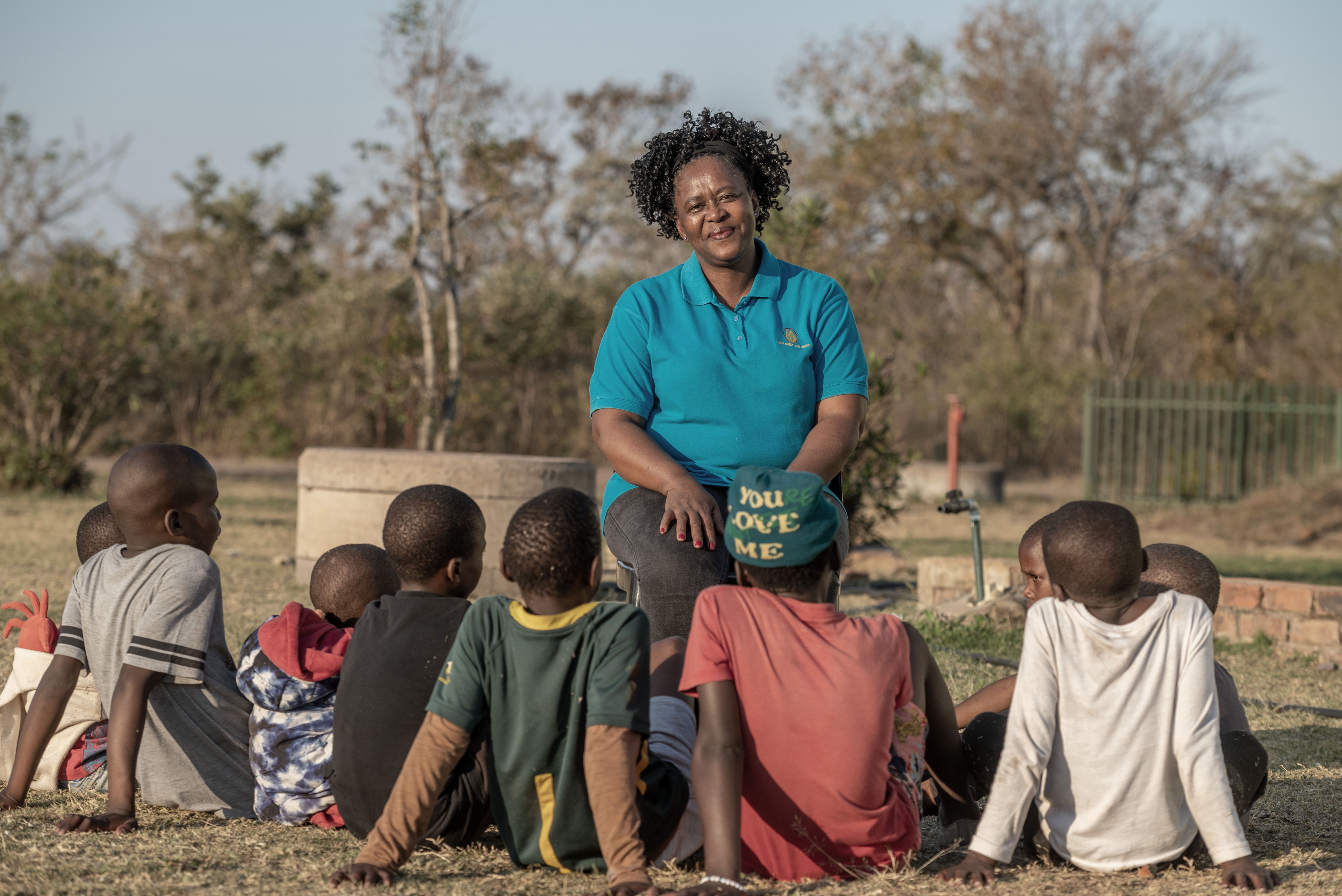
 Jeanette Lesisa is the manager at the Holy Family Care Centre outside Tzaneen, Limpopo. (Photo: Leon Sadiki)
In a remote area about an hour outside the town of Tzaneen in Limpopo stands a small, mint-green church. Its backdrop is sprawling farmland, encircled by the far northern reaches of the Drakensberg mountain range. Its congregation is made up almost entirely of children.
On Sunday morning at 9am, the youngsters, from toddlers to teenagers, filter through the doors. Different groups take turns in leading the service with songs and readings, delivered largely in Sepedi. They bring an infectious energy to the space, lending new life to old rituals.
If a visitor were to drop in from out of town – perhaps a journalist on a journey through the province – they would be greeted by smiles and waves from the older children, and a barrage of hugs from the younger.
/file/attachments/orphans/Tamsin-HolyFamily-Limpopo4_379628.jpg "Children lead a morning prayer in song at the Holy Family Care Centre outside Tzaneen, Limpopo. (Photo: Leon Sadiki)")
These are the charges of the Holy Family Care Centre, a home for orphaned and vulnerable children. The children live on the sprawling property surrounding the church, which holds dormitories, study halls, an early childhood development centre and sports fields. The centre, founded as an HIV/Aids project in 2001, is under the direction of the Daughters of Our Lady of the Sacred Heart, an international religious congregation.
Every child who stays at the centre has a story marked by incredibly difficult circumstances, notes Sister Sally Duigan, the director of the home. They often arrive malnourished, ill or traumatised, having experienced neglect, abuse, abandonment or the loss of their caregivers.
/file/attachments/orphans/Tamsin-HolyFamily-Limpopo5_701526.jpg "Children lead a morning prayer in song at the Holy Family Care Centre outside Tzaneen, Limpopo. (Photo: Leon Sadiki)")
Duigan has been the director of the centre since 2013. In her experience, the act that makes the greatest difference in the lives of the children who pass through its doors is “letting them know that you really love them”.
“That’s a big thing. Very often, just giving them hugs,” she says. “I reinforce all the time with the staff to be there to meet them when they come from school. I find that it’s really important... to give them a sense of belonging.”
/file/attachments/orphans/Tamsin-HolyFamily-Limpopo7_922063.jpg "Sister Sally Duigan and other caregivers join children as they lead morning prayer in song at Holy Family Care Centre outside Tzaneen, Limpopo. Since founding the centre in 2001, she has devoted her life to caring for more than 70 children who call it home. (Photo: Leon Sadiki)")
Supporting the HIV/Aids response
Duigan first came to Tzaneen in 2000, when her order was heavily involved in responding to the HIV/Aids crisis, providing home-based care, education and childcare for vulnerable populations. In the years before anti-retrovirals (ARVs) became widely available, she saw many mothers and children dying from the disease.
While the response to the pandemic has come a long way since then, reducing mortality and new infections, the centre still sees children arriving with untreated or poorly managed HIV.
“We’re a microcosm of what’s going on in society, what the problems are within families. There are still people who have traditional beliefs and who don’t believe in the medication; who don’t take it themselves and don’t let the children take it,” said Duigan.
/file/attachments/orphans/Tamsin-HolyFamily-Limpopo3_235377.jpg "Holy Family Care centre building sits at the foot of the Drakensberg, outside Tzaneen in Limpopo. (Photo: Leon Sadiki)")
The centre is currently caring for 75 children, 17 of whom are on ARVs.
“It’s really hard for the children. And one of the side effects… from the ARVs in these children is depression… There’s not a lot you can do about it except to try and give extra love and support, and talk to them and help them have hope for the future,” said Duigan.
When she stepped into the role of director at the centre, a large part of her focus was on capacity-building for staff from local communities. For her, the home is not only a place where children can find a safe environment in which to reclaim their childhood, but also a place where the adult carers can learn and acquire new skills, leading to future opportunities.
/file/attachments/orphans/Tamsin-HolyFamily-Limpopo6_843582.jpg "Sister Sally Duigan and other caregivers join children as they lead morning prayer in song at Holy Family Care Centre outside Tzaneen, Limpopo. Since founding the centre in 2001, she has devoted her life to caring for more than 70 children who call it home. (Photo: Leon Sadiki)")
Children as individuals
The manager of the Holy Family Care Centre, Jeanette Lesisa, describes herself as a jack-of-all-trades. Her days start early, checking on the children in the dorm rooms and monitoring handovers between the night and day staff. Her work involves everything from maintenance to finance and administration.
The centre receives funding from the Department of Social Development, with most children referred to the home through social workers. While the initial period for which a child is placed there is three months, many children end up staying far longer due to the challenges that come with family reunification.
/file/attachments/orphans/Tamsin-HolyFamily-Limpopo11_950862.jpg "Jeanette Lesisa is the manager at the Holy Family Care Centre outside Tzaneen, Limpopo. (Photo: Leon Sadiki)")
While at the centre, the older children attend the local school in the neighbouring village of Calais, while those under five are looked after at the early childhood development programme housed on site. Tutors run after-school and weekend study sessions for additional educational support, says Lesisa.
There are also many opportunities for the children to engage in fun, social activities. The centre has a soccer field, swimming pool, trampoline, and courts for volleyball and tennis. Other programmes offer pursuits such as knitting, boardgames or arts and crafts.
Among the staff members, the personal characteristics that make the most difference in connecting with the children are patience, and understanding the differences between the children, allowing each young person to be accommodated as an individual, says Lesisa.
/file/attachments/orphans/Tamsin-HolyFamily-Limpopo8_928844.jpg "Children during a reading session at the Holy Family Care Centre outside Tzaneen, Limpopo. (Photo: Leon Sadiki)")
/file/attachments/orphans/Tamsin-HolyFamily-Limpopo9_960714.jpg "Children keep themselves busy playing soccer on the footbal pitch at Holy Family Care Centre outside Tzaneen, Limpopo. Since founding the centre in 2001, she has devoted her life to caring for more than 70 children who call it home. (Photo: Leon Sadiki)")
Warmth and love
When Vusimuzi Mboweni, one of the carers at the Holy Family Care Centre, spoke to Daily Maverick, he was still out of breath from leading the children in a game on the sports field. Though he has only been working at the home for a month, he says he has already lost weight trying to keep up with his energetic charges.
Mboweni studied education, but he says his role at the centre has involved far more than supporting learning. He helps with the children’s day-to-day problems, and has started assisting with the church choir.
“I’m developing a love for the younger children because with what I studied, it was mainly [focused on] the older children,” he says. “It’s been fun, and it’s helping me keep fit.”
/file/attachments/orphans/Tamsin-HolyFamily-Limpopo12_915243.jpg "Vusimuzi Mboweni play with the children to keep themselves busy with a game of soccer on the football pitch at Holy Family Care Centre outside Tzaneen, Limpopo. Founded in 2001, the centre has become home to more than 70 children under the care of Sister Sally Duigan. (Photo:Leon Sadiki)")
With care work being a largely woman-dominated space, Mboweni believes it makes a difference for the children to have a male carer involved in their day-to-day lives who can act as a role model. He explains that he is careful in how he interacts with each child, especially when managing behavioural problems, as he understands that they have been shaped by a broad range of backgrounds and experiences.
“You can see whenever new people come around, they are so welcoming. They just want to feel that warmth and that love that we’ve all experienced at home, and they haven’t,” he says.
/file/attachments/orphans/Tamsin-HolyFamily-Limpopo13_738163.jpg "Jeaneth Hlangwana helps to prepare breakfast at Holy Family Care Centre outside Tzaneen, Limpopo. Founded in 2001, the centre has become home to more than 70 children under the care of Sister Sally Duigan. (Photo:Leon Sadiki)")
Another carer, Jeaneth Hlangwana, who has worked at the centre for 13 years, echoes Mboweni’s sentiments. She emphasises the importance of adjusting her work to the needs of the children and working to understand where they come from.
“Never shout at them, do not neglect them... Don’t ever raise your voice at them, because if you do that, it’s where you lose that child,” she says.
“We just thank thank Sister Sally. She is good to us and she taught us a lot of things. To... approach the children with a good heart. To love the children, because we love the children as we love our own.” DM
/file/attachments/orphans/ChildrensReporterV2_187851.jpg "Tamsin-DG-Murray-Trust")
Comments
Scroll down to load comments...