




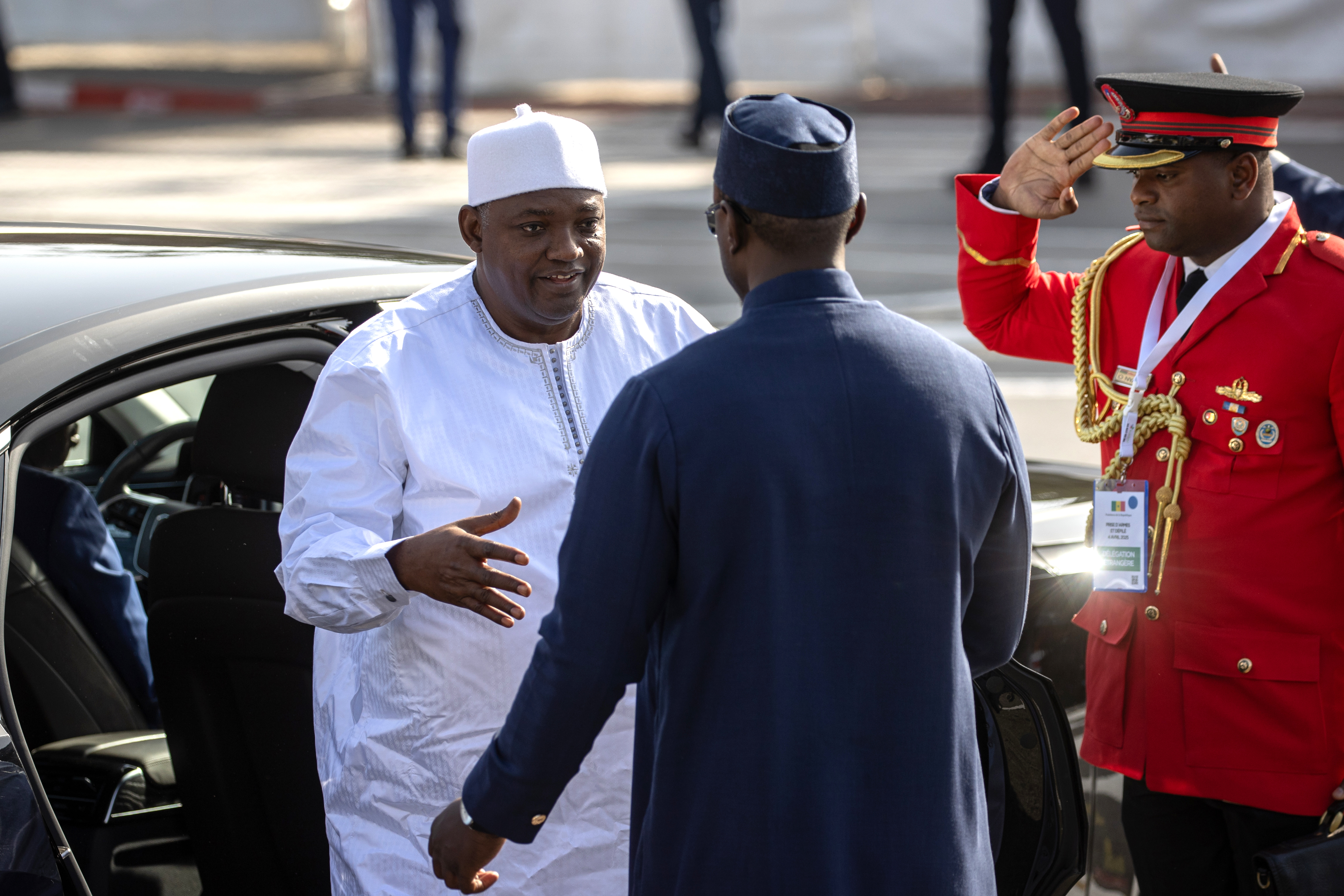
 Senegalese Prime Minister Ousmane Sonko (C front) greets Gambia's President Adama Barrow(L) during celebrations for the 65th anniversary of Senegal's independence, in Dakar, Senegal, 04 April 2025. Senegal gained its independence from France on 04 April 1960. EPA-EFE/JEROME FAVRE
In and around the capital Banjul, protesters burned tyres in the street and erected barricades, shouting "Barrow must go!" as plumes of smoke filled the air, the Reuters witness said.
The West African nation's electricity issues — with some residents reporting blackouts lasting up to 48 hours — come ahead of a presidential election expected in December in which Barrow is seeking a third term.
In a sign of growing frustration with the government, protesters in the town of Farato gathered outside the residence of Vice President Mohammed B.S. Jallow and destroyed banners at an office of the ruling National People's Party.
"I know that the fans have stopped turning, children work in the dark, mothers throw away stale food, and the heat is unbearable by day and by night," Barrow said in a televised address to the nation late on Tuesday.
He said electricity demand was at record levels, with major units failing and seasonal conditions cutting hydropower production.
Officials are "working relentlessly to restore stability and improve the reliability of electricity supply as soon as possible," Gambia's information minister, Ismaila Ceesay, said in a statement earlier that described the events of the previous night as "deeply disconcerting".
Ceesay apologised to those affected by the power cuts.
"As a government, we recognise the frustration, anger and hardship that many Gambians are experiencing," he said.
A police spokesperson did not respond to a request for comment on Tuesday.
Barrow visited facilities for the national utility, National Water and Electricity Company Ltd, on Tuesday morning and promised that Gambia would receive new generators this week and restore electricity by the end of October.
He said the government was in the final stage of installing an additional 24-megawatt generation machine and that it awarded a contract for a 50 MW solar power plant.
UTILITY WARNED OF DEMAND SURGE DUE TO HEAT
NAWEC said in a statement on August 15 that it was experiencing "an unforeseen surge in electricity demand during the peak period," which it attributed to high temperatures.
It also reported "a technical incident affecting one of the major power-generating units on the import side," without elaborating.
The situation would require load shedding "affecting several parts of the country", but no dates were given.
NAWEC did not respond to a request for comment on Tuesday.
"There is no light everywhere. There is no light. People have been crying about electricity," said Ousainu Jammeh, a resident of the Westfield area of Banjul.
Jammeh said he went outside to join protesters after tear gas "landed in my house."
After protests died down in the pre-dawn hours, Jammeh joined crowds of young men who used water to douse fires and clear the barricades.
Traffic had returned to normal in Banjul on Tuesday morning.
(Reporting by Pap Saine and Malick Njie; Writing by Robbie Corey-Boulet and Anait Miridzhanian; Editing by Mark Porter, Gareth Jones and Daniel Wallis)
Comments
Scroll down to load comments...