




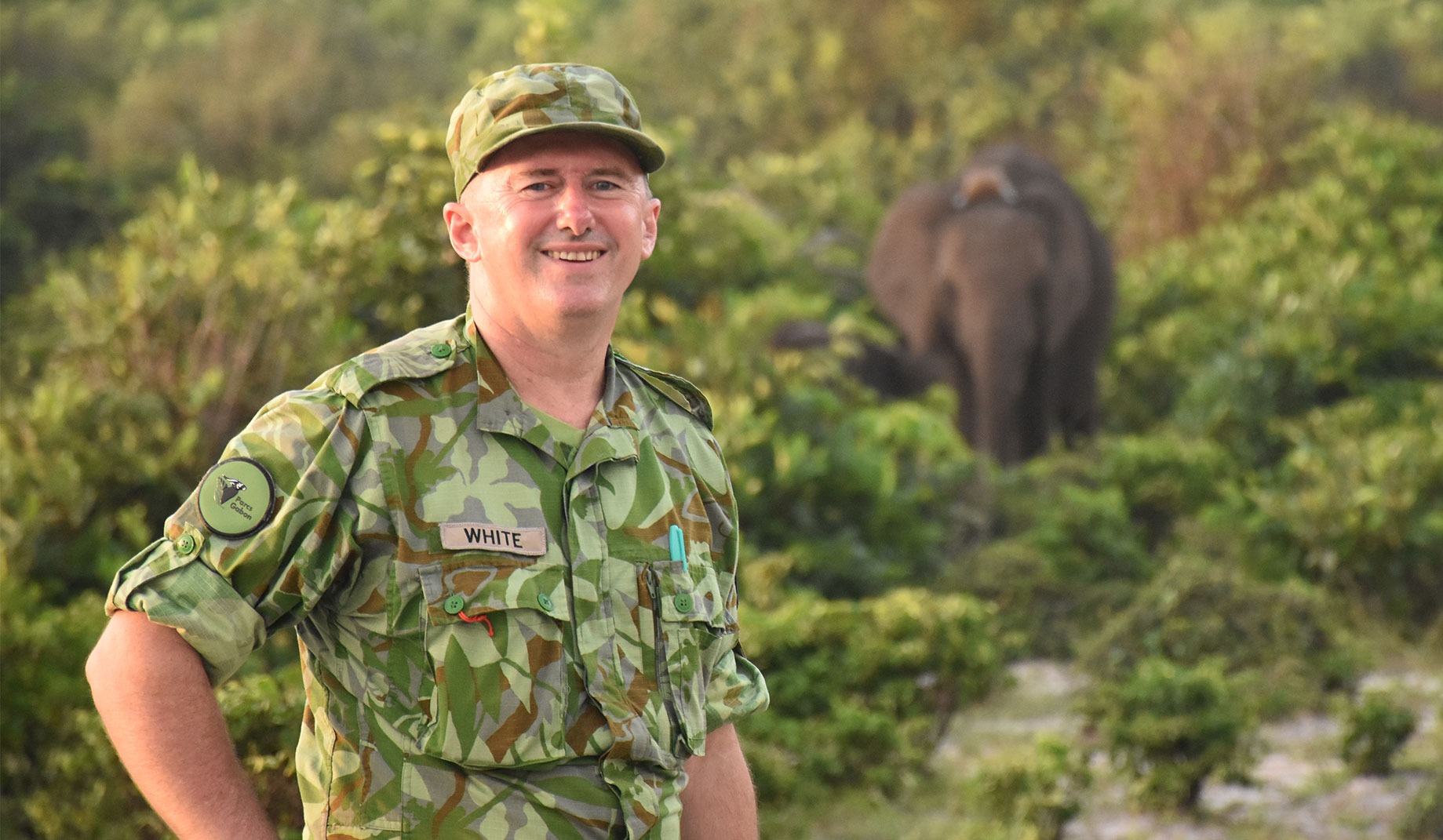
 Loango National Park in Gabon. Conservation scientist Lee White spent more than three decades working to protect Gabon’s forests and wildlife. (Photo: Supplied / Kate Abernethy)
Climate change will trigger wars over water across much of Africa unless the continent protects the Congo Basin, warns former Gabonese environment minister Professor Lee White.
White describes the Congo Basin as the “pumping heart of Africa”, generating atmospheric rivers – vast streams of moisture in the atmosphere – that sustain agriculture across much of the continent, from the Sahel to the Ethiopian Highlands. If the forest falls, he argues, Africa’s water cycle could collapse with it.
White’s warnings about Africa’s environmental future are rooted in a life shaped by extraordinary experiences. As a schoolboy in Uganda, he regularly found himself in playground fistfights with one of the sons of the late dictator, Idi Amin.
“He would stare you in the eye and say, ‘I’m gonna tell my dad to kill your dad’,” White recalls.
Life at home was just as extraordinary. His parents had adopted an orphaned chimpanzee named Cedric, who grew up alongside White and his sister.
“My sister, Alison, would be in nappies on one of my mother’s hips, and my brother Cedric the chimpanzee in nappies on the other hip,’ he says.
/file/attachments/orphans/Roving-Rep-Lee-White-Congo2_711562.jpg "Lee White with Cedric, an orphaned chimpanzee adopted by his family. Cedric grew up alongside White and his
<br>sister, Alison. (Photo: Supplied / Lee White)")
Those formative years eventually led him to Gabon in early 1989 to do a PhD on forestry and wildlife. “I discovered a country which is a tropical paradise for a zoologist, and basically, I never left," says White.
Lee White’s journey in Gabon
Over the next 35 years, he would become a scientist, conservationist, head of the national parks agency and, ultimately, the country’s minister of environment.
White never planned to become a politician. For 10 years, he was simply a scientist, happiest when walking through the Gabonese rainforest studying gorillas and forest elephants.
/file/attachments/orphans/Roving-Rep-Lee-White-Congo_705992.jpg "Lee White during his years with the Wildlife Conservation Society. His work surveying Gabons biodiversity
<br>helped draw him deeper into the country's conservation struggles. (Photo: Supplied / Lee White)")
One encounter has never left him. Coming across his first poached elephant, White went to fetch wildlife rangers. When they returned, the dead animal had disappeared beneath a covering of broken branches. “Other elephants had come,” he recalls, “broken branches and completely covered the dead elephant so it was buried.’
While working for the international NGO the Wildlife Conservation Society White spent five years surveying Gabon’s biodiversity. As his work took him deeper into Gabon’s forests, he realised that the ecosystems he was observing were increasingly threatened by logging, mining and bushmeat hunting. That stark reality pulled him, as he puts it, “out of the forest into conservation politics”.
It was during that period, he says, that “a mixture of luck, being proactive, and being in the right place at the right time” led to a meeting with then-president Omar Bongo.
“I convinced him to create a network of 13 national parks, which kind of changed the environmental trajectory of Gabon,” he says.
After presenting a map of the proposed protected areas, the president simply told his ministers: “This is what we should do.”
Turning point
The creation of Gabon’s national parks marked a turning point for conservation in the country. Protecting them, however, required building an entirely new institution from the ground up. In October 2009, White was appointed to head the National Parks Agency, where he spent the next decade building the organisation and training its first generation of rangers.
His appointment collided with a severe escalation in the elephant-poaching crisis. Heavily armed, organised criminal syndicates were slaughtering the country’s forest elephants, with ivory trafficking helping to finance extremist groups such as Boko Haram.
“Between 2005 and 2015, we lost 70% of the forest elephants across Africa,” White recalls.
The British-born zoologist suddenly found himself on the front lines. “I was basically developing a paramilitary organisation... turning biologists into warriors and sending them out almost to the war front,” he says. “Recruiting – a bit like Ukraine today – people to go to the front to fight against the poaching gangs.”
People died. While White’s uncompromising style and support for heavily armed anti-poaching units earned him admirers and critics in equal measure, the agency became a formidable force in the fight against wildlife crime.
His successes on the front lines did not go unnoticed, but it was an entirely different kind of cartel that would ultimately propel him into one of the country’s highest political offices.
Illegal logging
While still head of the National Parks Agency, White was tasked by the president with investigating illegal logging. Working alongside the Environmental Investigation Agency, he began targeting what he describes as the “Chinese forestry mafia”.
The inquiry uncovered widespread corruption. Some government officials, White says, were accepting bribes to approve management plans that existed only on paper. Rather than surveying forests or consulting communities as the law required, companies fabricated inventory data and maps, while corrupt inspectors signed them off.
The investigation led to major arrests and a massive political scandal that ended with Gabon’s vice-president and forestry minister being fired. His reward? The ministry itself. In 2019, White was appointed as Gabon’s Minister of Water, Forests, Environment and the Oceans.
But for White, the real cost of this corruption was not just political – it was deeply personal for local communities. This became glaringly apparent when government-licensed loggers arrived in the forests surrounding Massaha, a community in northeastern Gabon.
The villagers had had enough, blocking the roads after bulldozers tore through the places they hunted, fished and farmed. “The first thing they did was drive through a cemetery,” White says.
Under Gabonese law, loggers must work with neighbouring communities to identify and protect sacred sites and ancestral cemeteries before harvesting begins. Because of the fabricated management plans, this never happened.
White recalls travelling to Massaha to meet with the community. After listening to their grievances and sharing smoked fish beneath a sacred tree, he instructed the forestry department to correct the failures. The conflict, he notes, was a symptom of bad management and weak law enforcement, rather than failed forestry laws.
For White, the lesson was clear. Gabon’s environmental legislation was not the problem. The real challenge was ensuring that the rules were properly enforced and that communities were treated as partners rather than obstacles.
As minister, White sought to redefine the relationship between conservation and economic development. For too long, he argues, Africa had been expected to protect globally important forests while receiving little in return. His answer was to build an economy that treated intact forests not as obstacles to development, but as one of Gabon’s greatest assets.
The ambition was simple: to make forests worth more standing than felled. Following the corruption scandals that preceded his appointment, White set about overhauling Gabon’s forestry sector. His aim was not to halt logging, but to ensure that forests generated greater economic value within Gabon while remaining ecologically intact.
Under the traditional “colonial” model, White explains, Gabon exported raw timber while surrendering up to 95% of its value to countries that processed it abroad. By requiring more timber to be processed locally and encouraging higher-value wood products, the forestry sector grew from a $200-million to a $1-billion-a-year industry, while direct employment nearly tripled to 35,000 jobs.
The more White considered Gabon’s future, the more convinced he became that it could not be separated from that of the wider Congo Basin. He describes the rainforest as the “pumping heart of Africa”, sending moisture through atmospheric rivers that sustain agriculture across more than half the continent.
/file/attachments/orphans/Roving-Rep-Lee-White-Congo3_967485.jpg "The Ivindo River in Gabon. White describes the Congo Basin rainforest as the “pumping heart of Africa”, warning
<br>that its loss could destabilise the continents water cycle. (Photo: Supplied / Lee White)")
“If we lose the Congo Basin to deforestation, I do not believe the African continent is viable,” he warns, predicting that such an ecological collapse would trigger wars over water across much of Africa and create 500 million water refugees.
Carbon cowboys and global hypocrisy
White points to agricultural commodities as a glaring example of how extractive economic models fail to incentivise conservation.
“Five percent of the global chocolate economy goes to the countries that produce cocoa,” he says. “Three percent goes to the actual cocoa producers, and most producers of cocoa in Africa have never actually tasted chocolate.” This, he argues, “is not a model that creates constituencies that believe in sound stewardship of the environment”.
To White, today’s global carbon market is simply another manifestation of this inequality, populated by what he calls “carbon cowboys” making false promises to developing nations.
Having helped author the Copenhagen Agreement and negotiated the integration of forest carbon into the Paris Agreement as an African representative, White’s disillusionment is deeply personal.
Gabon played by the rules, registering 187 million tonnes of reduced carbon emissions with the United Nations. Yet, the international community paid for just a fraction of it – handing over $17-million for a mere 3.4 million tonnes.
“I’m afraid I have become a [...] UNFCCC [United Nations Framework Convention on Climate Change] sceptic. I would say, for now, the carbon markets have totally failed,” White says.
/file/attachments/orphans/Roving-Rep-Lee-White-Congo4_490854.jpg "Lee White at the 2026 FT Climate & Impact Summit in London. White has remained an outspoken advocate for
<br>Africas environmental interests, drawing on decades of experience in forest conservation and carbon policy.
<br>(Photo: Supplied / Lee White)")
He points to what he sees as a glaring hypocrisy in how the Global North values Africa’s ecological services compared with its own. “It’s one molecule, CO₂. But a tonne of that molecule in the Congo Basin is worth $5 or nothing. A tonne of that molecule in the EU is worth 85 euros,” White says. “Explain to me where the equity is in these markets?”
Near-brawl at climate summit
That frustration boiled over at the COP26 climate summit in Glasgow, where White served as the lead negotiator for Africa. Desperate to convey that climate change was a matter of life and death for the continent, the diplomatic tensions escalated into a near-brawl.
“I almost had a fistfight on the plenary floor, both with John Kerry, who was representing America, and with Frans Timmermans, the vice-president of the EU,” White recalls. “We were so vested in getting that result that it almost became a physical fight.”
After the bruising Glasgow negotiations and years spent fighting for the future of the Congo Basin, White’s next audience will be researchers attending the 15th annual Oppenheimer Research Conference in early October. There, he hopes to persuade scientists that publishing papers is only part of their responsibility.
“It’s a privilege to have a life where you get to be a scientist,” he says. “Science is fascinating. But it’s also a responsibility that you need to communicate to try and make the world better.”
It is a philosophy that has taken him from tracking pygmy hippopotamuses in West African rainforests to the cabinet room of a president, and from there to the front lines of global climate diplomacy.
And at 60, he insists his work is far from over.
“I’m hoping it’s not finished,” he says. “I’ve got two or three things I still want to get done.” DM
This article was produced with support from Jive Media Africa, the science communication partner to Oppenheimer Generations Research and Conservation.
White’s presentation at the Oppenheimer Research Conference in Midrand from 7–9 October will be live-streamed at the following link: ORC 2026.


Comments
Scroll down to load comments...