




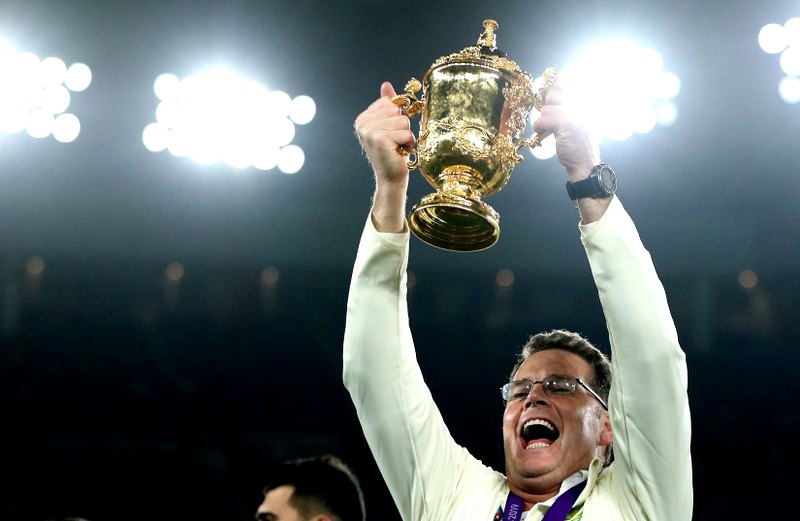
 Rassie Erasmus celebrates World Cup glory in 2019 ahead of his landmark 100th match in charge of the Boks this Saturday. (Photo: David Rogers / Getty Images)
The Springboks need a victory or draw in Baltimore this Saturday to win the Greatest Rivalry series outright.
The Boks have already clinched the “series within the series” – having won 2-1 in the recent matches staged in South Africa – and are one positive result away from securing bragging rights, at least in the context of this particular tournament, for the next four years.
Last week’s 29-24 victory in Soweto bolstered the Boks’ recent record against the All Blacks to seven victories in the last nine Tests. If they win at the M&T Bank Stadium on Saturday night, Rassie Erasmus’ men will match the feat of Peter de Villiers’ 2009 team, who famously beat New Zealand three times in a calendar year.
Erasmus’ charges have won two World Cup finals, a British & Irish Lions series decider and many other marquee clashes over the past nine years and, as seen in the recent victory in Soweto, they have learned to embrace the pressure and prevail in the big moments that often mean the difference between glory and defeat.
Of course, they didn’t become an all-conquering powerhouse overnight, and it’s significant to note that the historic meeting in the US will mark the 100th Test since Erasmus, Siya Kolisi and many others first came together ahead of a watershed 2018 season.
/file/attachments/2995/1762092444_563424.jpg)
From basement dwellers to trendsetters
South African rugby hit rock bottom in late 2017 after the Boks succumbed to a record 38-3 defeat to Ireland in Dublin.
Before that, they lost 57-0 to the All Blacks in Albany and registered inaugural losses to Argentina, Japan and Italy. They were, by every definition and measurement, the worst Bok team in history.
Many of those players are still with the team today, and some are now recognised as legends of the game.
/file/dailymaverick/wp-content/uploads/2025/11/489133268.jpg "Siya Kolisi came off the bench at RWC 2015 in the Boks' opening match against Japan in Brighton. The Boks lost 34-32 in one of the greatest upsets in rugby history. (Photo: Julian Finney/Getty Images)")
Malcolm Marx, Kolisi, Pieter-Steph du Toit, Eben Etzebeth, Lood de Jager, Handré Pollard, Damian de Allende and Jesse Kriel all featured in that dark period between 2015 and 2017, yet were backed by Erasmus in 2018 as he felt that they had the potential to take South Africa back to the top.
Erasmus made a series of shrewd decisions over the course of his tenure as head coach and director of rugby, but the call to install Kolisi as captain may be remembered as the most important.
While the appointment took many by surprise at the time, the flanker has grown into the role to become the most successful Bok captain in history, surpassing John Smit’s record of 54 Test wins last week.
Erasmus has always preached the importance of balancing youth with experience, a philosophy evident from his very first match as head coach – a standalone Test against Wales in Washington, DC, on 2 June 2018.
To manage the tight schedule before the upcoming home series against England, Erasmus split his squad. He fielded an experimental team in the US against Wales, while sending his strongest available lineup ahead to South Africa to prepare for the first Test against England in Johannesburg.
Although the Boks lost to Wales, they bounced back to claim the three-match England series 2–1. By the end of this four-game international block, South Africa had secured a marquee series win while significantly broadening their squad depth.
/file/dailymaverick/wp-content/uploads/2023/04/Rugby-Contract-extensions-MAIN-1.jpg "Springboks head coach Rassie Erasmus with defence coach Jacques Nienaber during the captains run at Principality Stadium on 24 November, 2018 in Cardiff, Wales. (Photo: Steve Haag/Gallo Images/Getty Images)")
It’s interesting to note how many of the players who were blooded in that 2018 season are still with the Boks today, and ultimately how Erasmus has pushed the players to realise their potential.
Ox Nché, Thomas du Toit, Kwagga Smith and André Esterhuizen featured in that loss in Washington, DC, while RG Snyman made his debut against England a week later.
Damian Willemse and Marco van Staden were introduced against Argentina, while Cheslin Kolbe – surely one of the greatest players of all time – got his chance when the Boks faced the Wallabies in Brisbane.
Success, struggle and more success
The Boks beat the All Blacks in Wellington in 2018 to end a nine-year losing streak in New Zealand.
That result alone marked the Boks as a team on the rise, even though they won just 50% of their Tests during Erasmus’ first season in charge.
/file/attachments/orphans/1033514198_505874.jpg "Bongi Mbonambi and Pieter-Steph du Toit of South Africa celebrate after winning The Rugby Championship match between the New Zealand All Blacks and the South Africa Springboks at Westpac Stadium on September 15, 2018 in Wellington, New Zealand. (Photo: Hannah Peters/Getty Images)")
Faith in Erasmus’ strategies and methods was rewarded in 2019 when the Boks made history by becoming the first team to win the Rugby Championship and the World Cup back-to-back.
The Covid-19 pandemic threatened to derail South Africa’s plans for global supremacy, and while they bounced back to win the Lions series in 2021, Erasmus and right-hand man Jacques Nienaber took the better part of two seasons to get the team back on track.
Since 2023, the Boks have taken their game to the next level – and this statement is based on their results as much as their improved attacking stats.
The Boks have achieved a winning record of 85% or higher over the past three seasons and have claimed another World Cup as well as two Rugby Championship titles in the process.
While there have been brief periods where they have surrendered the No 1 ranking to other teams – as was the case after they lost 33-16 to the All Blacks at Ellis Park last month – they have finished the calendar year at the top of the World Rugby Rankings for three consecutive seasons.
Overall, the Boks have won 73, drawn one and lost 25 since the start of the 2018 Test season – for a success rate of 74%.
/file/attachments/orphans/Rugby-100Tests7_376347.jpg "Jesse Kriel of the Springboks in action during the Rugby Championship 2024 match between South Africa Springboks and Argentina Pumas at Mbombela Stadium on September 28, 2024 in Nelspruit, South Africa. (Photo: Dirk Kotze / Gallo Images / Getty Images)")
Still building for the future
Erasmus often talks about the team's three priorities: results, development and transformation.
The records and accolades listed above speak for themselves, and with regard to transformation, Erasmus and the coaches have gone out of their way to empower black players over the years and ensure that the team is multicultural.
The Bok coach has endeavoured to pick a team that is reflective of South Africa’s demographics, and there’s something to be said for that policy and the fact that it’s coincided with South Africa’s longest spell at the pinnacle of world rugby.
Since day one, Erasmus has spoken about blooding new players and building squad depth, and even now, after winning everything there is to win in nearly 100 Tests, the coach is looking to the future.
As many as 71 players were used during the first phase of the 2026 season, as Erasmus and company assessed the options with the Greatest Rivalry series and 2027 World Cup in mind.
Erasmus will also be thinking about the four-year cycle that follows, given that he has extended his contract with SA Rugby to 2031 and will lead the team to the next global tournament in the US.
Some of the young guns who featured for the Boks and South Africa A earlier this year – such as Riley Norton, Esethu Mnebelele, Vusi Moyo, Yaqeen Ahmed, Markus Muller, Jaco Williams and Zekhethelo Siyaya – could be in the mix.
/file/attachments/orphans/22351721621_678380.jpg "Ethan Hooker of South Africa is tackled by Billy Proctor of New Zealand during The Rugby Championship match between New Zealand All Blacks and South Africa Springboks at Sky Stadium on September 13, 2025 in Wellington, New Zealand. (Photo: Hagen Hopkins / Getty Images)")
Players blooded in more recent seasons may have 50 caps or more by 2031, and Sacha Feinberg-Mngomezulu, Ethan Hooker, Canan Moodie, Cameron Hanekom and Zach Porthen may have graduated to leadership positions.
Current squad members who are 30 or younger could still be in the mix, as Erasmus judges players by their work rate rather than their age. Starting XV regulars like Willemse and Ruan Nortjé, for example, could go on to play at the next two World Cups.
Looking ahead to 2030
The global tournament is not the be-all and end-all, and Erasmus may be wondering how the result of the 2026 Greatest Rivalry series will echo into 2030, when the Boks head to New Zealand for the next instalment of the epic showpiece.
The Boks and the All Blacks could meet in the quarterfinal of next year’s World Cup, but the result of that clash is unlikely to have a bearing on the Greatest Rivalry series staged in the Land of the Long White Cloud some three years later.
/file/attachments/2997/BOKRECORDBYYEAR2018-26_366609.png)
If the Boks lose in Baltimore this Saturday, Erasmus and company will have four years to stew over a missed opportunity and will know that their task will be even tougher when they play at least three of those Greatest Rivalry Tests on Kiwi soil.
If they wrap up the series this weekend, they will add yet another title to an already stacked trophy cabinet and remind all and sundry why they are the leading side in the game.
The 2027 World Cup will be the Boks’ next and most pressing priority, but if all goes to plan in Baltimore, Erasmus may begin to ponder how to beat the All Blacks in 2030, and whether they can become the first South African team to win a series in New Zealand since 1937.
While the result on Saturday won’t change what the greatest Bok team in history has achieved over a 100-Test period, it may set the coaches and players on a different course in the seasons to come. DM
Comments
Scroll down to load comments...