




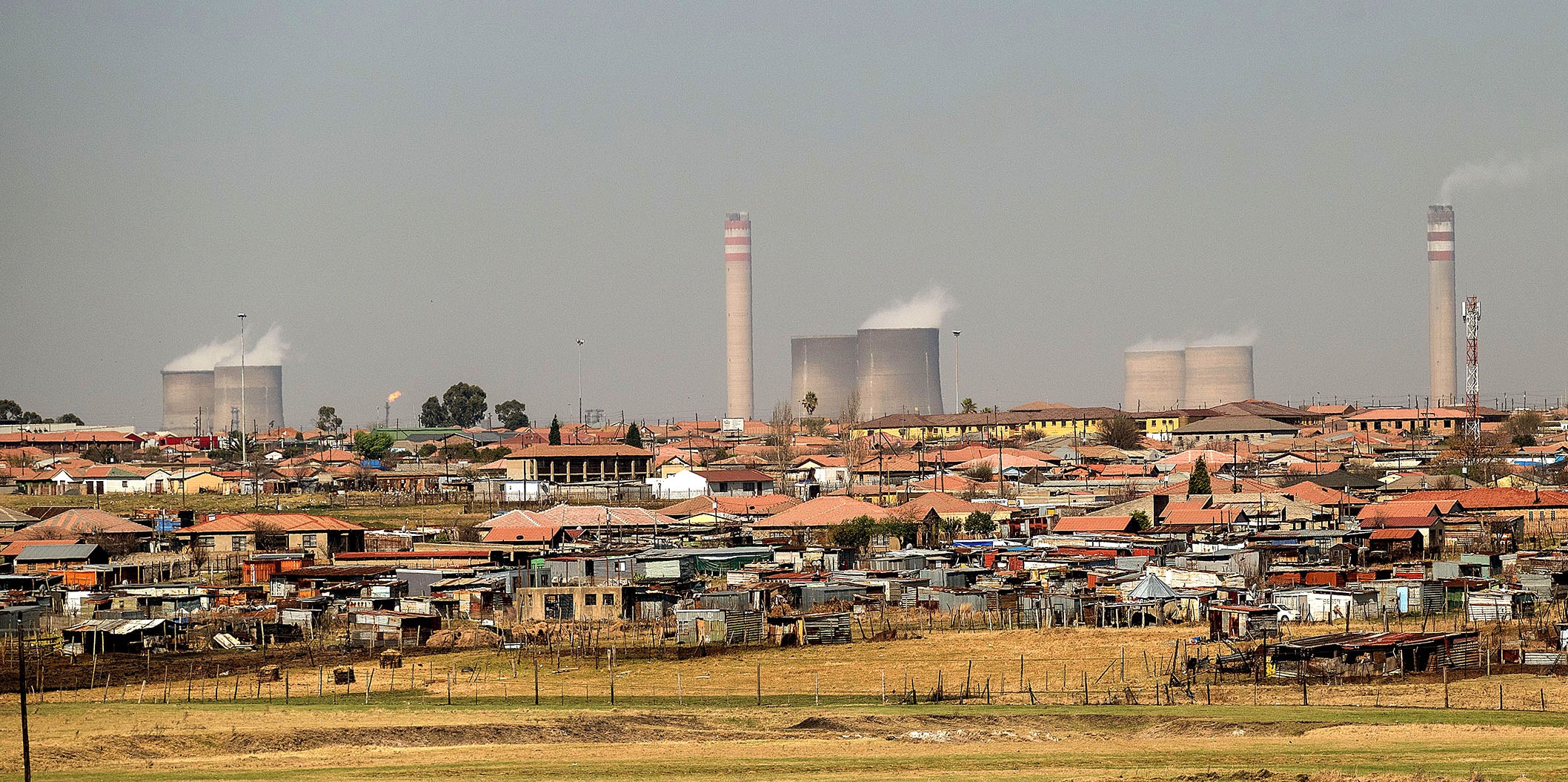
 The Sasol Secunda towers loom over Embalenhle in Mpumalanga. (Photo: Leon Sadiki)
Dineo Hoffman, who has lived in Embalenhle for more than 28 years, said that living under the shadow of Sasol Secunda for most of her life meant that, like many of her peers, she pinned her hopes on one day working for the petrochemical giant.
“Growing up here, I didn’t understand that there was anything wrong with me or that the air was bad. Everything was fine until I got a learnership to work at Sasol. I passed the psychometric test and all the other tests, but when it came time for me to do the medical test, it turned out that I failed the RFA,” Hoffman told Daily Maverick.
/file/attachments/orphans/Lerato-Sasol-HealthImpacts11_765168.jpg "Dineo Hoffman suspects she failed a learnership health assessment at Sasol because of the same pollution she says is caused by the company. A community member in eMbalenhle, outside Secunda, she says that, like many others in the area, she is affected by environmental pollution allegedly caused by Sasol. (Photo: Leon Sadiki)")
The RFA Hoffman was referring to is a Rehabilitation and Functional Assessment test, which is a standardised medical screening evaluation used to check if an employee has the physical and cardiorespiratory fitness to do manual work safely over an eight-hour shift.
“They told me that my lungs are not okay, and that’s when I realised that I had been sick for a while; I just had not realised it,” Hoffman said.
For Hoffman, living under the shadow of the Secunda industrial complex, and the alleged health complications that come part and parcel with exposure to increased levels of air pollution, are the very reasons she could not work at Sasol Secunda.
/file/attachments/orphans/Lerato-Sasol-HealthImpacts5_614676.jpg "Sasol towers in Secunda. (Photo: Leon Sadiki)")
She told Daily Maverick that with each passing year, her breathing becomes increasingly strained, and she struggles to walk up stairs without running out of breath.
This is the reality many people living in fence-line communities face. A daily struggle that has been quantified by a new report.
Sasol’s Secunda plant is celebrated as the world’s largest coal-based synthetic fuels and chemicals complex. Supplying around 30% of South Africa’s liquid fuel demand, it sits at the bedrock of the national economy. However, in 2024 alone, approximately 1,000 people died prematurely from exposure to a cocktail of particulate matter (PM2.5) and nitrogen dioxide (NO2 ) emitted from the industrial complex.
This is according to a new report released by the Centre for Research on Energy and Clean Air (Crea) on Monday, 7 September.
The report, titled The hidden cost of coal-to-liquids in South Africa, found the emissions caused 260 new cases of childhood asthma annually and left 1,300 children living with active asthma attributable to exposure. Before birth, pollution reaches the womb, linked to 1,100 pre-term births and 820 low-birth-weight infants every year.
The study attributes 2,030 asthma-related emergency room visits and 2,600 years lived with disability (YLD) to chronic obstructive pulmonary disease (COPD), Type-2 diabetes and strokes caused or exacerbated by plant emissions.
/file/attachments/2997/Screenshot2026-09-07at205735_646855.png)
In total, Crea calculates the annual health-related economic cost at R19-billion. While these costs sit off Sasol’s balance sheet, they are borne directly by households, employers and the public health system.
“The health and economic costs of this pollution are borne largely by society rather than the polluter,” Crea stated in its report.
Impact on children
One of the most damning findings of the report was the impact on the lives of children.
The report found that children and infants bear a disproportionately heavy burden from the air pollution generated by Sasol Secunda. Because their lungs are still developing and they breathe more air per kilogram of body weight than adults, young people living under the plume face severe short- and long-term health risks. The Crea report reveals that this harm begins in the womb and continues throughout childhood.
“The facility’s emissions contribute to a health burden that begins early in life and can have consequences beyond the immediate period of exposure,” the report said.
In 2017, Sharon Mbonani, who was born in Secunda, gave birth to her first child.
“Everything was normal. I had a bit of high blood pressure, but it wasn’t something to panic about,” Mbonani told Daily Maverick.
/file/attachments/orphans/Lerato-Sasol-HealthImpacts3_371090.jpg "Sharon Mbonani is helping the community of eMbalenhle in Secunda to challenge the pollution allegedly linked to Sasol in the area. (Photo: Leon Sadiki)")
She explained that a month after her son’s birth, he was found unresponsive in his cot. “He died next to me, and in those moments you just don’t know what you did to cause this,” an emotional Mbonani said.
Though her firstborn’s death was not officially linked to air pollution in and around Secunda, when her second child was born three years later and started to show signs of health problems, she did not waste any time in acting.
“He was not gaining weight, and not as active as other children. He was one year old when we took him to his father’s place [in Springs], and we left him there for one week, and they took him to a specialist. When they got there, the doctor said that he was living in a place with high emissions. From the examinations, the child had a throat infection that had multiplied four times,” she explained.
Mbonani ultimately decided that her son would be raised with his father’s family in Springs to prioritise his health and wellbeing.
“It’s terrible because I cannot see him as often… but now he is almost seven, and he is thriving,” Mbonani said.
SA’s weak emissions standards
South Africa, much like the rest of the world, has Minimum Emissions Standards (MES), which specify exactly how much industries are allowed to emit.
Instituted under the National Environmental Management: Air Quality Act, these standards are meant to safeguard public health. However, the legal framework is plagued by leniency and widespread exemptions.
In March 2020, the government amended the MES, doubling the allowable sulphur dioxide (SO₂) limit for older, existing coal combustion installations (such as those operated by both Eskom and Sasol) from the originally permitted 500 milligrams per normal cubic meter (mg/Nm³) to 1,000mg/Nm³.
This is dramatically higher than international standards for air quality set by the World Health Organization (WHO).
According to the Crea report, the plant released 112,000 tonnes of SO₂, along with large amounts of hydrogen sulphide (H₂S) and other harmful gases in 2024.
/file/attachments/2997/Screenshot2026-09-07at205907_441530.png)
Even within this lenient national system, Sasol secured facility-specific alternative limits. Following postponements granted since 2015, an appeal decision allowed Secunda’s West and East stacks to operate under daily limits of 1,700mg/Nm³ and 1,400mg/Nm³, respectively, through to March 2030 – 70% and 40% above the national standards.
The landmark 2022 high court ruling in the “deadly air” case found that the government’s failure to enforce air quality standards in the Highveld Priority Area violated residents’ constitutional rights. However, regulators continue granting exemptions that allow massive industrial point sources to pollute far beyond safe public health thresholds.
A call to end exemptions
/file/attachments/orphans/Lerato-Sasol-HealthImpacts6_116851.jpg "Khehla Mahlangu, a community leader in eMbalenhle, outside Secunda, stands at a distance from the Sasol plant. He says the community is affected by environmental pollution allegedly caused by Sasol. (Photo: Leon Sadiki)")
To address the health risks and regulatory issues outlined in the report, Crea and civil society stakeholders propose five actionable interventions:
Health-based review of exemption licences: Licensing authorities must evaluate Sasol Secunda’s alternative limits against measured ambient air quality, local population exposure and health impacts rather than technical compliance alone. Any failure by Sasol to meet its emissions reduction commitments should result in the immediate withdrawal of these exemptions;
Enforceable annual milestones: Convert Sasol’s voluntary 30%-by-2030 SO2 reduction target into legally binding, unit-level annual milestones. These milestones should apply to all major pollutants, including SO2, nitrogen oxide, particulate matter, and H2S, across the entire facility;
Independent monitoring and transparency: Require Sasol to publish regularly audited, high-resolution stack monitoring data, operational exceedances and equipment failure reports. Ambient air monitoring data should be independently verified and made accessible to the public;
Strengthening national air quality standards: Establish binding national ambient air quality standards for H2S aligned with WHO health guidelines. Legislative loopholes in the National Environmental Management: Air Quality Act that allow major polluters to seek continuous alternative limits should be closed; and
Community-centred enforcement: Integrate epidemiological evidence into regulatory decisions and Highveld air quality management plans. Provide fence-line communities with real-time public health alerts and clear data during major pollution or odour episodes.
In response to the report’s findings of significant health and economic impacts linked to emissions from Secunda facility, Sasol told Daily Maverick that it was reviewing the methodology and conclusions made in the Crea report, adding that “it would be premature to comment on the conclusions reached before completing a careful review” and that it “cannot endorse the specific figures presented”.
The petrochemical giant urged caution regarding the findings. “Any attempt to attribute health outcomes to a single emission source should be approached with caution given the complexity of air quality in the Highveld Priority Area, which is influenced by multiple industrial, domestic, transport and regional sources,” Nangamso Tom, Sasol’s senior specialist for group media relations and corporate communications, told Daily Maverick in response to the publication’s questions.
Regarding compliance and regulatory standards, Sasol defended operating under alternative SO₂ limits, adding that its application “did not seek general leniency from compliance” but aimed to regulate emissions on a load basis rather than a concentration basis. According to Sasol, this integrated emissions reduction solution, supported by an independent health risk assessment, is “expected to deliver greater overall reductions in SO₂ load than would be achieved through application of the concentration-based limit alone”.
Sasol also highlighted its long-term efforts to reduce environmental impacts, which include:
Invested over R9.5-billion since 2015 into emission-abatement initiatives.
Anticipates a 30% reduction in SO₂ emissions from the Secunda steam plants by 2030 (off a 2019 baseline), alongside lower emissions of NOₓ, particulate matter, and greenhouse gases.
Implemented boiler turndowns, low-NOx burners, particulate matter retrofits, and volatile organic compound (VOC) abatement projects.
Submitted an Emission Reduction and Management Plan under the Highveld Priority Area regulations, where it currently awaits feedback from licensing authorities. DM


Comments
Scroll down to load comments...