




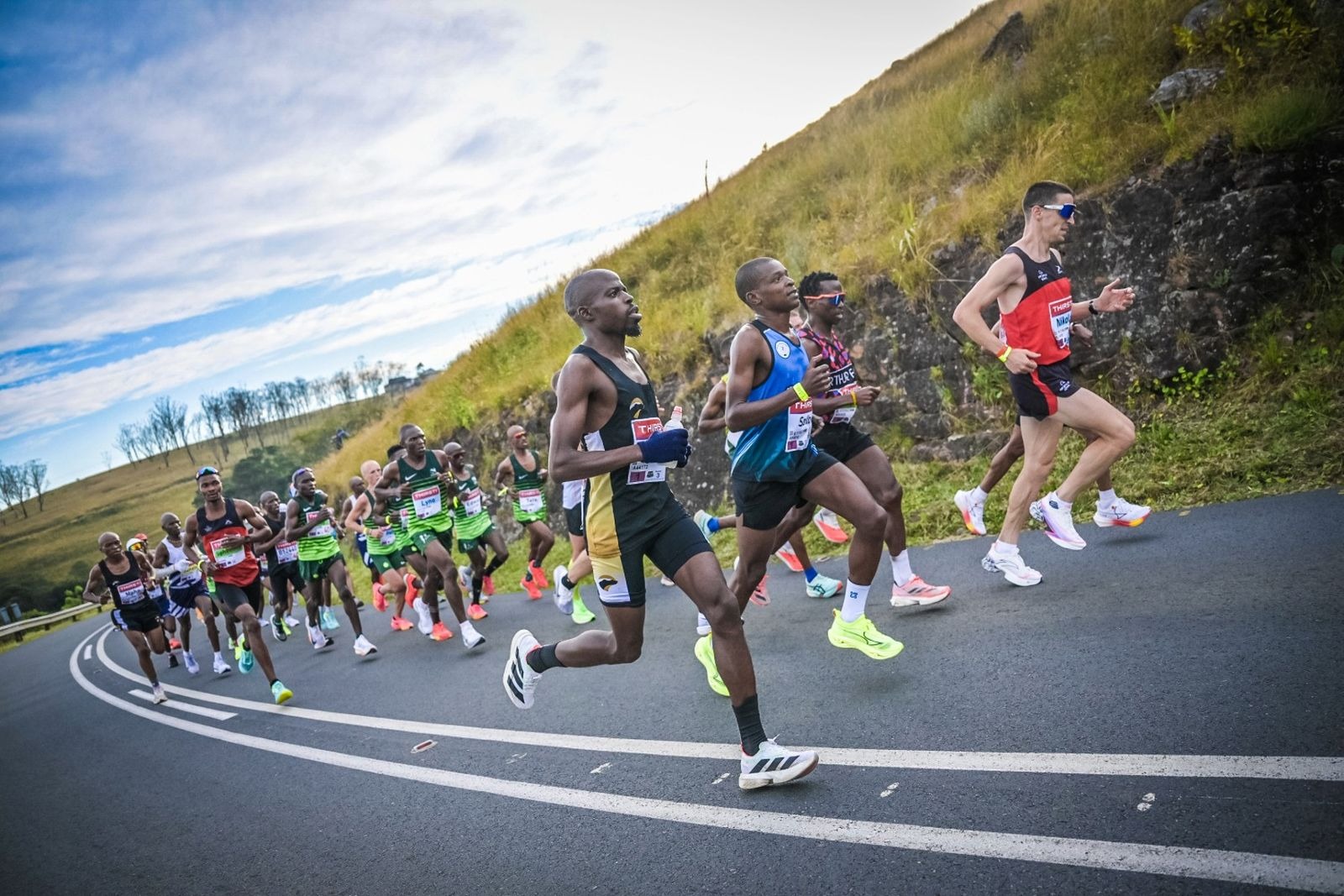
 A pack of highly motivated elite runners will be chasing line honours as Comrades marks the 50th edition of the ‘up run’. (Photo: Tobias Ginsberg / Comrades Marathon Association)
On 19 August, the Comrades Marathon Association (CMA) officially launched the 2027 centenary edition of the iconic ultramarathon and currently the biggest changes appear to be taking place in the boardroom rather than on the road.
In the same week as the launch, Athletics South Africa (ASA) announced that it would not sanction the 2027 Comrades Marathon, marking the latest escalation in a months-long dispute between the organisers of South Africa’s most famous road race and the athletics authorities responsible for governing the sport.
The most immediate concern for prospective Comrades runners is qualification.
However, Mark Leathers, chairperson of the CMA, said there is “nothing logistically to worry about”, neither in the buildup to the race nor on race day.
“[ASA], KwaZulu-Natal Athletics [KZNA], Comrades – everyone’s in agreement that the CMA can legally host the race next year,” said Leathers. “From that aspect, whether or not the event is going ahead is unequivocally, on all fronts, a yes. It’s going ahead. With regard to everything else, things are largely remaining unchanged.”
How qualification works
The qualification period for the 2027 Comrades Marathon runs from 15 June 2026 to 3 May 2027.
Although runners may enter before qualifying, they must still complete an approved qualifying event and submit their qualifying details before the deadline.
The qualifying criteria remain the same, requiring runners to complete an officially timed standard marathon of 42.2km in under five hours.
Leathers said concerns that ASA’s decision could affect qualifying races were largely misplaced because almost all qualifying events are expected to remain sanctioned through provincial and national athletics structures. Last year there were 138 qualifying races.
“You still have to qualify. Almost 100% of your qualification marathons are going to remain as sanctioned events by the federations,” said Leathers.
According to Leathers, most races rely on federations for permissions and administration, whereas larger events require sanctioning to ensure that elite athletes can earn World Athletics ranking points. As a result, runners will still need licences and club affiliations to compete in most qualifying races, even though a licence is no longer required to enter or run the Comrades itself.
/file/attachments/2997/20251129_134951_Edit_251754_823884.jpg "Lawyer Mark Leathers is the new chairperson of the Comrades Marathon Association, with Nontuthuko Mashimane as his deputy. (Photo: Comrades Marathon Association")
“Qualifiers are remaining sanctioned pretty much exclusively. For that you need to belong to a club; for that you need a licence,” he said. “The only difference is we’re not asking people in the entry process for licence numbers because you don’t need a licence to run Comrades now. But bear in mind, you still need the licence to have qualified.”
Entries for Green Number holders (10 or more Comrades medals) and Yellow Number holders (nine medals) opened on Tuesday, 25 August, with all 3,500 available entries selling out within three hours. By Wednesday, 792 of the 1,000 charity entries had also been sold.
“Things are selling out quickly. The interest is there,” said Leathers.
According to Jan Jordaan, president of the Benoni Northerns Athletics Club and an avid runner, runners are not concerned with whom the CMA is affiliated – they just want to run.
A potential issue identified by Jordaan, however, may be the impact on SA’s traditional club system if runners no longer need to be affiliated to participate in Comrades.
Jordaan said some runners who belong to clubs primarily to obtain licences may reconsider their memberships.
“There might be a few clubs that feel it,” said Jordaan. “If they don’t really offer anything, people might say, ‘Well, we don’t need you any more; we don’t have to be affiliated.’
“But from a club perspective, I’ve got no doubt that we will just carry on as per normal, that it won’t make any difference,” said Jordaan. “We might lose some runners as well, purely because it’s those runners who you never see; that’s never part of the club. But the bulk of the runners I think will still stay, purely because what we offer is a lot more than just running.”
Leathers argued that the impact on clubs was a non-issue because clubs are “the lifeblood of South African road running”.
“People want to be part of their clubs, they want to be sociable, they want to be involved,” he said. “From that aspect [Comrades Marathon] will still have club tent areas and people are encouraged to run in the colours of their running club even though it’s not mandatory, because it creates further camaraderie.”
/file/attachments/orphans/ComradesMR_SGM_2Aug26_632184.jpg "Comrades Marathon Association Members affirmed an independent path for the CMA at Saturday’s Special General Meeting. (Photo: Supplied/ Comrades Marathon Association)")
At an impasse
The dispute stems from the CMA’s decision in November 2025 to end its affiliation with KZNA. Earlier this month, more than 1,000 members reaffirmed that position at a special general meeting, with 694 members voting against reaffiliation and 338 voting in favour.
Last week, ASA issued a statement distancing itself from the event, saying the CMA had failed to “recognise and comply with the governance and regulatory framework governing athletics”.
“As the national governing body for athletics in South Africa, Athletics South Africa has a responsibility to ensure that all athletics and road running events are conducted within a consistent governance framework, and in compliance with the applicable rules, regulations and standards,” ASA said.
“Athletics South Africa confirms that the 100th Comrades Marathon has not been authorised or sanctioned through KwaZulu-Natal Athletics and formally distances itself from the organisation, administration and conduct of the event.”
For now, the CMA and the athletics authorities remain at an impasse as the CMA shifts its focus to putting up a spectacular centenary edition.
“We’ve reached out to both [ASA and KZNA] and we’ve said to them if there is to be a relationship, things will need to change,” said Leathers. “It will no longer be a one-sided relationship. It will be a collaborative partnership.
“When they figure out what their role looks like in this collaborative partnership, and where they can add value, they can come back and talk to us.”
What changes?
Although much of the runner experience remains the same, there are a few notable differences.
One is race attire. Previously, runners were generally required to compete either in their club colours or in an official race shirt.
Although club colours are still encouraged, they are no longer mandatory. Additionally, instead of relying solely on officials allocated through KZNA, the association can now source officials more broadly.
The CMA is also engaging directly with the South African Institute for Drug-Free Sport to oversee anti-doping measures.
Although the dispute between the CMA, KZNA and ASA remains unresolved, the association is pressing ahead with preparations for what is expected to be an iconic race.
The 2027 edition will mark both the race’s centenary and the 50th Down Run, with a record field of 28,000 runners expected to take part between Pietermaritzburg and Durban. DM
/file/attachments/2997/DM-04092026-001_475147.jpg)
Comments
Scroll down to load comments...