



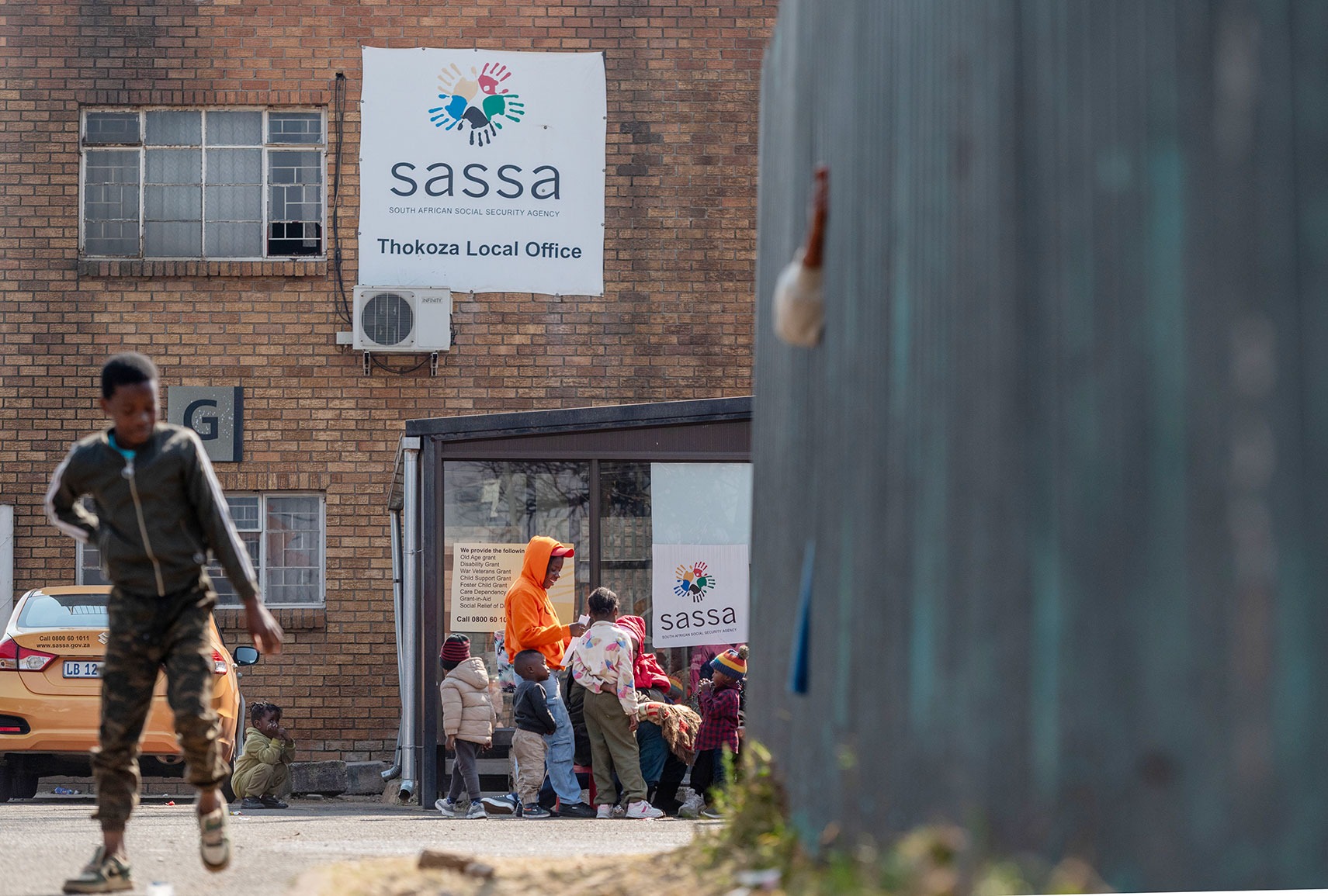
 Sassa beneficiaries wait in long queues in Thokoza on the East Rand. Many expressed dissatisfaction with the system, saying it regularly goes offline, while some have had to return many times before being helped. (Photo: Leon Sadiki)
 When Cleone Tigerls’s (32) eldest daughter, Lamisha, was six years old she contracted streptococcal meningitis, a severe condition that inflames the protective layers around the brain and spinal cord. An initial misdiagnosis of tonsillitis caused delays in her treatment, and while Lamisha survived, she was left permanently mentally and physically disabled.
For Tigerls, a mother of three living in Eldorado Park, Johannesburg, caring for Lamisha consumes most of her time. She receives the R2,400 Care Dependency Grant which the the South African Social Security Agency (Sassa) provides monthly for caregivers of children living with disabilities, as well as the Child Support Grant for her two younger children.
But even with this additional support she is at the end of her rope, trying to meet the acute needs that come with Lamisha’s condition. She has been unable to seek out work, worried about leaving her daughter’s care in another’s hands. The family relies on her husband’s work in the automative industry, which is not stable.
/file/attachments/orphans/Tamsin-CDG-SASSA2_688469.jpg "Cleone Tigerls from Eldorado Park collects a disability grant for her son. However, despite receiving the grant, she says the money is still not enough to meet their needs. (Photo: Leon Sadiki)")
“I just need help. That’s all. Just to get a place for my family. This is not right... The people in special needs, they need more attention,” Tigerls said.
The family lives in a two-room structure on the property of Tigerls’s mother-in-law. Lamisha, who is now 13, is largely bedridden, and needs help with eating and going to the toilet.
While she attends a special needs school, the monthly scholar transport cost is R1,200 – half the grant. When Tigerls can’t afford to pay Lamisha is unable to go to school.
The other significant expenses Tigerls faces for Lamisha are nappies, nutritious food she needs to stay healthy, and regular trips to Chris Hani Baragwanath Hospital for check-ups and prescriptions. Tigerls estimated that she spent about R3,000 on food each month, sometimes buying more expensive items on credit and paying them off the following month – a “continuous cycle”.
/file/attachments/orphans/Tamsin-CDG-SASSA6_676411.jpg "Cleone Tigerls from Eldorado Park collects a disability grant for her son. However, despite receiving the grant, she says the money is still not enough to meet their needs. (Photo: Leon Sadiki)")
“The Sassa grant doesn’t cover the whole month,” said Tigerls, adding that with the rise in prices for food and essentials, she has had to go for cheaper brands and smaller amounts.
Tigerls approached the Department of Social Development for help, but was only able to receive one food parcel. She said she is desperate for help to mkake her home more disability-friendly.
“We need to be educated more, even with sponsorships, because [Lamisha is] special need. She needs priority. And I don’t know where to go. I don’t know where to start... It’s a struggle. I don’t know who to turn to,” she said.
/file/attachments/orphans/Tamsin-CDG-SASSA5_560063.jpg "Cleone Tigerls from Eldorado Park collects a disability grant for her son. However, despite receiving the grant, she says the money is still not enough to meet their needs. (Photo: Leon Sadiki)")
Limited support for parents
Christina Mafunda (40), a mother of three living in Marikana, North West, receives the Care Dependency Grant for her four-year-old daughter, who has Down’s syndrome.
Mafunda has struggled with unemployment. While she used to work on the farms, opportunities have been few and far between in recent months.
Her daughter’s condition makes her vulnerable to health problems, including respiratory illnesses and eye infections. Mafunda has to take her to the clinic frequently, but said she cannot always afford transport.
/file/attachments/orphans/Tamsin-CDG-SASSA7_559715.jpg "Christina Mafunda and her daughter, Keatleqile, as she share the difficulties of caring for someone with a disability. They live with Christina’s mother in Marikana, in the North West. Christina relies on her daughter’s grant money to survive. (Photo: Leon Sadiki)")
At the time she spoke to Daily Maverick, her daughter was suffering from an eye infection, but Mafunda had been unable to afford the medication to treat it. She said she was hoping to buy more medicine once the next grant payment came through.
Mafunda worried about what would happen when her daughter reached schoolgoing age, since the nearest special needs school that could accommodate her needs was in Rustenburg, about 45 minutes away.
Part of Mafunda’s struggle has been working out how to manage her daughter’s condition on her own. She said there was limited access to information or guidance in the community, and no counselling available for parents of children with disabilities. When she needed advice she relied on an older woman in the community who had offered support.
/file/attachments/orphans/Tamsin-CDG-SASSA8_991707.jpg "Christina Mafunda and her daughter, Keatleqile, as she share the difficulties of caring for someone with a disability. They live with Christina’s mother in Marikana, in the North West. Christina relies on her daughter’s grant money to survive. (Photo: Leon Sadiki)")
Slow pace of change
Zara Trafford, a senior researcher at the Institute for Life Course Health Research at Stellenbosh University’s Department of Global Health, conducted in-depth PhD work on the Care Dependency Grant in 2021 and 2022, engaging with beneficiaries whose children were born between 1985 and 2013.
“What was really striking to me was that their experiences were really similar, even though... the one person’s child was… pushing 40, and another person’s child is seven or eight years old. That struck me as an indication of the really slow pace of change with this particular grant. And it’s a bit of a metric for the broader slow pace of change for families of kids with disabilities,” she explained.
/file/attachments/orphans/Tamsin-CDG-SASSA1_808419.jpg "SASSA beneficiaries wait in long queues to be assisted in Thokoza, on the East Rand. Many expressed their dissatisfaction with the system, saying it regularly goes offline, while some have had to return multiple times before receiving assistance. (Photo: Leon Sadiki)")
The Care Dependency Grant is framed as a contribution towards supporting a child with disabilities, rather than a way of catering to all needs, noted Trafford. However, she pointed out the difficulty of seeking out other forms of income while caring for a special needs child full-time, especially as many caregivers are not comfortable leaving their child with someone else.
“It’s complicated because some children with a disability do not need nappies and assistive devices, and others do. And the way that... all of our grants are designed is that it’s a set amount,” Trafford said.
“The reality is that whereas for some families having… [R2,400] might be enough or it might cover a substantial portion of the needs, for other families that wouldn’t even begin to touch sides.”
Transport
One of the major accessibility barriers for people with disabilities in poorer communities is transport, confirmed Trafford. She argued that public transport services were inaccessible, even for people living in an urban environment.
The national director of the National Council of and for Persons with Disabilities, Therina Wentzel, told Daily Maverick there was an existing policy at the Department of Transport requiring the subsidisation of scholar transport at schools, but that this was inconsistently applied across provinces.
The department’s National Learner Transport Policy, published in 2015 with the Department of Basic Education, stated that priority needed to be given to pupils with disabilities.
“We do understand that government can’t fix everything, but these are the most vulnerable people in our country. So, I think a bit more should be put in that budget,” Wentzel added.
Experience at Sassa
Another challenge confronting parents of children with disabilities is the experience at Sassa offices, continued Wentzel. She argued for better training of the staff and doctors to recognise and respond to the broad range of disabilities clients might present.
“There’s sometimes the parents with very severely disabled children who sit in those offices forever. They’re not moved forward into the queue, and they are not dealt with with dignity. There’s a huge training need with Sassa staff who are at the coalface, where they actually deal with the parents and primary caregivers,” she said.
“We can’t expect the government... to have solutions for everything because it’s going to take quite a bit of research and resources for government to be able to see... how and when you can serve the diverse needs of parents... But I think the consultative process is is the best one to follow, and then to design a variety of options. You can’t have a one-size-fits-all.”
Prioritising disabilities
Children living with disabilities were not highly prioritised by the government, said Trafford, noting that interventions aimed at other groups were often higher up on the list because they were easier to execute.
“A lot of these families [of disabled children] are so ground down by their daily experiences that it’s really difficult to organise. It’s really difficult to collaborate with one another because their daily lives are… very intense,” she said.
At the moment, children receiving the Care Dependency Grant cannot receive any other type of grant, such as the Child Support Grant or Grant-in-Aid.
The Grant-in-Aid is an additional financial support mechanism provided by Sassa for individuals who already receive an Older Person’s, Disability or War Veteran’s grant, but need full-time, regular care from another person due to a physical or mental disability.
Trafford argued that allowing parents of disabled children to apply for additional support through other grants could help bridge some of the access gaps affecting families.
In the longer term, however, she emphasised the importance of ensuring that every government sector in the country understood that “disability was their business” and an issue they should be actively addressing.
“One of the other pieces of feedback I got from someone in [the Department of Social Development] was that as soon as you mention disability, it’s seen as expensive. And that’s exactly the point. How are you expecting individual families to sustain that expense? And also some of that expense could be offset if there were proper systems in place,” Trafford said.
“The bigger answer is that there needs to be better systems integration; better collaboration across these different sectors; and more awareness in all of these different places. That is realistically a job that takes decades.”
From Sassa
Daily Maverick asked the Department of Social Development for comment, but had not received a response by the time of publishing.
As of August 2026 the total number of Care Dependency Grant beneficiaries in South Africa stood at 179,202. There has been a “consistent and noticeable increase” in the number of children receiving this grant over the past five years, according to Sassa, with the number of recipients standing at 153,768 in 2021/22.
“This upward trend indicates that a growing number of eligible children have been enrolled during this period, resulting in a significantly higher beneficiary count compared to five years ago,” the agency said.
Asked why Care Dependency Grant beneficiaries were not eligible for the Grant-in-Aid, Sassa said this grant was only available to recipients of the Older Person’s, Disability or War Veteran’s grants, with applicants also required to show a need for regular care and assistance from another person as a result of a physical or mental disability, illness or medical condition.
At an office level, “Sassa has implemented queue management strategies designed to ensure that vulnerable groups receive priority service. These groups include older persons, persons with disabilities and individuals who are frail or have mobility challenges. The purpose of these measures is to reduce waiting times, improve accessibility and ensure that vulnerable clients are assisted in a dignified, efficient and compassionate manner when accessing Sassa services,” the agency said. DM
Those seeking more information about services for special needs children can contact the National Council of and for Persons with Disabilities. Email: busiswa@ncpd.org.za or esther@ncpd.org.za or phone 011 452 2774.
/file/attachments/orphans/ChildrensReporterV2_187851.jpg "Tamsin-DG-Murray-Trust")
Comments
Scroll down to load comments...