




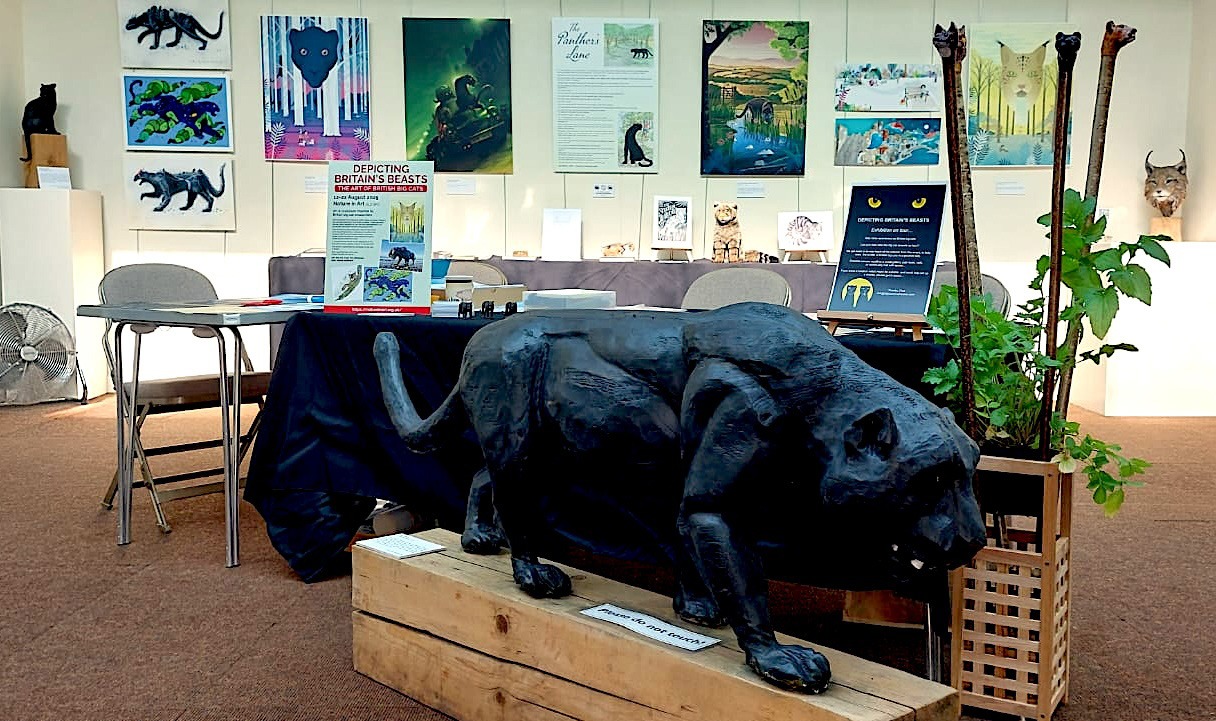
 Artwork and sculpture aim to raise awareness of black leopards in Britain at the Nature in Art show, August 2025. (Photo: Rick Minter)
 Somewhere in Kent, opposite a sheep farm, there’s a story that would sound less peculiar if it came from the African bush.
The farmers occasionally lose sheep. Unremarkable, perhaps. What they allegedly stumbled across afterwards is not.
“They’ve found them with obvious big-cat kill marks or up in trees,” according to an anonymous local resident whose account was shared with Daily Maverick by British big-cat researcher Rick Minter.
The resident reportedly said that neighbouring farmers had experienced similar incidents, but described the subject as something approaching a rural code of silence.
“It seems to be a bit of a ‘taboo, code omertà, fight club-type’ topic in the local farming community so none of them talks about it,” according to the account.
It is an unverified account. A sheep in a tree is hardly proof of a leopard.
But it is just one story among Minter’s reports of sightings, animal carcasses, DNA results, tooth marks, snippets of footage and close encounters that have convinced him that large cats are living wild in Britain.
Indeed, Minter, author of Big Cats: Facing Britain’s Wild Predators and host of a podcast devoted to the subject, believes black leopards and mountain lions may be naturalising in the British countryside.
After “24 years” investigating the phenomenon, he told Daily Maverick this week: “I have absolutely no debate to settle.”
/file/attachments/orphans/RickMintercameratrap_216026.jpg "Minter depicted in a photo of his own camera trap. (Photo: Rick Minter)")
‘Truth or lie’: The cat as black as night
Minter’s certainty begins, in part, with something profoundly simple: he says he has spotted a black leopard.
For a few seconds, in the broad light of day.
“Having seen one in daylight in profile for 40 seconds certainly helps!” he told us, after this week publishing an in-depth feature in BBC Wildlife Magazine.
There is no photograph. The sighting occurred, Minter says, before he had a mobile phone with a camera. Indeed, he initially thought he was looking at a dog.
This mundane first impression is central to his explanation for one of the most obvious problems confronting Britain’s big-cat believers: If sizeable predators really are roaming a densely populated country, why aren’t there more good photos of them?
Minter says witnesses often don’t initially realise that what they are looking at is extraordinary. You know, it’s not something you would expect to see in the genteel countryside every other day.
And yet he adds that he has now spoken to about 1,500 people who claim they have encountered big cats. Their accounts, he says, contain conspicuous consistencies.
An unusually long, tubular tail. Rounded ears, thick legs, large feet and prominent shoulder blades. Witnesses describe fluid movement, a muscular but sleek body and what Minter calls a “confident attitude”.
Sometimes there is another “witness” of sorts. “In a third of cases, a dog or a horse is with the witness and has reacted too,” he says.
Assessing such reports obviously depends heavily on human testimony. Minter says he considers between 80% and 90% of the reports he receives as credible and consistent, while acknowledging that witnesses themselves are sometimes uncertain because of distance or difficulty judging an animal’s size.
“At least 10% of incidents are too close-up for any mistake,” he says. “So, it’s a case of truth or lie.”
/file/attachments/orphans/Ruralshowdisplayarea_855585.jpeg "Minter says he fronts an information stand at rural shows in Britain each summer. The aim is to explain big cat sightings, receive reports and provide space for discussion. The Westmorland Show, Cumbria, September 2023. (Photo: Rick Minter)")
The search for something harder than a sighting
Minter points to what he describes as “six publicly known positive DNA results” matching leopard, including samples from Gloucestershire and Cumbria. DNA, therefore, could ultimately become one of the most consequential pieces of the puzzle.
However, Minter does not argue that the existing results alone establish a breeding population. Instead, he wants more samples and comparisons between their genetic sequences.
“If we achieve that, it will enhance the value of the results and also help show an emerging strain of British black leopards,” he says.
According to the big-cat investigator, forensic tooth-pit analysis can examine marks left on prey bones to identify the type of predator responsible. He says more than 10 samples collected from locations in England and Scotland have matched cat imprints, based on a triangular pattern produced by the pointed cusps of “carnassial teeth”.
An artificial-intelligence recognition process is now being developed, he notes, in conjunction with a high-powered microscope, potentially allowing more remains to be assessed.
At his talks, he also shows footage that reportedly hails from an English estate and depicts two adult-sized black leopards crossing a field.
One limps. The other, he says, “rushes along the hedgerow as if it’s gliding”.
What about dead leopards?
Ending up as roadkill is a known threat to leopards outside protected areas such as the Kruger National Park. If Britain has a population of large cats moving through a landscape threaded with roads, collisions would seem inevitable.
Minter says there are various unconfirmed reports of road accidents involving big cats.
Two have been discussed on his podcast. One allegedly involved two public bodies and an informal explanation after the animal was cleared away. In another, Minter says a motorist reported hitting a big cat while entering a motorway, but was unable to stop and determine what happened to it.
Nobody is suggesting leopards are native to modern Britain. If they are there, they had to come from somewhere.
Minter believes today’s reported animals may descend from exotic pets, private collections, zoo animals and other captive cats that escaped or were deliberately released at various points in the past.
Some, he suggests, could have “leaked out” as early as wartime, when people keeping large carnivores struggled to obtain enough meat. A population in Malaysia is known for its melanistic – black – leopards.
/file/attachments/orphans/Ruralshowsurvey_590645.jpg "A survey of public views on black leopards at the Westmorland Show, Cumbria, September 2023. (Photo: Rick Minter)")
‘Serious animal welfare and public safety risks’
The underlying proposition – that an exotic big cat could escape or be released from captivity and survive – is not dismissed by Dr Neil D’Cruze, a wildlife policy specialist with the South African non-profit organisation Blood Lions, established to campaign for the closure of the country’s commercial captive predator industry.
According to the organisation, the industry has grown to about “350 captive facilities holding at least 8,000 lions, as well as thousands of other predators including leopards, cheetahs, caracals, and servals, and exotic species such as tigers, jaguars and pumas”.
“Although there is no conclusive evidence of a naturalised leopard population, it is entirely plausible that non-indigenous big cats escaping or being released from captivity could survive in suitable habitat,” D’Cruze told Daily Maverick.
“If they began breeding, these powerful predators could adversely affect native wildlife and livestock, while creating serious animal-welfare and public-safety risks,” he says.
For South Africa, D’Cruze sees another lesson in Britain’s strange and unresolved story.
“Whatever the truth behind these reports, they reinforce a wider point: big cats should not be kept as private possessions or bred for commercial gain.”
IFAW: ‘Extremely unlikely’
Ilaria Di Silvestre, Europe policy director at the International Fund for Animal Welfare (IFAW), agrees that exotic cats could, in principle, have found their way into the British countryside after living in captivity.
“Unfortunately, people often seek rare and exotic animals to keep as pets, either legally or illegally,” she told Daily Maverick. “Only afterwards do they realise how difficult and dangerous it is to care for these animals once they are no longer small, cute cubs.”
But Di Silvestre argues that the behaviour attributed to Britain’s supposed leopards presents a problem for that explanation.
A leopard raised in captivity, she says, would be unlikely to possess the learned hunting skills necessary to routinely bring down large herbivores. “It is more likely that such animals would approach people in search of food and would therefore be quickly noticed,” she said.
She is especially doubtful about the possibility that escaped or released animals could have established a self-sustaining population.
“It would require multiple parent leopards carrying the same rare melanistic trait to be released over a period of years, survive in the wild, and successfully reproduce.”
That, in IFAW’s assessment, is “extremely unlikely” – even if melanism (the trait that can make a leopard “black”) occurs more frequently in some populations, such as those in Southeast Asia.
And with too few founders, inbreeding would become a constraint.
If a breeding population were somehow confirmed, she says, it would present “a serious public safety and environmental concern” requiring the attention of British authorities and animal-welfare organisations.
A spokesperson for Humane World for Animals UK says “there have certainly been animals released or escaped from the pet trade in the past but it’s very unlikely today as there are so few kept as pets in the UK and those that are must be strictly licensed under the Dangerous Wild Animals Act 1976. The likelihood of there being enough individuals to breed is low and there have been no verified sightings, carcasses or live animals captured.”
IFAW and Humane World, then, are not raising funding to address any “serious public safety and environmental concerns” just yet.
/file/attachments/orphans/Life-sizeleopards_297464.jpg "Cut-out leopards encounter each other at the Nature in Art show, Gloucestershire, August 2026. (Photo: Rick Minter)")
A matter of enchantment – and more data?
But Rosie Miles, an English expat conservationist working in the Greater Kruger area, has researched big cats in Africa for 15 years.
“I really want them [black leopards] to exist,” says Miles, the author of Girl of the Wild: Misadventures in the African Bush. “To be thriving right under our noses all these years … I know how leopards in particular can be extremely elusive, only letting you see them on their terms. So, the possibility of big cats existing in the UK isn’t entirely inconceivable to me.”
But then comes the important qualification: “You don’t have to see leopards to know they are there.”
Intrepid researchers can use camera traps, spoor surveys and scat-detection dogs to establish the presence of animals without needing to catch one strolling conveniently past a camera.
For his part, South African wildlife guide Mark Graves “is frustrated that more systematic searching isn’t happening”, the BBC Wildlife article reports. “Too often it’s just a single sign, like a footprint, that’s found, when there must be more clues,” he notes in the article.
We were unable to reach Graves before publication, but he is quoted as saying: “The logistics of tracking are difficult – trails may go onto private land, for example. With more dedicated funds, trust from landowners, and techniques like employing scat-detection dogs, I’ve no doubt we’d make more progress.”
Miles agrees that such studies require money, time and expertise, and says there does not appear to be the motivation to conduct the kind of systematic survey that could finally settle the question.
For now, she cautiously confesses that she chooses to remain suspended somewhere between trained scientific caution and the enchantment of her English childhood.
“Until such work provides firm evidence either way, I am going to cling onto the hope that one day I’ll spot the Beast of Bodmin Moor when visiting my family in Cornwall.”
/file/attachments/orphans/Cut-outleopard_160551.jpg "A cut-out representation of a black leopard at the Nature in Art show, Gloucestershire, August 2026. (Photo: Rick Minter)")
‘We are not on the warpath’
Indeed, some farmers may have decided that they can live with potential confrontations.
Minter recalls a Scottish farmer featured on his podcast who did not support the reintroduction of the extinct lynx but said he and his neighbours tolerated the leopards they believed were already there.
“We are not on the warpath,” the farmer apparently told him. The supposed reason is almost as exceptional as the revelation: the farmers don’t necessarily want anyone coming to rescue the cats – or shoot them.
As the anonymous Kent resident suggests: “They say the cats just want to co-exist and stay away from them, and that’s fine (as long as they don’t nick too many sheep!)”
For now, there are the whispered stories – and, somewhere in Kent, an extraordinary claim about sheep turning up where wool has no business being.
Up in the trees. DM


Comments
Scroll down to load comments...