




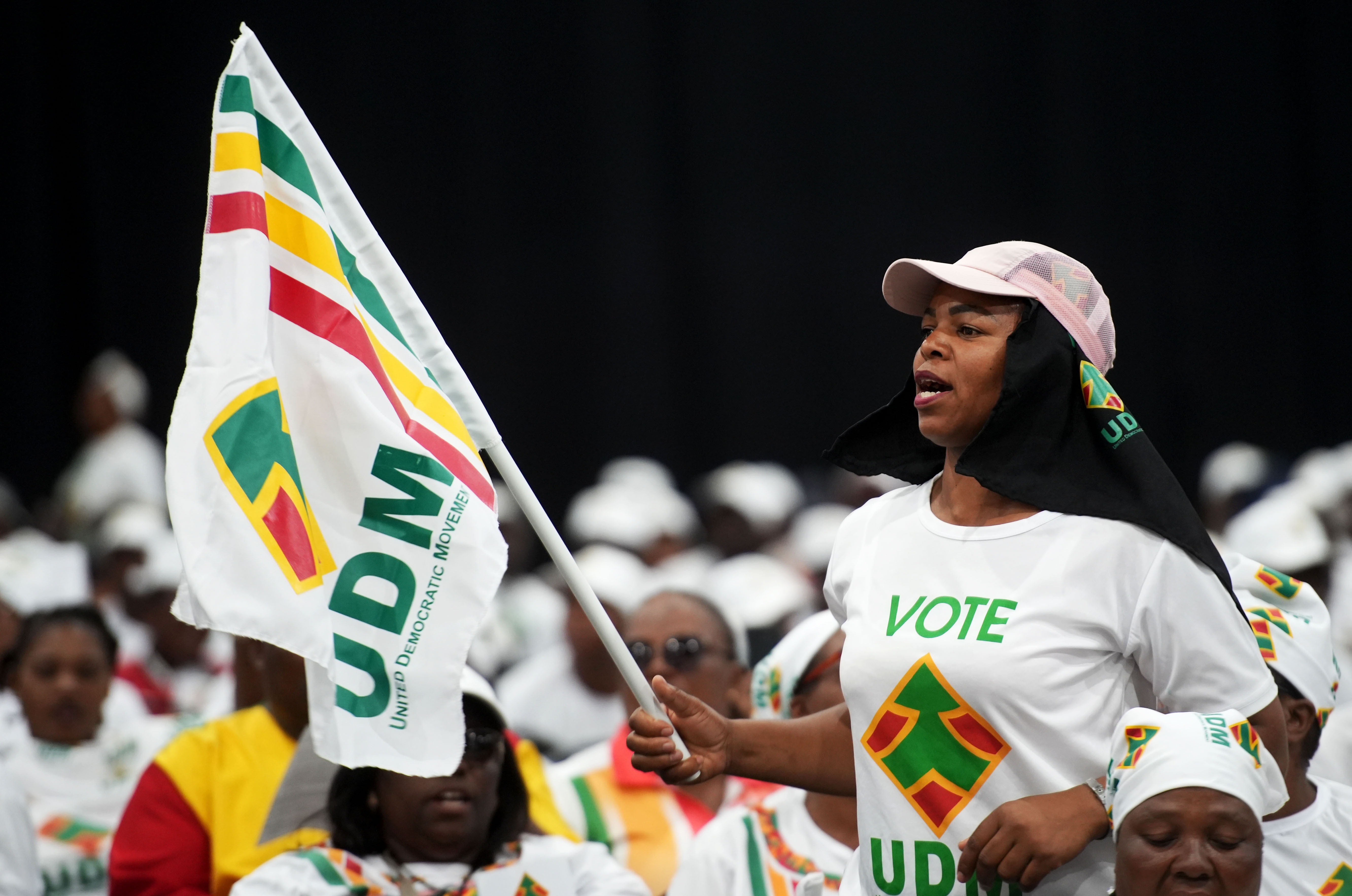
 United Democratic Movement supporters at their elections manifesto launch. (Photo: Gallo Images/City Press/Tebogo Letsie)
 /file/attachments/orphans/Election2026LogoInarticle_260133.jpg "LGE-2026-logo-signpost")
The UDM is led by seasoned politician General Bantu Holomisa and has 51 councillors, mostly in the Eastern Cape, with some metropolitan seats in Gauteng.
The party manifesto is also seasoned – it knows what’s not working: “Municipal collapse is usually not sudden. It is the result of years of poor planning, weak administration, bad appointments, irregular procurement, unpaid creditors, broken billing systems, neglected infrastructure, and a failure to hold people accountable.”
That is probably the manifesto’s strongest insight. The UDM says councils should first know what infrastructure they own, what condition it is in, and what must be repaired first. Its governing philosophy is strikingly unflashy: fix what exists before chasing expensive new projects.
That makes this a manifesto built more around maintenance and municipal competence than big-ticket promises.
/file/attachments/orphans/Fer-manifesto-UDM4_185814.jpg "United Democratic Movement (UDM) supporters at the UDM elections manifesto launch. (Photo: Gallo Images/City Press/Tebogo Letsie)")
1. Turn on the taps
What’s your plan to keep the water flowing?
The UDM promises water and sanitation infrastructure maintenance, leak detection and reduction, preventative maintenance, asset management and “fast response systems” for infrastructure failures. It also promises clear service-delivery schedules and public reporting.
The verdict: Good diagnosis and sensible municipal basics. The emphasis on maintenance and knowing the condition of municipal assets is stronger than simply promising new infrastructure.
2. Keep the lights on
How will you fix electricity, end outages and pay Eskom?
The manifesto promises “reliable electricity distribution and protection of municipal grids”, preventative maintenance and protection against theft and vandalism. Its financial programme also calls for realistic funded budgets, stronger revenue collection, better billing and regular monitoring of municipal debt and creditors.
The verdict: Sensible, but thin. The UDM understands that municipal electricity depends on functioning distribution infrastructure and financially viable councils.
3. Fill the potholes
What’s your plan for roads, pavements and affordable public transport?
Road and stormwater maintenance are explicitly part of the basic services programme. The UDM also calls for improved public transport planning and traffic management, and better spatial planning linking housing to transport, jobs and services.
The verdict: Roads are treated correctly as assets that require continual maintenance rather than occasional rehabilitation. There is no affordable transport proposition.
/file/attachments/orphans/Fer-manifesto-UDM2_837760.jpg "United Democratic Movement (UDM) leader Bantu Holomisa addresses supporters at the UDM elections manifesto launch. (Photo: Gallo Images/City Press/Tebogo Letsie)")
4. Sort out the s**t
How will you fix sewage, sanitation and crumbling infrastructure?
Here the manifesto is much stronger. Water and sanitation maintenance, leak reduction, preventative maintenance, asset management and rapid responses to infrastructure failures sit at the heart of the UDM’s Pillar 1. It explicitly links failing sanitation and dirty water to public health.
The verdict: The useful conceptual shift is that maintenance is not an add-on; it is the job.
5. Light up our streets
How will you keep streetlights working and make neighbourhoods safer?
The UDM specifically includes streetlight maintenance among its basic-service priorities. It also emphasises protecting municipal infrastructure from vandalism and theft, and maintaining clean and safe public spaces.
The verdict: The manifesto understands that street lighting and maintained public infrastructure are part of making neighbourhoods safer.
6. Clean up our towns
What’s your plan for rubbish collection, illegal dumping and cleaner public spaces?
Regular refuse removal is a core promise. The UDM also promises action against illegal dumping, and clean, safe and accessible public spaces.
The verdict: Clear, practical and squarely within municipal competence.
But: “Regular” is doing a lot of work. How regular? What happens when collections are missed?
7. Help us hustle
How will you make it easier to work, run a business and create jobs?
This is one of the manifesto’s more substantial sections. The UDM wants municipalities to become “enablers of opportunity, not obstacles to development”.
It promises support for small businesses, cooperatives and informal traders; reduced red tape; better management of trading spaces and markets; supplier development; municipal information desks; internet access points; and better information about grants, development finance and private investment.
There is also a strong localisation policy: municipal procurement should prioritise South African-owned businesses, particularly in townships, informal settlements and rural areas.
The verdict: Practical and recognisably local-government focused.
8. A home for everyone
What’s your plan for homelessness, social housing and building integrated communities?
The UDM gets an important point right: housing is a shared responsibility. National and provincial governments carry key responsibilities for housing policy, funding and delivery, while municipalities have central roles in planning, land use, infrastructure, beneficiary administration and building control.
It proposes releasing well-located land, upgrading informal settlements, serviced sites, better management of municipal rental stock, action against hijacked buildings, transparent beneficiary systems and housing close to jobs, schools and transport.
The verdict: Strong on integrated settlements and avoiding housing that traps people far from jobs and services.
But: Homelessness itself is barely addressed.
9. Break the nyaope curse
What will municipalities do about drugs, addiction and the social problems they bring?
This is the manifesto’s weakest match with the Manifesto Test.
The UDM recognises the problem, saying municipalities should create spaces where young people can develop and avoid “the destructive pull of crime, drugs, and hopelessness”. It promises sport and recreation facilities, arts and cultural programmes, youth development initiatives and partnerships with civil society.
Those are useful preventative measures.
The verdict: There is no substantive municipal drugs strategy: no harm reduction, treatment referral, outreach, rehabilitation partnerships or specific plan for drug hotspots.
10. Give us a city worth living in
How will you improve parks, libraries and recreation — and make local democracy actually work?
This is probably the UDM’s strongest answer.
It explicitly says sports fields, libraries, community halls, parks and cultural programmes must not be treated as luxuries. It promises maintenance and fair access.
More unusually, it puts some teeth into councillor accountability. UDM councillors are expected to hold regular community meetings, report on council performance, help residents with complaints, monitor ward projects, support functional ward committees and promote participation in planning and budgeting. Candidates must sign an accountability pledge.
The manifesto goes further: residents should be consulted about budgets, development, land use, service delivery, tariffs and local economic opportunities.
The verdict: Very good. It treats democracy as something that happens between elections.
But: “Regular” community meetings are not defined, and there is no mechanism set out for sanctioning UDM councillors who fail to meet these standards.
/file/attachments/orphans/Fer-manifesto-UDM3_179464.jpg "United Democratic Movement (UDM) supporters at the UDM elections manifesto launch. (Photo: Gallo Images/City Press/Tebogo Letsie)")
Will you play nicely together?
Here the UDM gives one of the clearest coalition answers.
It says coalition politics must not become a “marketplace for positions”. Coalition agreements should be written, publicly disclosed, based on measurable service-delivery outcomes, clear about roles and responsibilities, linked to financial discipline and clean governance, and capable of being monitored by residents.
It also says it will withdraw support where coalition partners undermine service delivery, ethical governance, financial discipline or the rule of law. The UDM leaves the door open to cooperation across governments and says it will work constructively within the GNU where that benefits residents.
The verdict: This is unusually specific about how a coalition should operate.
But: It doesn’t tell voters which parties it would or would not govern with, or what its non-negotiable policy red lines would be. If you are voting UDM, a good question to ask.
What’s cool
We like the emphasis on infrastructure maintenance as fundamental to good governance. This should be obvious but it isn’t in most parts of the country. Its coalition principles are also progressive and clean-spirited.
Reality check
The UDM has not been able to influence the downward trajectory of most Eastern Cape municipalities, so it will need many more seats to implement its ideas. DM
Comments
Scroll down to load comments...