



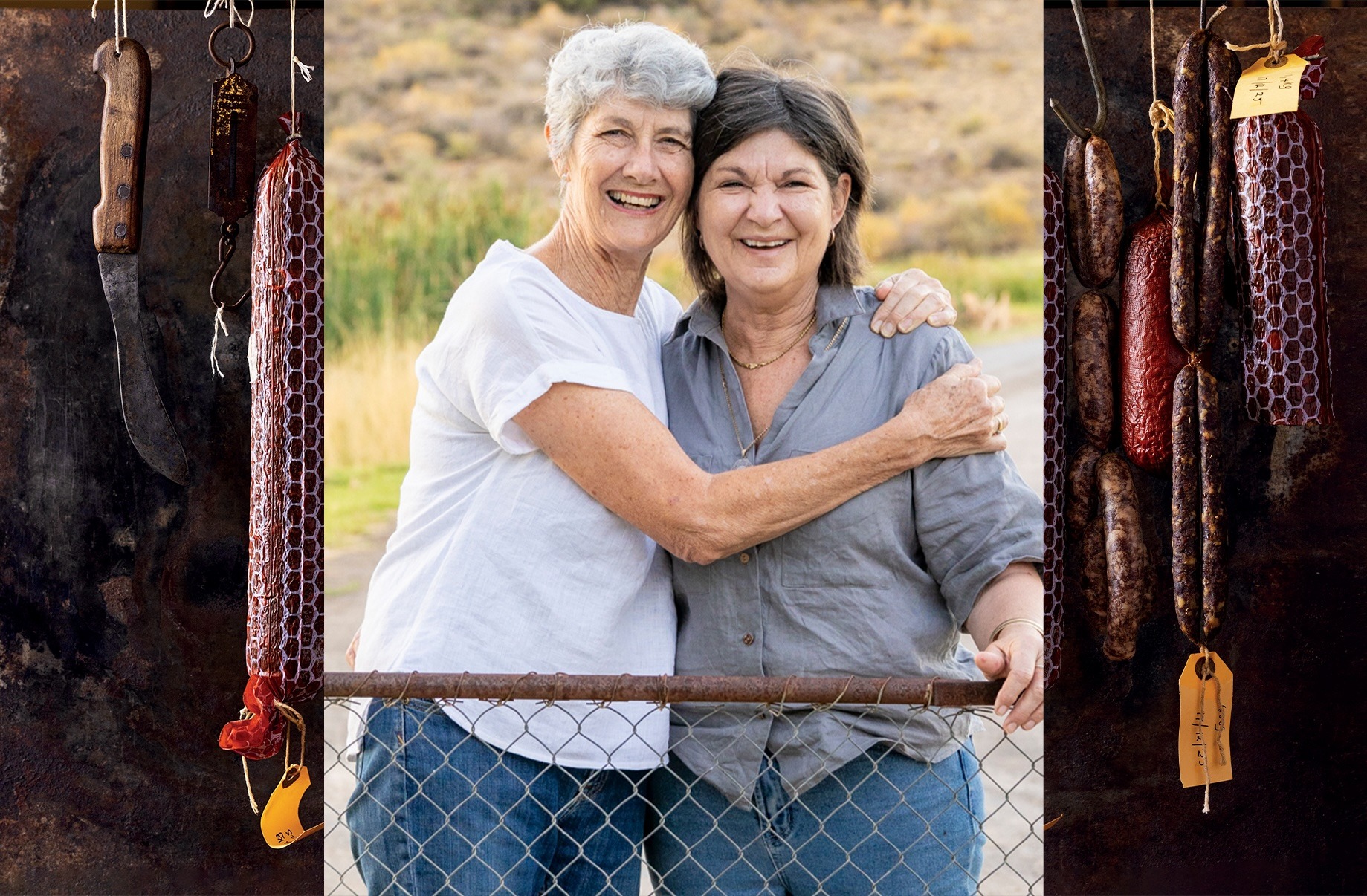
 Annatjie Reynolds, right, and Lynne Minnaar, authors of Karoo Venison (Human & Rousseau). In the background is Annatjie’s ‘basic salami’, cabanossi, droëwors and other styles of cured venison. (Photos: Donna Lewis)
Annatjie Reynolds is a Karoo legend. All she has had to do is be on her farm, doing what she does, and over time her fame has spread throughout the vastness of the Karoo, and beyond.
Somewhere along the way Annatjie and I became Facebook friends, and a mutual admiration grew, though we have never met. I regard her as one of the most inspiring people of the land we call Karoo. Because of the distance between my city life and hers outside Richmond – one of my favourite Karoo towns – I sent her some questions by email.
Now, if you have the very good sense to buy her book, you can know everything Annnatjie knows about venison. As she says, in reply to one of my questions: “This book of ours is actually my farm course file in book form. It’s all there is to know.”
Ah, that little word: “ours”. Because it’s not only Annatjie’s book. As with her two earlier book projects, this is a joint effort by Annatjie and her friend Lynne Minnaar. The publishing partnership goes back more than a quarter of a century.
“Our children attended the Union Prep school in Graaff-Reinet. As in most schools, money is always a problem. We decided on a recipe book as a fundraising event. Lynne and I teamed up with others and Karoo Family Favourites saw the light.”
‘People started asking for more’
/file/attachments/2997/Kuduliverpatewith-2_923727.jpg)
That was in 1999: “Lovely book with favourite recipes of parents at that time. It was a very good project with about three or four reprints. In the Karoo Family Favourites were some venison recipes and people started asking for more.”
This is their third collaboration. Their Karoo Family Adventures travelled far and wide, and soon after we moved to Cradock in 2014, people started asking me, “Have you read Annatjie Reynolds’s venison book?”
In 2003 they compiled the second book, Karoo Venison, which has seen several reprints. So it must have been a no-brainer for Human & Rousseau when presented with this comprehensive tome that encapsulates a world of knowledge these two women are happy to share. The book will travel throughout the Karoo and beyond, just like Reynolds’s famed venison credentials.
She was once a home economist at the now defunct Meat Board. “This is where I furthered my knowledge on carcasses, meat cuts and their uses, recipes and demonstrations. I was very privileged to have had Sannie Smit as a mentor.
“Lynne and I, and our friend Albè Neethling (Albè sadly passed away six years ago) decided to do a book, Karoo Venison, with new venison recipes, with the aim for the cook to be able to use venison on an everyday menu.”
They were self-publishers. “We did the first two reprints ourselves, we were our own publishers. Good for us. Then Lynne contacted Jonathan Ball Publishers and they took over. They did three reprints.
“In the process of marketing, I took on demonstrations and later did courses on the farm. This is what I could do – my own intellectual possession. Lynne took the role of ‘Lynne Lysie’ (Lynne List), I still call her that. She is a real English lady. Knows how to behave and what to say when. Excellent with admin and to follow up.”
I asked Annatjie to tell me about the first time she dissected an animal – and she is famous for this task often associated with male strength.
“Tony, I grew up on a Karoo farm. With three sisters, all very different in personality. Uncles, aunts, nephews and nieces, friends came to visit on the farm during winter school holidays. The men hunting springbuck with happy and excited children around.
“At a young age, learning how to ‘hide and be still’ in the veld. To be careful and responsible with guns. Never carry a loaded gun. Always and often, make sure that the gun is ‘safe’. Do not get over-excited... shoot the good, certain and focused shot. See that the buck is gutted soon and well. I never did this myself, but knew how and when it was done.
“I have never butchered an animal, but I learned how to take the carcass apart and I do it regularly. Because I know what dishes I want to use a specific cut for. And I freeze it accordingly. I want it to be common sense.
“One knows what a sheep or buck looks like. Neck, shoulders, shanks, ribs, loin cuts, legs.
‘We did it the girly way, but still hands-on’
/file/attachments/2997/Karoospringbokwith-2_265378.jpg)
“But I can hunt. Never covered with blood and all the gory stuff. Never ate fresh liver and had our faces covered with blood. We were not boys, we did it the girly way, but still hands-on. As children we worked and helped with the carcasses, and we learned a lot, all gathered outside the kitchen under the big pine tree. In those days only droëwors en biltong. And fynvleis for venison pies. And the best leg or a thick neck of springbuck to be larded and pot-roasted.”
What are the secrets of dissecting an animal?
“Know the cuts and its eienskappe (properties?). For example, forequarter cuts with lots of connective tissue need moist-heat cooking methods. If you know what dish you want to prepare, you will know if you want to cut cubes from the leg, for example. If you need organic, lean mince, use the shoulders and the thick flank of the leg. Be sure to remove sinew and connective tissue. It’s very important to start off with good-quality meat – well shot, instant kill, well gutted and well ripened in the skin.”
These are the words of one who knows. The voice of the true artisan. I ask the meatmeister what her favourite cuts of wildsvleis are, which part of the animal she favours. Her answer pleases me.
“I love to cook fynvleis. I freeze it in usable batches to make bitterballen, venison patee (she uses the Afrikaans word), small venison pies, terrines, etc.”
Fynvleis is indeed a fine thing, a Karoo treasure in its own right. If you’ve relished a venison pie bought from a good farm stall somewhere in the Karoo, that was venison fynvleis that you were eating. Fynvleis ought to be one of the most desired and famous foods to come out of southern Africa.
‘The gold of the Karoo’
/file/attachments/2997/Slow-roastedvenisonshanks-2_776500.jpg)
One of the most popular topics of Karoo conversation around the braai or kitchen table is this: which animal’s meat is your favourite. The best. Often takbok (fallow deer) comes up in these conversations, or kudu. I ask Annatjie for her favourite and it’s no surprise.
“Springbuck. Andrew Conroy, my neigbour, calls it Gold of the Karoo.”
And venison has come into its own, it seems. Asked if more people were eating venison in 2026, Annatjie replied: “The consumers of venison are definitely increasing. As the art of cooking improves and gets more attention, the adventurous and creative eater and home cook are more and more interested in cooking with venison.
“It is an elongation of the hunting experience, a challenge to process your own, to advance your skills, an adventure with friends and family from the slagkamer to the table.”
Reynolds has lived on Niewefontein farm near Richmond in the Northern Cape since she married Kobus Reynolds in 1985.
“Niewefontein is a lovely, unique farm with lots of character. The homestead was built in 1873. It is not a family farm – Kobus was the second son, and his dad bought it after his agricultural studies.
‘Sakke vol fokken growwe sout’
/file/attachments/2997/Gemsbokfilletwithstreakybacon-2_886213.jpg)
“This is the place where I got to ‘learn myself’. In my mother tongue, ‘ná sakke vol fokken growwe sout’” – a reference to the Afrikaans idiom “om sewe sakke sout saam te eet”, alluding to the amount of time that needs to be spent together to really get to know someone.
“Ek het gedink ek trou met Kobus Reynolds: he turned out to be McGyver. Hier kan ek wees wie en wat Annatjie regtig is. (Here I can be who and what I really am.) We raised two great adults here. Martin and Jana. Am proud of them and very grateful that they could experience happy and uncomplicated farm lives. It forms a unique character in people.”
In Afrikaans, she says: “Here I have peace, I can read, plant flowers and vegetables, walk and think. And I can use my brain power to bring something to fruition that prevents me from stagnating.”
We return to meaty matters for the remainder of the interview. Which is best, lamb or mutton?
“Well-matured mutton is much more tasty than lamb. Mutton for roasts and stews, and “‘n twee-tand hamel eerder as’n lam”. She’s saying that a hamel (wether, or castrated lamb) with only two teeth has meat that is prized in the Karoo. The famed “tweetand”. Anything younger (‘n lammetjie), she adds, is “just too small and favourless, even if the flesh is soft”.
I get her on to a bugbear of mine, the Geographical Indication of Karoo lamb, asking her what she thinks of it.
“I think it is overrated and not practical. A bit of a gimmick and can be easily misused. Karoo lamb must be off the veld and it seldom is. Quantity over quality is the question.”
/file/attachments/2997/karoo-venison-cover_139988.jpg)
So don’t just take my word for it – here’s a better expert than I on the subject. Buy your lamb and mutton, if you can, from the farmer directly, or from butchers who source lamb from farmers they know and trust. It only needs to have lived, breathed and eaten off the Karoo veld. It doesn’t need to have a label saying it’s certified.
Now, if you’ll excuse me, I need to read the chapter about hot smoking and cold smoking, while I eye that smoker at the bottom of the garden with another eye on the spring weather coming up. DM
Comments
Scroll down to load comments...